What “valid” really means in practice
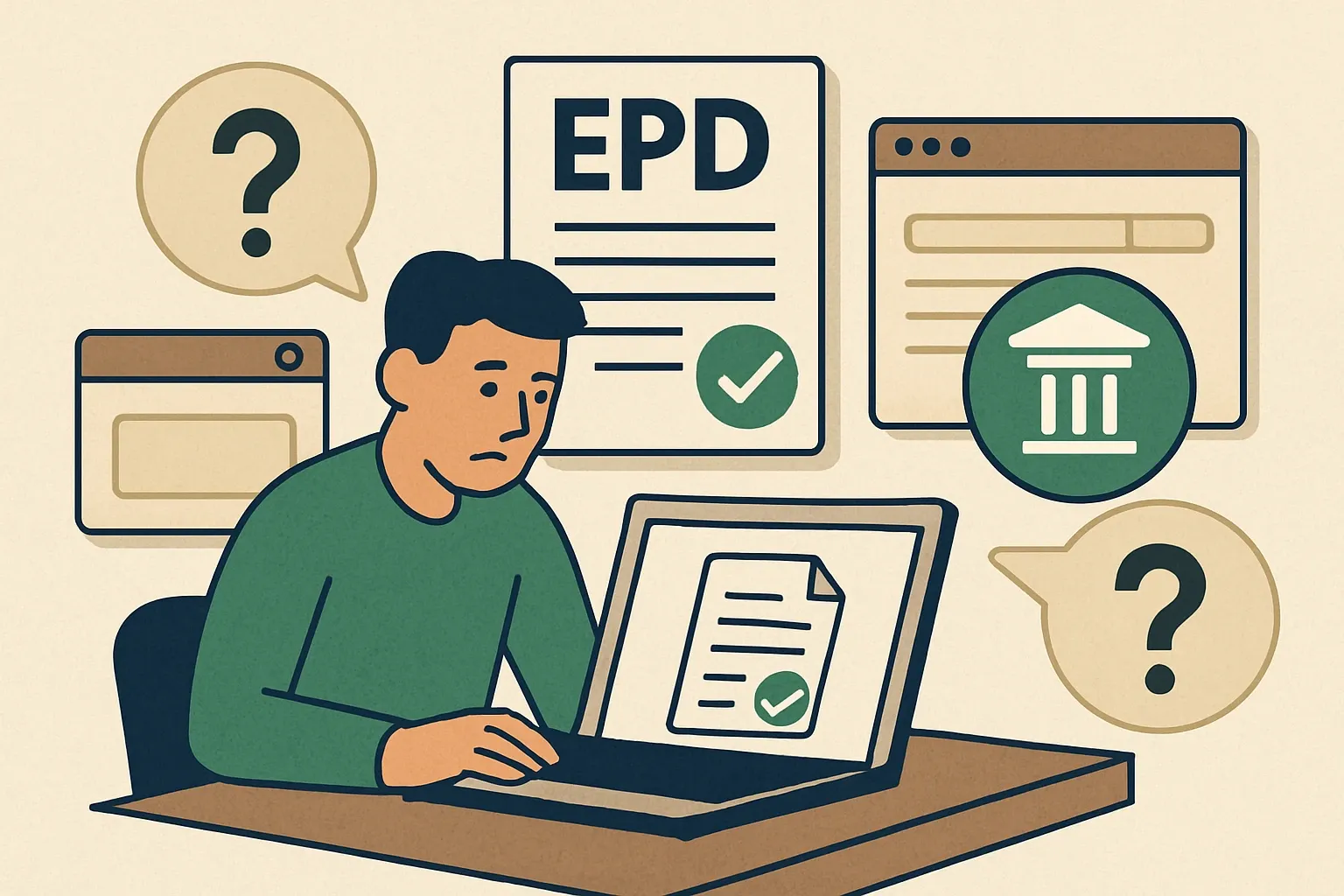
A compliant EPD is issued under a program operator, independently verified to an accepted standard, and publicly available. A usable EPD is all of that plus discoverable in the places specifiers check first. Reviewers default to what they can confirm quickly in operator libraries and trusted repositories, not to lengthy email threads or attached PDFs.
Operator, registry, repository explained
Think of the operator as the publisher, the operator library as the catalog entry, and data hubs as the search engines of materials. Operators include regional and global bodies. Registries and repositories include national databases and cross‑market portals that aggregate operator records so project teams can search across brands. If your EPD is missing in those views, it feels invisible.
Why public hosting beats perfect PDFs
Publicly accessible means a stable URL on the operator site that anyone can open without paywalls or logins. Many reviewers also expect a machine‑readable record in the hubs they already use so their tools can auto‑check dates, standards, and scope. When a hub flags a record as unsupported or can’t resolve a URL, teams often decline the submittal even if the PDF looks flawless.
The four failure modes behind a “not valid” reply
- No operator record. The declaration exists only as a PDF or on a marketing page.
- Verification mismatch. The EPD is not clearly verified to ISO 14025 with EN 15804 or ISO 21930 reference, or the verifier is not independent.
- Not truly public. The file sits behind a login, a broken link, or a short‑lived file share.
- Incomplete metadata. Missing expiry date, product identifiers, or standard version causes repositories to mark it unsupported.
Want to ensure your EPDs are discoverable for specifiers?
Follow us on LinkedIn for insights that help you optimize your EPD visibility and win more projects.
Make it findable where specifiers actually look
Publish first in the operator’s library with a reliable permalink. Then ensure it appears in the repositories your market leans on so model checkers and submittal portals can surface it during reviews. Finally, add a canonical EPD page on your site that points to the operator record to anchor customer communications and avoid version confusion.
Timing traps between “published” and “findable”
There is a real lag between operator publication and aggregation into data hubs. The delay length varies by operator workflows and sync cadence, and it can stretch right when a bid is due. Operator choice influences the time to listing and therefore the commercial window in which your team can actually use the EPD. Plan for this lag during launch and avoid announcing publising before the record is live in the places buyers search.
Verification labels that travel across borders
If projects reference EN 15804, make sure the declaration cites EN 15804+A2 and names the verifier. For North American work, ISO 21930 references remain common. Dual‑referencing can be appropriate when the operator supports it, as long as the LCA model, cut‑offs, and allocation rules align with the cited standard. Clear labeling reduces back‑and‑forth in global specs.
A readiness checklist before you hit send
- Operator library entry is live with a stable URL, expiry date, and product identifiers.
- PDF clearly lists verification per ISO 14025 and either EN 15804 or ISO 21930, plus the verifier name and role.
- Machine‑readable record is present in at least one widely used repository for your market.
- Your website points to the operator URL, not a file share.
- Contact and version history are visible so reviewers can reach the right person fast.
Fixing common discoverability gaps
If the operator link is missing, request indexing and confirm the final URL. If a repository shows the record as unsupported, check metadata completeness and the standard version tag. If reviewers cite a broken link, replace the asset with a permanent file at the operator and update every downstream pointer. When schedules slip, share the operator’s confirmation email and provide the canonical URL as soon as it propagates.
The commercial stake
Specs move fast. If reviewers cannot verify an EPD in their tools, they reach for a competitor they can confirm. Treat the operator listing and repository presence as the final mile of the EPD process. Nail that final mile and the document starts to work for sales, not against it. We see teams regain hours in submittals and avoid value‑drain discounts when their EPDs are easy to find and easy to trust.