What EC3 does well, and why it misses live updates
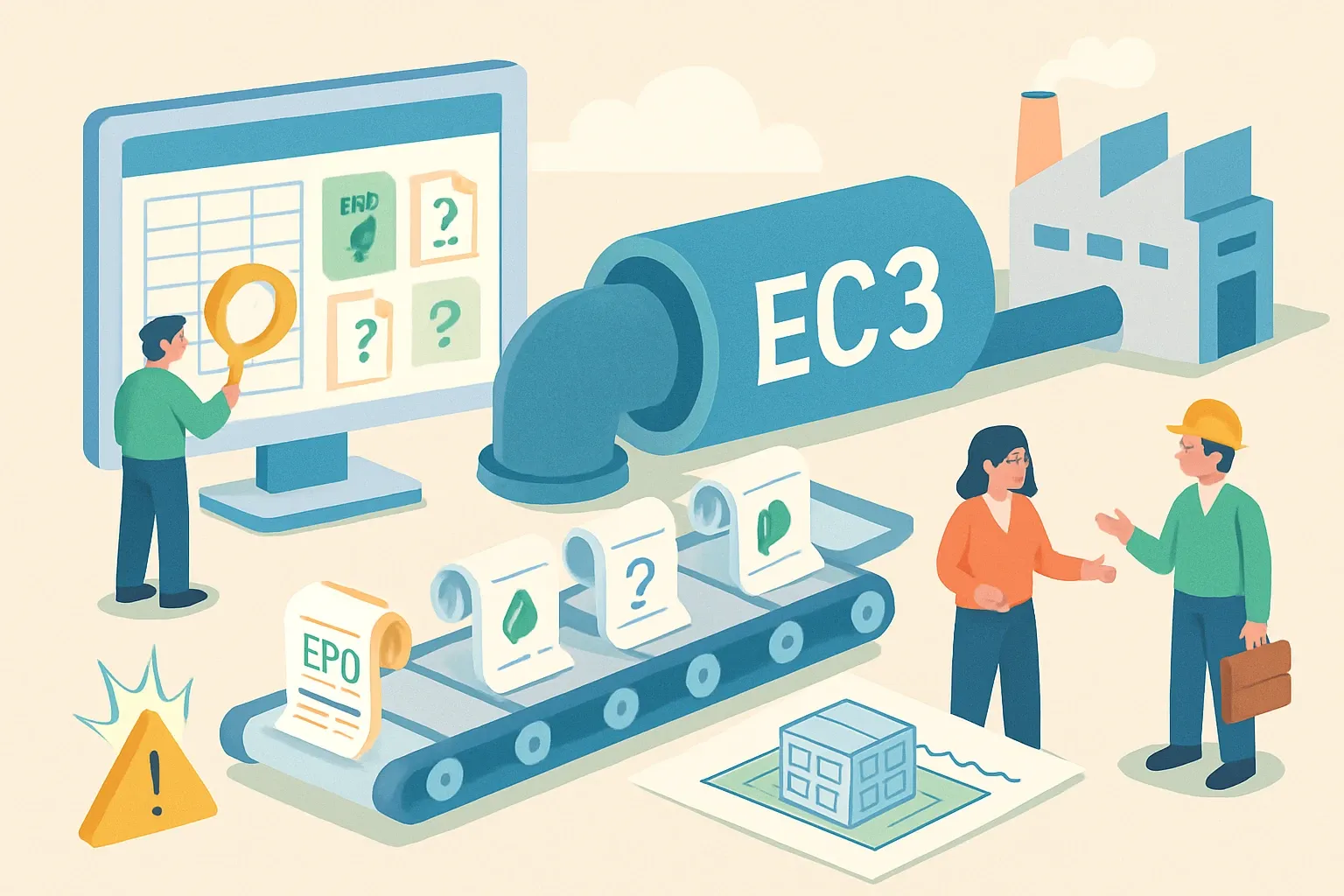
EC3 helps specifiers compare embodied carbon and discover products. Its index pulls from program operators that choose to share, plus some direct manufacturer uploads. Because that participation is opt in and uneven, the database often mirrors where the market was months ago rather than what is live today. That is not malice, it is plumbing.
The data pipe reality
Program operators hold the authoritative record. Many share machine‑readable entries or PDFs on their own timelines, then decide if and how to mirror those records to aggregators. When a new EPD posts at the operator and the aggregator sync lags, your best product might be invisible in the tool specifiers open first. We see teams cross‑check EC3 with operator libraries and a quick web search, then start email ping‑pong to confirm dates and scopes.
Validity is not the same as visibility
An EPD can remain valid while being hard to find in a single aggregator. Most major operators set validity at five years, unless the applicable PCR says otherwise (EPD International FAQ, 2024) (IBU, 2025). That five‑year clock keeps your declaration usable, but discoverability still depends on where and how you publish it.
Where the canonical records live
Think of operator libraries as the source of truth and aggregators as convenience stores. Examples include The International EPD System, IBU, PEP ecopassport, EPD‑Global powered by EPD‑Norway, and others. Their footprints are large and public, which is why many spec teams start there when accuracy matters. As a scale marker, ECO Platform’s registry listed 12,749 EPDs for the International EPD System and 2,565 for IBU as of July 1, 2025 (ECO Platform, 2025) (ECO Platform, 2025).
How EC3’s feed actually works in practice
The aggregator depends on program operators pushing structured data, or on manual submissions. Some operators prioritize their own portals and digital exports first. Others have APIs that third parties can query subject to terms. If your operator is not actively syncing to EC3, your updated PDF can sit in plain sight on the operator site while EC3 still shows an older record. That is why coverage feels patchy across categories.
Want to ensure your EPDs are seen by specifiers?
Follow us on LinkedIn for insights that help you publish effectively and win more tenders.
The practical playbook for manufacturers
Publish where verifiers and rating systems look first, then syndicate. Here is a simple, low‑stress sequence that reduces back‑and‑forth:
- Choose a respected operator for your target markets and publish the EPD there, with clear product names, SKUs, plants, and scope.
- Enable machine‑readable output wherever offered, and keep the PDF public and one click from your product page.
- Cross‑list when markets warrant it, using mutual recognition rules rather than re‑doing verification.
- Submit to aggregators after operator publication, then set a reminder to re‑submit if the listing does not appear in a reasonable window.
- Stand up a simple EPD center on your site that mirrors operator metadata and files, so submittals do not stall when a portal is down.
Make it digital by default
EPDs that ship with XML or JSON unlock faster checks in BIM and LCA tools. Include product identifiers, declared unit, plant locations, and any scenario data used for A4 or A5. Keep filenames human readable. Use the same titles across your website, operator listing, and any catalog PDFs so nothing looks like a contradiction.
Renewal planning that protects specs
Map your portfolio by validity date and by revenue. Refresh the high‑revenue and high‑spec items early so renewal never collides with a critical bid. Track PCR changes that affect comparability, and brief sales on what changed in the new issue. A short one‑pager beats a late‑night scramble, every time.
What good looks like to buyers right now
Specifiers want three things. A current, verified EPD from a recognized operator. A public link that works without a login. A short, consistent product naming pattern that matches the cut sheet. Meet that bar and you cut response time. Miss it and you invite avoidable questions, which slow submittals and risk substitution.
The simple path forward
Rely on operator libraries for the record, use EC3 for discovery checks, and keep your own EPD center clean and current. Do that, and your enviromental proofs show up where people actually look, when they need them, without drama.