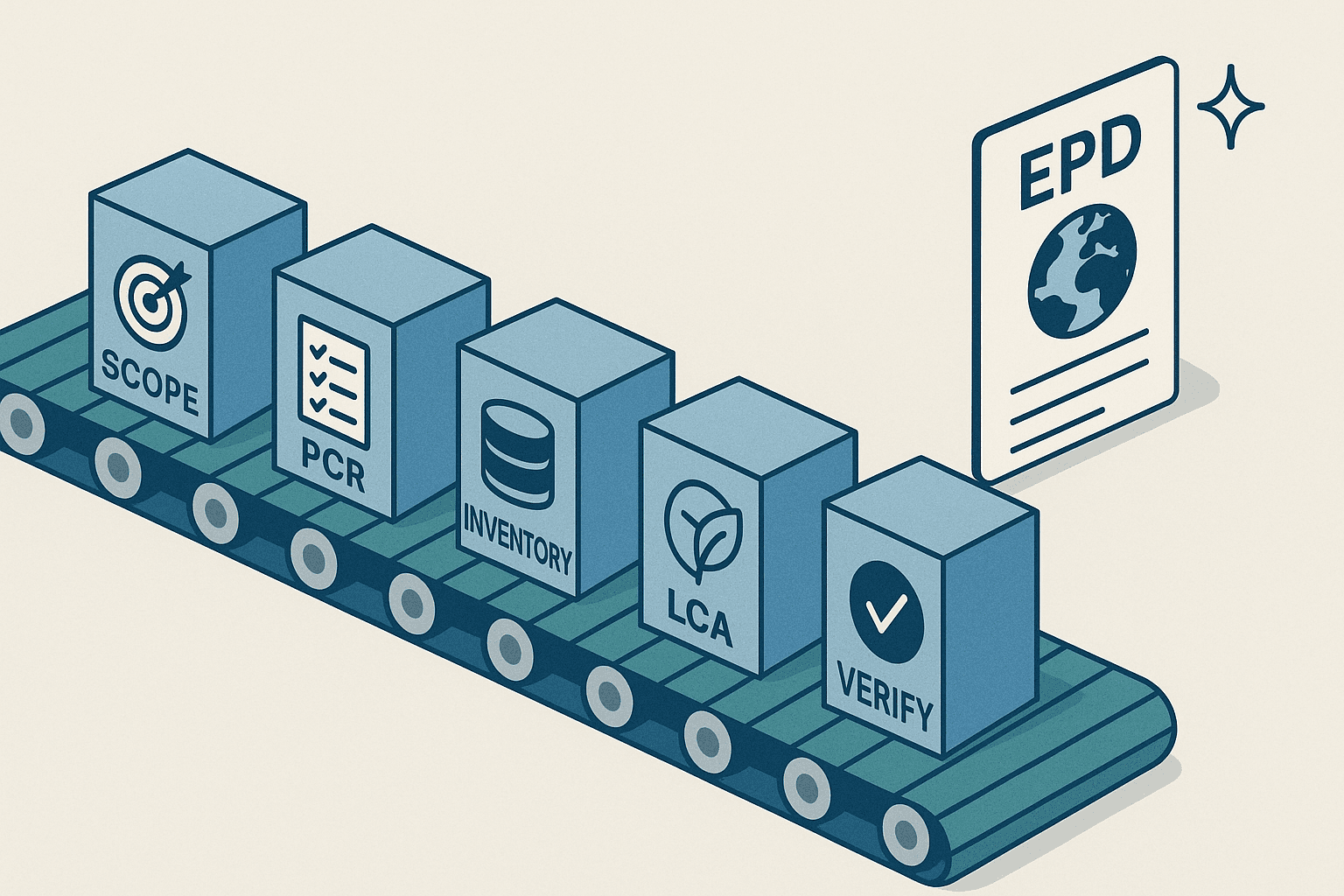
What these EPDs are in plain English
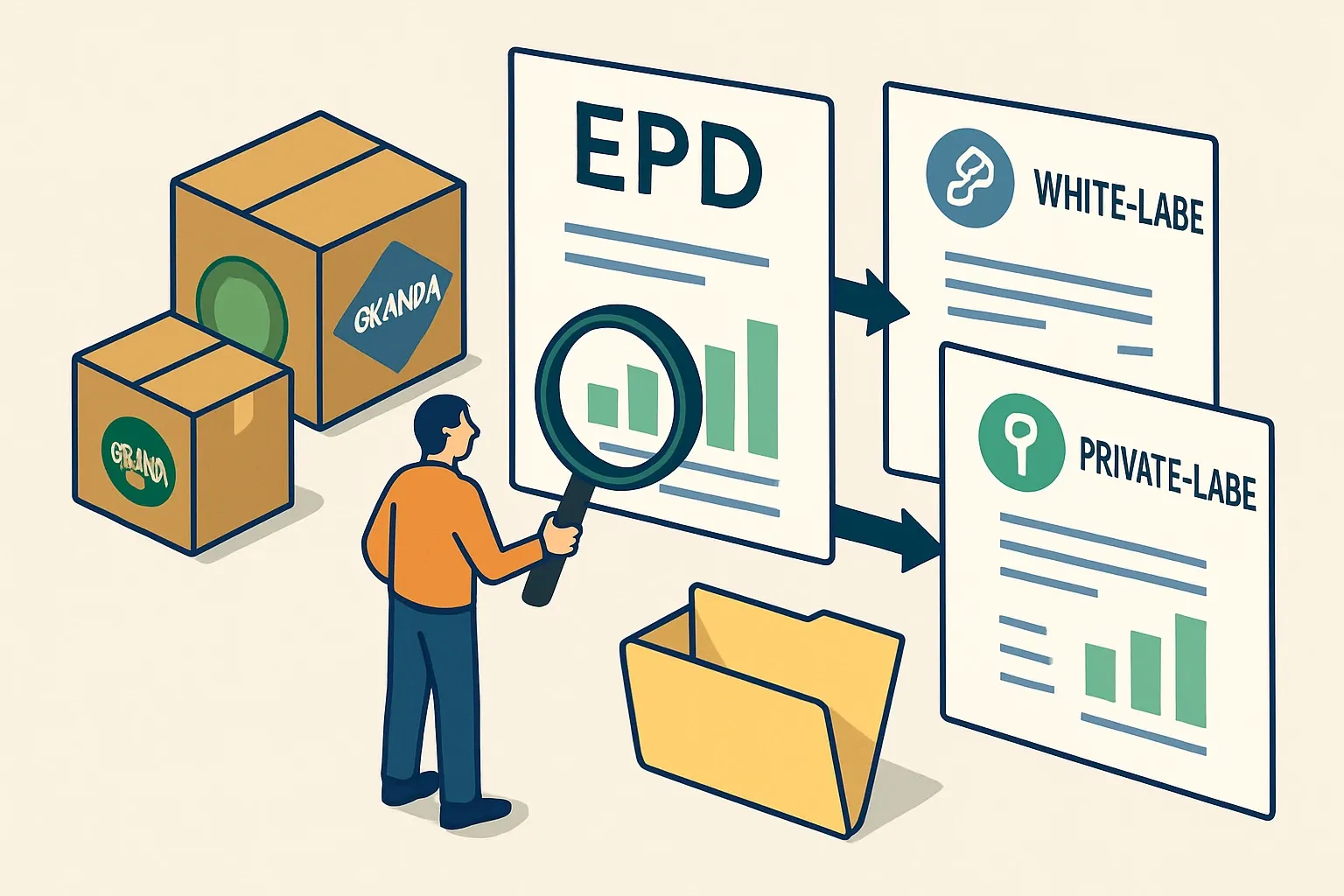
A white‑label EPD is created for a manufacturer’s product and then republished for another brand that sells the exact same product. A private‑label EPD is similar but owned by the trader or distributor rather than the factory. Think of it like the same track pressed on different vinyl sleeves. The data is the track. The sleeve is the brand.
When a white‑label or trader EPD is allowed
Rules hinge on identity, not marketing. You need the same declared unit, same PCR, same production site or sites declared identically, and the same bill of materials and process control. Under the International EPD System’s latest instructions, an EPD may be owned by the trader, which formalizes private‑label publication after a 90‑day transition that took effect on September 17, 2024 (RINA, 2024).
Proof manufacturers and distributors should prepare
Auditors look for evidence, not assurances. Prepare a signed equivalency attestation, site lists, process flow diagrams, QA specs, and supplier change logs. If the private‑label variant has a different formulation, coating, or packaging weight, it stops being eligible. Close only counts in horseshoes, not in LCAs.
Who owns the declaration and what that means
The EPD owner, whether manufacturer or trader, carries responsibility for surveillance during the five‑year validity period, including an internal annual follow‑up to check that data is still accurate and action changes that matter (EPD International, 2025). Ownership is about accountability for updates and corrections, not just whose logo sits on page one.
How verification and copies usually work
Each published document must be third‑party verified. In many programs, a white‑label or trader copy references the original model and background report, then receives an administrative review and verification to confirm sameness. If the operator issues separate registration numbers, each copy is its own published EPD record even when the LCA model is shared.
Fees and timelines, without the guesswork
Budgets vary with scope, verifier availability, and operator steps. Expect one full verification for the base model, then incremental verification and program‑operator fees per additional brand record. Exact prices differ by operator and negotiation, so quoting “typical” numbers would be misleading here. What we can say is that copies usually move faster because the heavy modeling is done already.
When an update becomes mandatory
If manufacturing changes drive a swing of 10 percent or more in aggregated results for any declared indicator across the included life‑cycle stages, the EPD must be updated and re‑verified during its validity, not just at renewal time (EPD International, 2025). That threshold is a bright line. Crossing it with a private‑label variant means the copy needs a fresh run, not a quick relabel.
Product families and the one‑result rule for construction EPDs
Several operators now restrict construction product EPDs that cover multiple similar products to a single set of results, typically average, representative, or worst‑case. Separate SKUs can still be listed, yet the impacts shown must be one set for the group, not a table of different values per SKU (EPD Australasia, 2024). Plan families accordingly so copies remain plug‑and‑play for brands.
Distributor playbook to stay compliant
If a distributor wants to own the declaration, publish under the trader EPD type when available and keep contracts crystal clear on who updates data, who pays which fees, and who answers auditor questions. Maintain supplier change notices and production site confirmations on a recurring cadence. Without that paper trail, a private‑label EPD will struggle to survive its first surveillance check.
Picking a program operator without headaches
Choose an operator commonly accepted where you sell and whose templates align with your PCR and markets. Verify that they support trader ownership and digital exports your customers actually use. In North America and the EU, acceptance patterns differ by segment, which affects how easily design teams can find and trust your declaration.
Practical guardrails that keep reuse on track
- Match formulation, packaging mass, and factories for every brand record.
- Keep a single master LCA model and background report under change control.
- Document equivalency and renew confirmations annually to match surveillance.
- Avoid cosmetic-only updates that risk version drift across copies.
Follow these and white‑label becomes repeatable. Ignore them and you’ll spend weeks untangling version spaghetti.
What this unlocks commercially
Private‑label and white‑label EPDs let you scale one high‑quality model across many SKUs and brands so specifiers see product‑specific transparency, not silence. Validity is five years with annual internal follow‑up, which gives a stable window to win specs without redoing the base work every season (EPD International, 2025). Done right, copies are fast to issue, easy to maintain, and credible when projects ask hard questions. Do it sloppy and you’ll recieve requests for clarification at the worst possible time.
Sources for the numbers mentioned
Five‑year validity, annual internal follow‑up, and the 10 percent update trigger are defined in the International EPD System’s guidance and news on internal follow‑up requirements, published December 11, 2025 (EPD International, 2025). The trader EPD type and the 90‑day transition that ended September 17, 2024 are documented in a technical summary of GPI 5.0.0 changes (RINA, 2024). The single set of results rule for construction product EPDs was confirmed by EPD Australasia in May 2024 to keep records compatible with ECO Platform ingestion (EPD Australasia, 2024).