Start with the rule of burdens
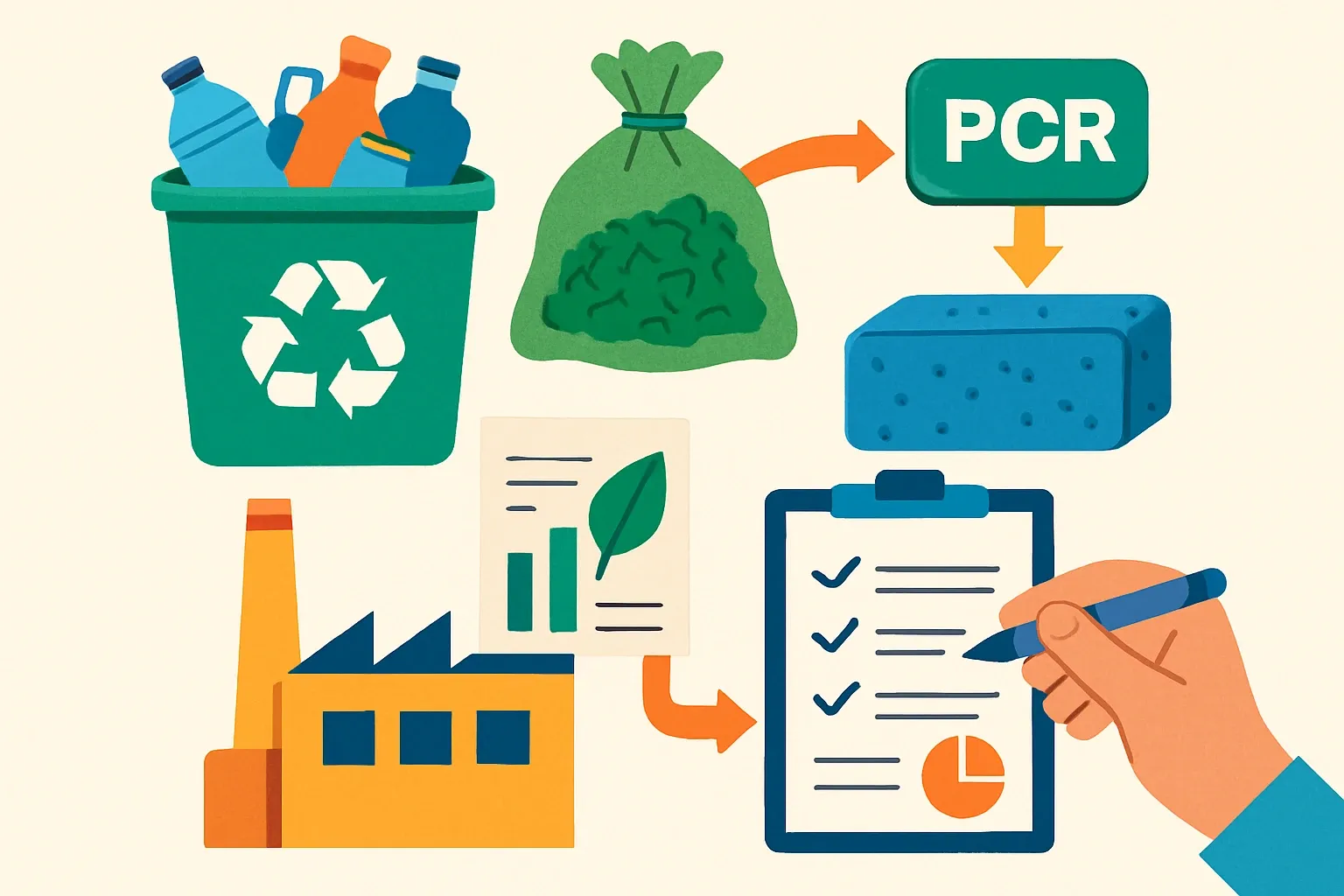
In cradle to gate accounting, recycled content carries the burden of being collected and processed back into a usable pellet or flake. The original production burden of that material was already counted in its first life, so it is not charged again. Virgin resin carries the full A1 to A3 load, recycled resin carries only its reprocessing.
Regrind is not a free lunch, it is a house credit
In‑process scrap that never leaves your facility, then returns as regrind, is treated as closed loop inside A3. You count the energy and ancillary inputs to grind, dry, and re‑feed, not the original polymerization. Capture the regrind rate and the added kWh or steam per kilogram. If your PCR adds special instructions, follow those to the letter. This keeps plant reality and EPD math aligned.
Post‑consumer vs post‑industrial, what actually changes
Both cut cradle to gate impacts compared with virgin resin because both avoid the virgin polymerization step. The difference matters mostly for rating systems, procurement language, and labeling. For carbon math in A1 to A3, the key driver is the percent recycled content and the process used to get it back into pellet form.
Where Module D fits
Module D reports potential future benefits and loads from recycling or recovery after end of life. Keep it separate from A1 to A3 when you talk about product carbon numbers. We see teams blend them together and the signal gets muddy, like mixing two audio tracks at different volumes. Stay disciplined, report A1 to A3 clearly, then show C and D as the standard requires.
Useful benchmark figures you can cite
Mechanical recycling of LDPE film shows about 0.44 kg CO2e per kilogram at the recycling plant boundary, which is consistent with recent literature (Resources, Conservation and Recycling, 2024) (Resources, Conservation and Recycling, 2024). (sciencedirect.com)
A certified figure for rPET pellets is about 0.45 kg CO2e per kilogram compared with 2.15 kg CO2e per kilogram for virgin PET, roughly a 79 percent reduction for the material input to A1 to A3 when recycled resin is substituted for virgin resin in like‑for‑like applications (Scientific Reports, 2025) (Scientific Reports, 2025). Always check the PCR for any quality correction factors if downcycling affects performance. (nature.com)
For context on recycling benefits at the municipal scale, EPA’s WARM model shows an average net reduction of about 2.83 metric tons CO2e per short ton of mixed recyclables recycled rather than landfilled. WARM is not an EPD tool and its system boundary differs, but it signals the order of magnitude value of keeping materials in circulation (EPA WARM, 2024) (EPA WARM, 2024). (epa.gov)
Plastics are still only about four to five percent of total U.S. recycling tonnage by weight, which is one reason supplier transparency on recycled content matters more than ever (EPA, 2025) (EPA, 2025). (epa.gov)
Supplier data to request without creating chaos
Ask for a one pager per resin grade or compound, refreshed each year.
- Declared percent recycled content by weight, split into post‑consumer and post‑industrial.
- Recycling process, mechanical or chemical, and any chain‑of‑custody certification claim used to substantiate allocation, for example RMS or ISCC. If mass balance is used, ask for the allocation period and methodology.
- Typical regrind rate fed to the line for your part or profile, plus the added kWh or steam per kilogram of regrind.
- Identifiers you can audit later, such as lot numbers, plant, and melt flow index. These are not for the EPD tables but they keep your trail tight.
Handling regrind on the shop floor
Treat regrind as a secondary input to A3 with its own energy and loss assumptions. Document sieving, drying, and any compatibilizers. If regrind forces thicker walls or higher part mass to meet the same spec, record that separately because function must match function in LCA. We might be boring here, but this is how you avoid surprises during verification.
Post‑consumer proof points for sales
When buyers ask whether recycled content helps their LEED v5 play, the answer is yes, but through simplified multi‑attribute scoring rather than a standalone recycled content tally, and your EPD remains the cornerstone. Keep your recycled content statement crisp, link it to the EPD scenarios, and be ready with audited documents. That keeps submittals fast and less likely to ping‑pong.
Quick pitfalls to avoid
- Mixing plant scrap and external PCR without stating the split. That muddies A3.
- Claiming recycled content from a mass balance credit without the underlying certificate and allocation dates.
- Letting suppliers send marketing decks instead of the numbers above. Politely insist on the one pager. It saves everyone time, espicially when projects ramp.
Bring it home
Think of recycled content like remixing a classic track instead of re‑recording the album. You keep the good parts and only pay for the studio time you actually use. If you get the three basics right percent recycled content, process description, and regrind energy your EPD math stays clean and your spec package lands on time.