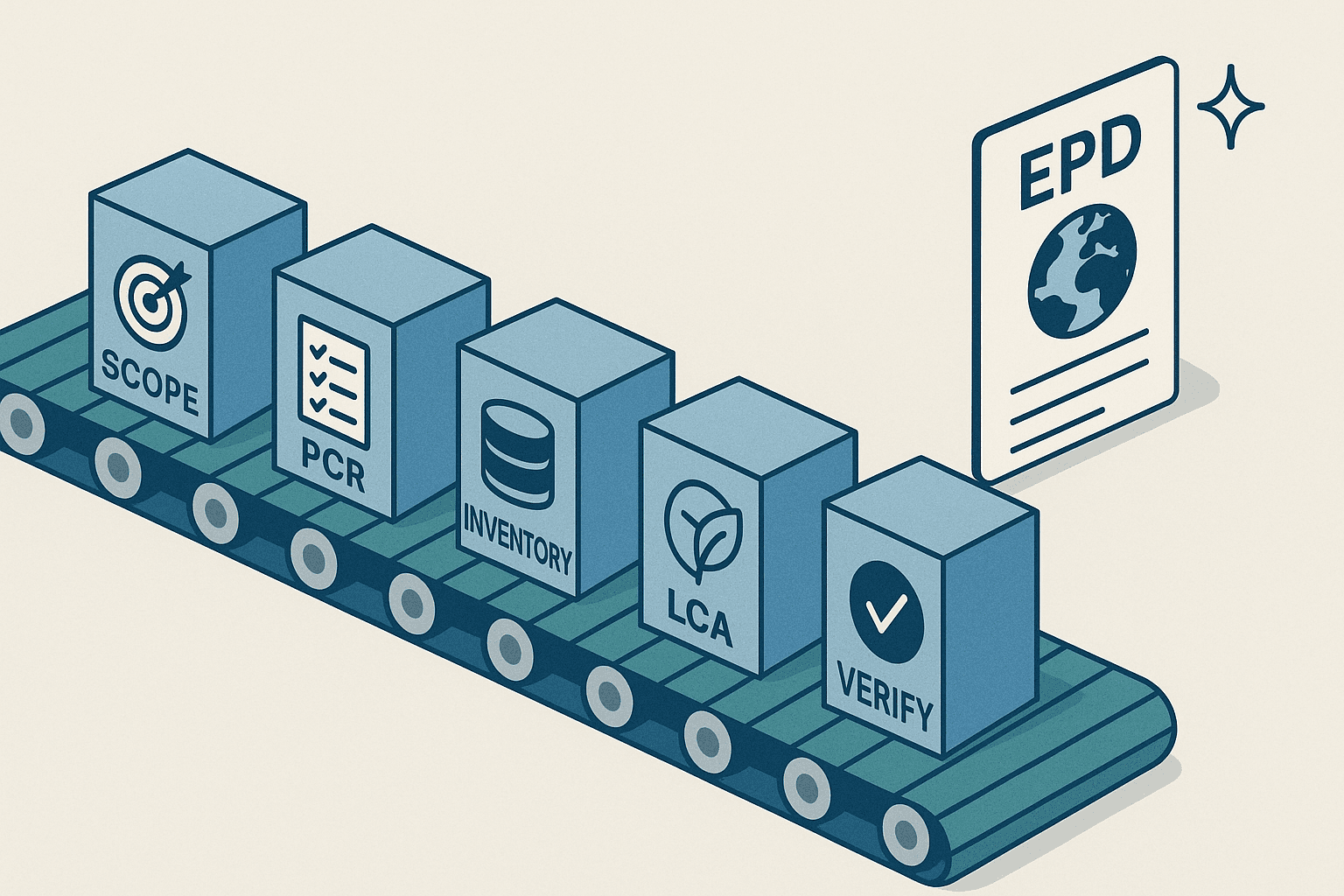
Start with the rulebook, not the spreadsheet
Pick the governing PCR and confirm the declared unit, scope, and required variability checks before any modeling. Think of the PCR as the rules of Monopoly. Ignore it and the game unravels. For modular systems, confirm how representativeness is judged across SKUs, which parameters must be fixed, and where worst‑case selection is expected.
Treat the product like a kit of parts
Modular cabling looks infinite on a price sheet yet finite on a shop floor. Identify sub‑assemblies that repeat across the line. Typical buckets include connector families, standard cable constructions, breakout styles, transitions, strain‑relief parts, and packaging types. These become reusable building blocks that anchor your LCI and your QC.
Name the scale drivers early
In practice, three drivers explain most variation. Connector type controls metal and polymer content at the ends. Fiber count or pair count controls conductor mass inside the sheath. Length translates the per‑meter or per‑foot composition into totals. Lock those drivers and you turn a maze of SKUs into a small, traceable parameter set.
Build parametric mass formulas
Create simple equations for each block. Connector mass becomes a fixed value per type. Cable core mass becomes a value per length and per fiber count. Sheath and ripcord scale with length. Add any adhesives or potting compounds as constants tied to assembly choices. These formulas let a single EPD cover a family without hand‑building BOMs for every permutation.
Handle breakouts and transitions with representative cases
Breakouts and fanouts often scare teams because geometry varies. The solution is to define a short list of representative designs that bound the space. Model a light, a typical, and a heavy case if the PCR requires worst‑case coverage. Document selection criteria. The point is not to capture every bend boot, it is to prove coverage across credible extremes.
Keep connectors in families, not chaos
Connector families usually differ by shell alloy, plating, ferrule, and backshell style. Group them into families with similar mass and process steps. Where one option clearly dominates environmental impact, select it as the family’s worst‑case for verification and publication. Note any exceptions where a plated or sealed variant must be treated seperately.
Packaging, kitting, and labeling rules that scale
Packaging is not an afterthought. Define packaging blocks that scale with length and with the number of breakouts or trunks in a shipment. Include spools, cartons, corner protection, and labels as structured elements. This prevents surprises when actual shipped configurations mix single and multi‑unit kits.
A sampling plan the verifier will respect
A verifier wants transparent reasoning, not volume. Propose a small set of SKUs that stress the model. Short length with high connector mass. Long length with high fiber count. Mid length with typical breakout. These become the checked exemplars for the EPD family. Record the parameter values, the building blocks applied, and the resulting totals so the math is auditable.
Data collection without the scavenger hunt
Ask manufacturing for bills at the sub‑assembly level, not the SKU level. Pull routings, scrap rates, and energy by workcenter for the connector and termination steps. Pull cable core composition from the standard construction specification. This avoids the trap of fishing for BOMs that only exist as sales options.
Align with representativeness and worst‑case rules
Most PCRs expect either a worst‑case declaration or a documented range within a family. Use your parametric model to show that the chosen exemplars cover the envelope. If a technology jump changes materials or processes in a fundamental way, split the family rather than stretching it. The cost of a second EPD is often smaller than the cost of confusion in a bid.
Guardrails that catch errors before the verifier does
Run three checks on every modeled configuration. First, do mass balances close within a tight tolerance. Second, do connector counts and breakout legs reconcile with length and pair count. Third, do energy and scrap scale with the real routing, not with an arbitrary percentage. If it feels like a video game boss fight, you just equipped the right armor.
Publishing path that stays operator‑agnostic
Different operators accept the family approach when the PCR allows it. Keep your documentation portable. Maintain a clean parameter table, the sub‑assembly library, and the sampling evidence. That way the same package can be submitted to Smart EPD, IBU, or others with minor format changes if business needs evolve.
Renewal without the re‑build
When data years roll forward or a PCR updates, the building blocks persist. Update electricity grids, process data, and supplier declarations at the block level. Re‑run the parametric set for your exemplars. Because the logic is stable, verification effort stays predictable and the commercial story does too. Teams dont lose months chasing SKU artifacts that never mattered.
Why this approach wins in bids
Specifiers increasingly prefer product‑specific EPDs for accurate accounting. A crisp, family‑based EPD helps avoid conservative penalties that push products out of contention when carbon targets tighten. It also clears the path for marketing and sales to position performance and lead time as the deciding factors, not paperwork.
Wrap up without the hand‑wave
Model the kit, not the chaos. Name your scale drivers. Build parametric blocks. Prove coverage with a lean sampling plan that a verifier can audit in one sitting. That is how modular cables and connector systems turn from EPD headaches into repeatable, bankable disclosures.