Start with a fixed reference year
Pick the reporting year early and stick to it. EPD modeling compares like with like, so a locked year prevents endless rework when transactional data keeps hopping between legacy and new modules. Freeze the product scope as well, so new SKUs entering the ERP do not derail the plan mid‑stream.
Define a minimum viable dataset
Agree on the smallest set of inputs that lets an LCA proceed, then collect everything else in parallel. A simple rule helps teams focus on what actually feeds the model instead of rummaging for every last byte.
- Plant energy by carrier (electricity, natural gas, fuels) with meter reads or invoices
- Annual production volumes and allocation keys per plant
- Bills of materials or recipe tables with material IDs and weights
- Inbound transport modes and typical distances per material
- Waste streams and treatment routes at the plant
Map fields once, translate often
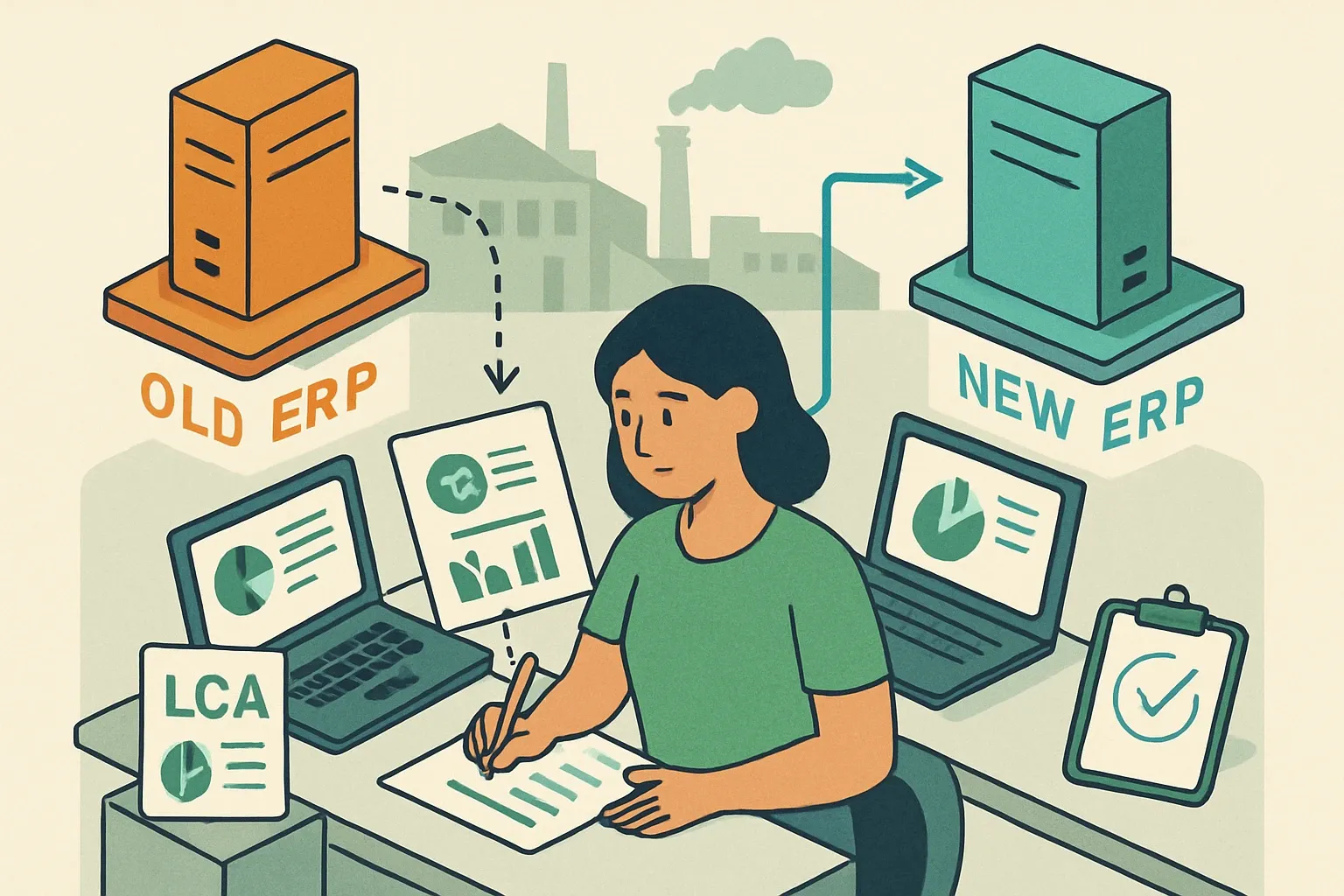
Create a single crosswalk that shows how each required field is named in legacy ERP, in the new ERP, and in shop‑floor logs. Keep the crosswalk in a shared folder, versioned. When names or IDs change, the crosswalk changes, not the LCA model structure.
Pull energy and volumes outside the ERP when needed
For many plants, meters, utility portals, and production logs are faster to access than ERP reports. That is worth it. The industrial sector accounts for about 23 percent of total US greenhouse gas emissions for 2022, so plant energy quality directly shapes EPD results (US EPA, 2024) (US EPA, 2024).
Keep a living gap register and proxy rules
List every missing field with its owner, due date, and an approved temporary proxy. Tie proxies to the governing PCR and note when they will be replaced. EPDs are typically valid for five years, so a defensible proxy today can be updated at renewal without losing commercial momentum (EPD International, 2024) (EPD International, 2024).
Clarify roles so people are not double‑booked
Sustainability defines data needs and checks conformance. IT extracts data and maintains the field crosswalk. Plant teams validate numbers and timing. Set response time targets and a weekly 30‑minute standup so issues surface early. It sounds small, but cadence beats heroics.
Create a single source of truth
Stand up a read‑only data room with folders for source files, transformed files, and sign‑off records. Use simple naming like Plant_YYYY_Source.xlsx. Add a change log that records who changed what and when. Auditors love it, and so will next year’s renewal team.
Protect comparability while SKUs evolve
ERP migrations often reshape BOMs and SKU hierarchies. Lock the modeling assumptions for the reference year and keep a separate appendix that explains how a legacy SKU maps to a new one. If a product truly changes, treat it as a new variant rather than silently blending data.
Choose proxies that age well
When gaps persist, prefer proxies sourced from high‑quality LCI libraries and program‑operator guidance. Document why the proxy fits the product and region, and set a date to revisit once the ERP data stabilizes. Prospective EPDs can be appropriate for brand‑new lines if production history is short, provided the PCR allows it.
Vendor questions that de‑risk ERP turbulence
- What is your minimum viable dataset for an LCA by product family, and will you publish that list up front?
- How do you handle field crosswalks when ERP names and IDs change mid‑project?
- Can your workflow accept meter data and shop‑floor logs without waiting for ERP reports?
- How are proxies governed so the final EPD is verifiable and comparable under EN 15804 or ISO 14025?
- What does your audit trail look like across versions, reviewers, and approvals?
Momentum beats perfection
A clean ERP is nice. A publishable, defensible EPD that helps win specs is better. Treat the ERP migration as a background fact, not a blockade. With a fixed reference year, a crisp minimum dataset, and a visible gap register, the project keeps moving and the organization definately feels the progress.