Why flat exports jam EPD automation
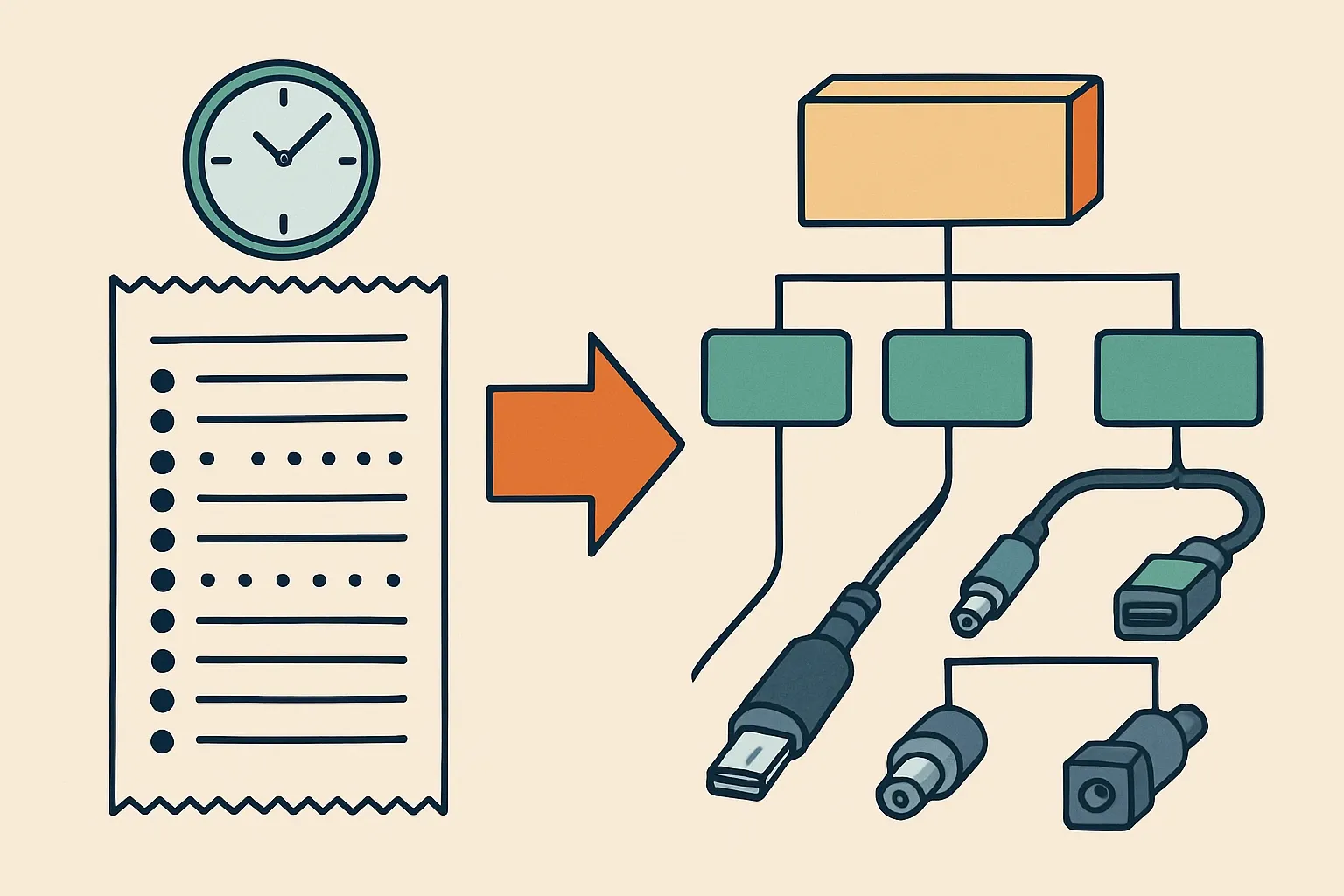
A flat BOM hides relationships. An LCA engine needs to know which subcomponents belong together, how many times a module repeats, and which parameters drive mass, energy, or yield. When that logic is implicit, both humans and AI waste cycles guessing. Slow reviews, brittle spreadsheets, and missed specs follow.
What a modular BOM actually looks like
Think of a LEGO set. Each bag contains a repeated subassembly, with counts and instructions. A modular BOM does the same in data form. You define components, group them into modules, then assemble finished SKUs from those modules with clear quantities and parameters. That hierarchy is the difference between “one product, one EPD” and a portfolio you can scale.
Define the meta model once
Create a canonical schema that all exports map into. Keep it simple and strict.
- Component table with unique IDs, functional names, mass per unit, and unit of measure.
- Module table that lists child components with quantities and rules for repetition.
- Product table that composes modules, sets parameters, and stores variant metadata like width or length.
Locking this meta model early lets platforms ingest messy CSVs and still output consistent, reusable LCA building blocks.
Grouping rules machines can trust
Spell out how parts are grouped, even when a site or supplier labels them creatively. Pick one rulebook, then never deviate.
- Parent child links: every row must either be a parent or point to one parent.
- Countable repetition: declare multiplicity for repeatable modules, not just total quantity.
- Clear fallbacks: if a part is unknown, route it to a default placeholder with conservative factors so modeling never stalls.
Names, IDs, and units that scale
Use stable, vendor neutral IDs. Avoid version numbers in names, store them in separate fields. Keep units SI and consistent across plants. One gram mismatch multiplied across thousands of meters can swamp your signal. If a parameter changes mass, tie the math to the parameter field, not to a one off note.
Parametric assemblies, made practical
Cables are a great example. Bundle conductor, insulation, shield, and jacketing as modules. Expose length as a parameter that scales each module’s mass. Add optional modules like armoring or pulling lubricant. Now any variant composes in seconds from the same library, and your EPD model updates with one change to the module.
Where PCR logic touches structure
Your schema should mirror scoping choices. If a PCR expects transport or packaging per module, carry those as explicit fields at the module level. If scrap or yield differs by component, keep those factors with the component, not the product. That alignment keeps verification comments short and predictable.
Data lineage that auditors appreciate
Track which plant, shift, and reference year each number came from. Reference years matter because LCAs and EPDs typically anchor to a defined twelve month window for utilities, volumes, and waste. When you revise, you can prove what changed and why, not just that a cell value moved.
Commercial pull that rewards structure
LEED still favors product specific, third party verified EPDs. Under v4.1, a product specific Type III EPD counts as 1.5 products toward the 20 product from 5 manufacturers threshold, which helps teams finish forms faster (USGBC, 2024) (USGBC, 2024). If your BOM is modular, publishing for top variants is weeks, not quarters, which keeps you in play when projects ask for proof on a deadline.
Keep EPDs current without rework
Plan for change on day one. Most operators set validity to five years and require mid cycle updates if a declared indicator worsens beyond defined thresholds, so build your data model to refresh quickly from plant systems (EPD International, 2025) (EPD International, 2025). When a resin shifts or a line gets electrified, you update the affected module and every linked SKU inherits the new math.
Hand off that makes verification smooth
Provide the verifier with your meta model, not just a PDF. Include a compact data dictionary that explains each field, cardinality rules, and parameter math. When the structure mirrors EN 15804 style tables and the PCR’s scope language, QA time drops and comments become about science, not spelunking.
Tooling that earns trust
Pick platforms that let you import raw exports, map to your schema, and validate against unit, parentage, and parameter rules. Great tools catch missing links early, flag unit drift, and let you regenerate results when a background dataset updates. That is how we protect R&D time while still shipping enviromental proofs fast.
Bring it together on page one
Turn flat lists into a tidy hierarchy. Name things once. Connect modules like LEGO. The payoff is real. Faster modeling, fewer surprises in verification, and EPDs that stay current as configurations evolve rather than starting from scratch each time.