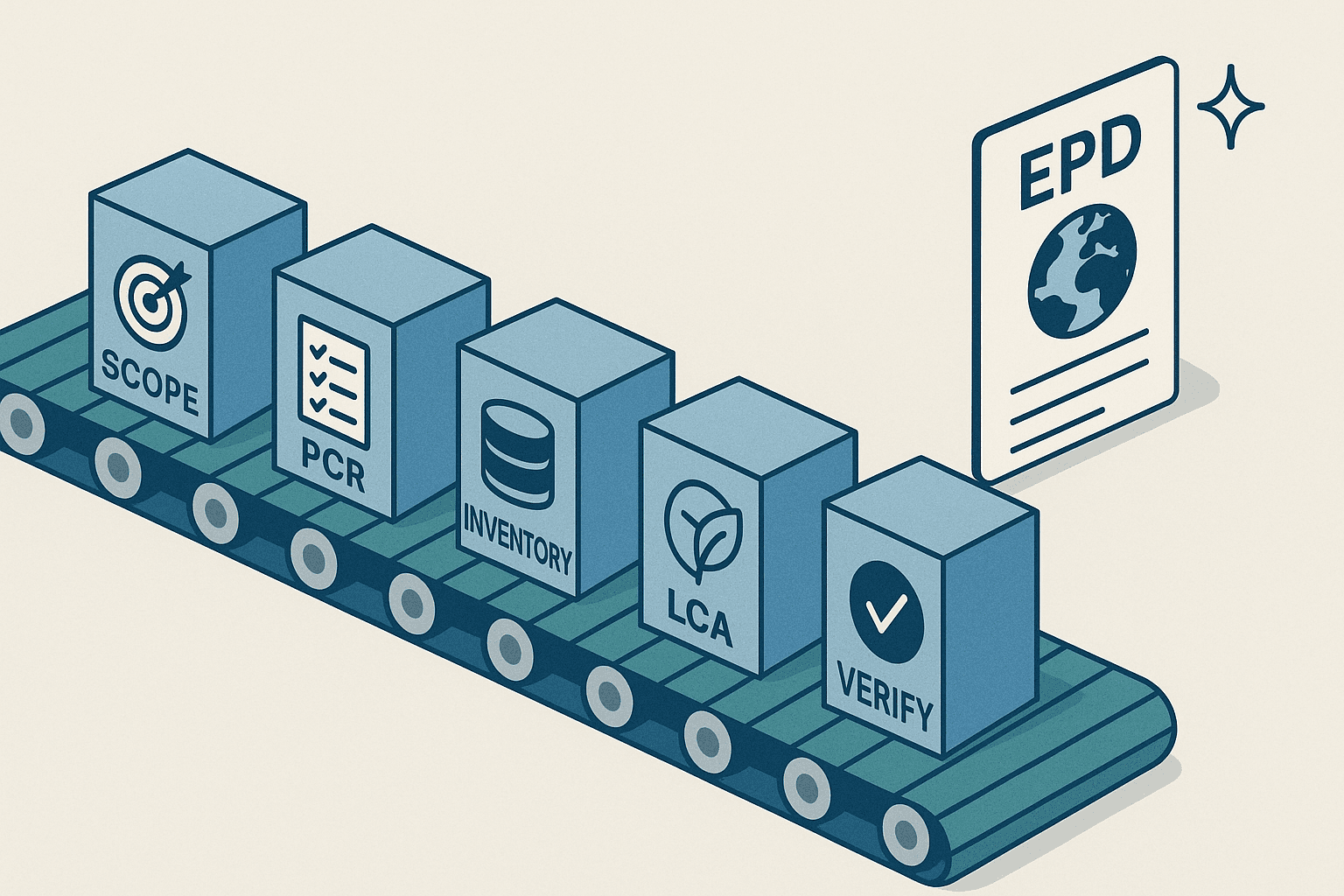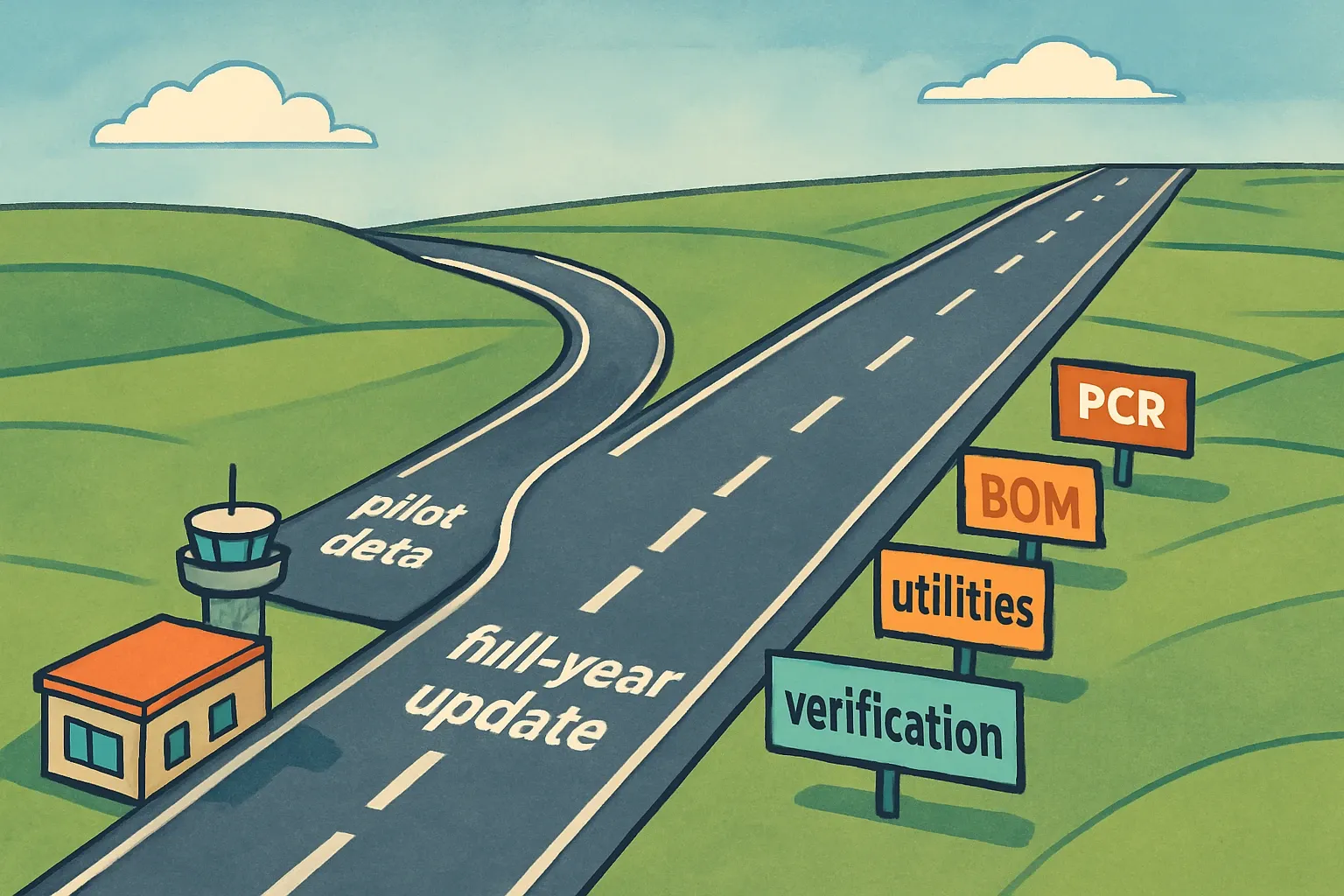
Why static EPDs collide with dynamic operations
An EPD freezes a moment in time, but manufacturing is a live feed. Grid mixes swing by region, supplier footprints evolve, and shipping modes swap with every contract. In the United States, electricity carbon intensity varies by more than three times between the cleanest and highest emitting eGRID subregions, so a plant’s grid change alone can move results a lot (EPA eGRID, 2025) (EPA eGRID, 2025).
What counts as “material” enough to update
There is no single number written on a stone tablet. Program operators commonly set five year validity for EPDs and expect an update if any declared indicator changes by about 10 percent during that window, as documented in operator FAQs (EPD International FAQ, 2025). That means routine housekeeping can wait, but a new supplier mix, energy contract, or transport shift that pushes an indicator beyond that tolerance deserves attention.
Make the plant model your unit of change
Treat each facility as a maintained model with version control, not a one off spreadsheet. Lock in bill of materials, utilities, waste, coproducts, and outbound logistics by lane. When something changes, you update parameters, not architecture. Verification then focuses on the delta and the evidence behind it.
Suppliers in flux, logistics in motion
Mode choice matters. Typical rail freight emits about 0.026 kg CO2e per tonne‑kilometre, while a single factor used for heavy road freight is around 0.07 kg CO2 per tonne‑kilometre. That is a difference of roughly 2 to 3 times for the same distance and weight (UK ETS analytical annex, 2024) (GOV.UK, 2024). Grid changes also move numbers quickly, and the latest eGRID data confirm large regional spreads that can reshape A1 to A3 results when a plant’s electricity source shifts (EPA eGRID, 2025) (EPA eGRID, 2025).
Consolidations, expansions, and recipe tweaks
Plant consolidation can change allocation, capacity factors, and waste rates. Expansion can introduce new equipment with different efficiency. Even a quieter “recipe” tweak, like a resin substitution or new coating content, can ripple through upstream categories. Keep a change log that ties each event to a model input and a timestamp, then recalc on demand.
Mass timber moves fast, and owners notice
Supply paths for CLT and glulam can be project specific, with mills, laminators, and finishers spread across regions. The market is scaling quickly, with 2,598 multi family, commercial, or institutional mass timber projects in progress or built in the U.S. as of December 2025, which raises the bar on current documentation (WoodWorks, 2025) (WoodWorks, 2025). Teams that can refresh EPDs quickly stay bid ready.
Update without starting from zero
Work from a central, validated model. Parameterize supplier, transport, and energy data. When an event hits, swap the input set, rerun, and generate an updated declaration that references the same PCR and program operator unless rules require a version change. Keep evidence close at hand, like new utility bills or route confirmations. This keeps verification tight and turnarounds short.
What to expect from a partner
Look for a platform that centralizes plant level data and a team that actually collects it. Ask who chases utility bills and supplier EPDs. Confirm that transport is modeled by lane, not a single blanket factor. Ensure they can publish with multiple program operators, since markets differ. The goal is speed without shortcuts, with numbers that stand up in review.
A simple decision playbook
- Did any declared indicator shift by roughly 10 percent or more since publication, based on current data pulls. If yes, plan an update next.
- Did a facility change its grid mix, fuel, or core process equipment. Recalculate with new energy data, then check the threshold.
- Did transport mode or distance change on primary lanes. Recalculate A2 and A4, compare against your last verified results.
- Is your EPD inside the last 9 months of its five year window. Start renewal prep while you operate the update cycle in parallel (EPD International FAQ, 2025).
Keep the spec moving
EPDs do not have to be fragile. With plant models as living assets, plus disciplined change tracking, updates become routine and submittals stay current. That saves the bid from waiting on a fresh study and keeps sales from losing momentum. It is definately more work up front, yet it pays off every time operations change and the market asks for proof.