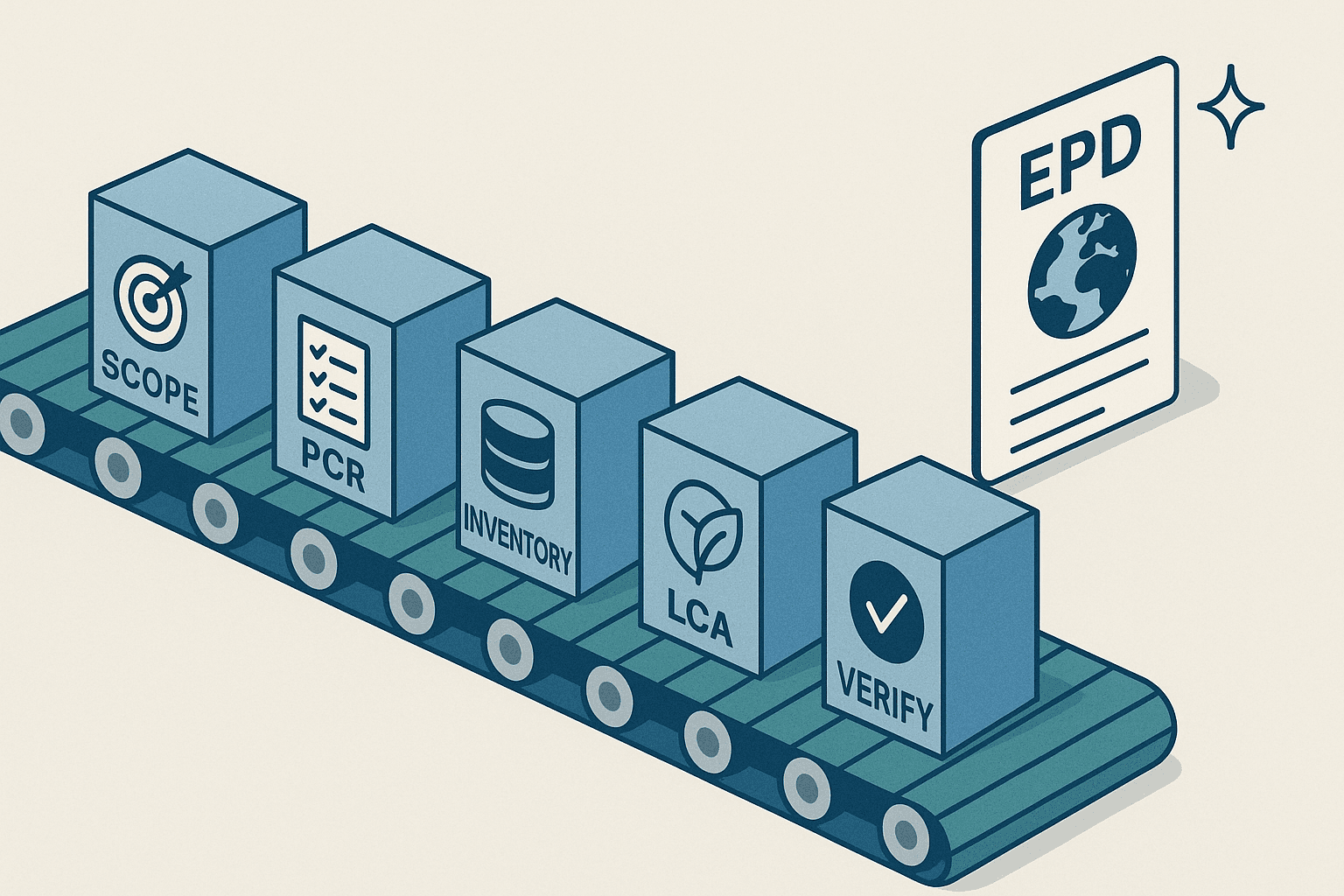
Why prioritization matters now
Embodied carbon from materials and construction accounts for roughly 10% of global energy‑related CO₂, so product data is increasingly requested in bids and public portals (GlobalABC, 2024) (GlobalABC, 2024). EPDs also carry a typical validity of five years, which means cadence and sequencing matter for portfolio coverage (EPD International, 2024) (EPD International, 2024).
Define the goal in commercial terms
Prioritize EPDs to win more specs, not to collect certificates. Pick targets that can influence near‑term bids or distributor line reviews. Measure success in revenue covered by current EPDs and cycle time from kickoff to publication.
A quick-scoring model you can run this week
Create a one page scorecard. Give each candidate product a 1 to 5 on four questions. Higher score wins queue position.
- Spec pull today. Are we actively blocked from projects by missing EPDs in key markets or customer accounts?
- Data readiness. Do we have twelve months of utility and production data and a stable BOM, or will a prospective EPD be needed?
- Portfolio impact. Will a single EPD cover a family with shared chemistry, sizes, or finishes under the relevant PCR?
- Competitive pressure. Do rivals already publish an EPD under the same PCR and operator that specifiers check first?
If two products tie, pick the one with simpler supply chains for faster publication.
Map requirements by market before you commit
State and municipal procurement increasingly asks for EPDs, while federal policies are in flux. LEED v5 is in development and keeps rewarding product-specific EPDs in materials credits, so having a compliant declaration remains a reliable differentiator for vertical building work. When selling in the EU, many manufacturers are preparing disclosures that align with CSRD, which is set to apply to about 50,000 companies in the bloc (European Commission, 2024) (European Commission, 2024).
Want to prioritize EPDs effectively for your products?
Follow us on LinkedIn for insights that help you win more specs and unlock market opportunities.
Pick the right PCR and operator on purpose
A PCR is the rulebook of Monopoly. Ignore it and the game falls apart. Study which PCR competitors use, when it expires, and which program operator specifiers trust in your category. If a PCR is expiring soon, you can still publish, then plan the refresh against the next version without losing validity in the meantime.
Choose first-mover products with three signals
Look for high‑volume SKUs that appear often in bid lists, SKUs sold into regions with Buy Clean‑style expectations, and SKUs with chemistry that remains stable across variants. That trio usually delivers a fast EPD and broad catalog coverage.
Sequence by plant and data gravity
If a product runs in three plants, start where metering is complete and waste streams are well logged. Plant‑level differences can materially shift impacts, so resist mixing data from multiple facilities unless the PCR allows a representative approach and the statistics check out. We see teams shave weeks by aligning early on which plant to model first.
Avoid common traps that slow everything down
Do not chase vanity products that rarely show up in bids. Do not split one family into five separate EPDs if the PCR permits a range declaration. Do not let a complex, custom option jump the line ahead of a standard SKU with clear data.
Refresh logic that saves budget
Track three timers for every published EPD. Months to EPD expiry. Months to PCR revision. Months since major formulation change. Renew when any one approaches a red line, not after a bid team escalates. Remember that a PCR expiry does not automatically void your EPD, it defines the rulebook for the next renewal.
Tooling and partners that actually reduce work
Prioritization is only useful if execution is fast and calm. Favor partners who handle the ugly data collection across finance, QA, and operations, then manage publication with your operator of choice. White‑glove collection means senior engineers stay on core work while the LCA moves forward. That is how speed, ease, quality and completeness show up in real life.
Portfolio KPIs worth watching quarterly
Aim for at least 70% of revenue covered by current EPDs in your top regions. Watch average remaining validity across those EPDs and keep it above 24 months. Track bid coverage, the share of tenders where your offered SKUs already have an EPD attached. If good numbers are missing, say so plainly and set a plan to fill the gaps, since data silence is usually hiding drag.
Your three-move starter sequence
List ten SKUs that drive the most near‑term bids. Score them with the quick model and pick the top four. Lock in PCR and operator choices to match the competitive landscape. Kick off data collection this week, not next quarter, and publish the first set in one clean sprint. It sounds simple because it is, but it is also the decisive habit that seperates the teams who win specs from the ones who keep deferring them.
Extra search help
If you came looking for an EPD prioritization framework or asking how to prioritize EPDs across a portfolio, the approach above is the fast lane without shortcuts. When LEED v5 lands, you will be ready rather than reactive.