Why after-the-fact EPDs miss the moment
EPDs help products clear procurement rules and stay in the spec when carbon targets apply. LEED v5 was ratified on March 28, 2025 and continues to reward verified product transparency through Arc forms, so disclosure remains a competitive lever, not a side quest (USGBC LEED v5, 2025). Waiting until after launch means leaving bids and margin on the table.
Make LCA a design-gate, not a report
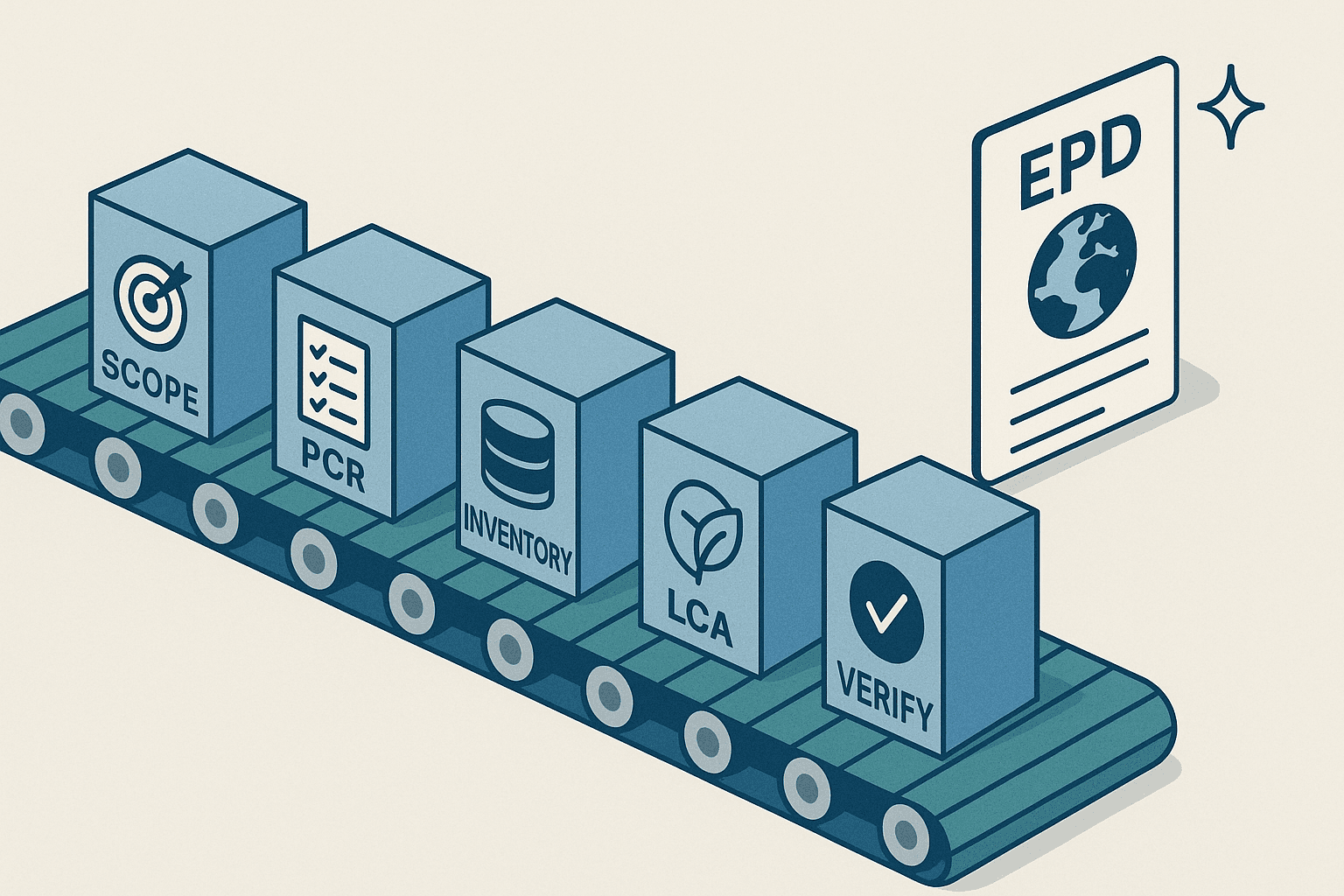
Treat LCA the way R&D treats safety reviews. Add a quick model at concept, a refined one at design freeze, then a verification path at pilot. Each pass answers a business question: can we cut transport miles, switch suppliers, or shift plants without blowing lead times?
Modular BOMs unlock real choices
A static BOM hides options. A modular BOM lists swappable inputs with ranges for mass, scrap, and recycled content. That structure lets a model update in seconds when a resin grade changes or a steel gauge moves. Think playlist, not mixtape.
Data plumbing that scales with you
Pull energy, waste, and logistics data from source systems, not from heroic spreadsheets. Grid emissions vary widely by location, so plant-level electricity must be regionalized. In eGRID 2023, Upstate NY sits around 275 lb CO2 per MWh while Oahu is about 1,575 lb CO2 per MWh, a difference of roughly 6x (EPA eGRID, 2025). That swing alone can reorder which factory should make a carbon-critical SKU.
Scenario planning beats retrofit
Give engineering a “what if” panel. Route a heavy product by rail for the long middle mile, then truck only for first and last. UK government evidence pegs heavy-goods road freight around 0.07 kg CO2 per tonne km in policy modeling, while national rail freight averages near 0.026 kg CO2e per tonne km, so a rail-first plan can cut freight intensity by roughly two thirds (UK ETS Analytical Annex, 2025) (ORR Rail Environment, 2025). Factors differ by country, but the direction of travel holds.
AI helps, experts decide
Use AI to generate fast baselines, normalize supplier EPDs, and flag outlier data. Humans still set system boundaries, select the right PCR, and sanity-check cutoffs. The mix keeps speed without sacrificing defensibility when a reviewer, or a GC, asks hard questions.
Pick PCRs with the market in mind
If competitors cluster around one PCR, use it unless a newer rule materially improves comparability for your product class. Track sunset dates so the next update does not collide with your launch calendar. If reliable averages for your niche are missing, say so plainly in the model notes and keep assumptions transparent.
Plan renewals like product refreshes
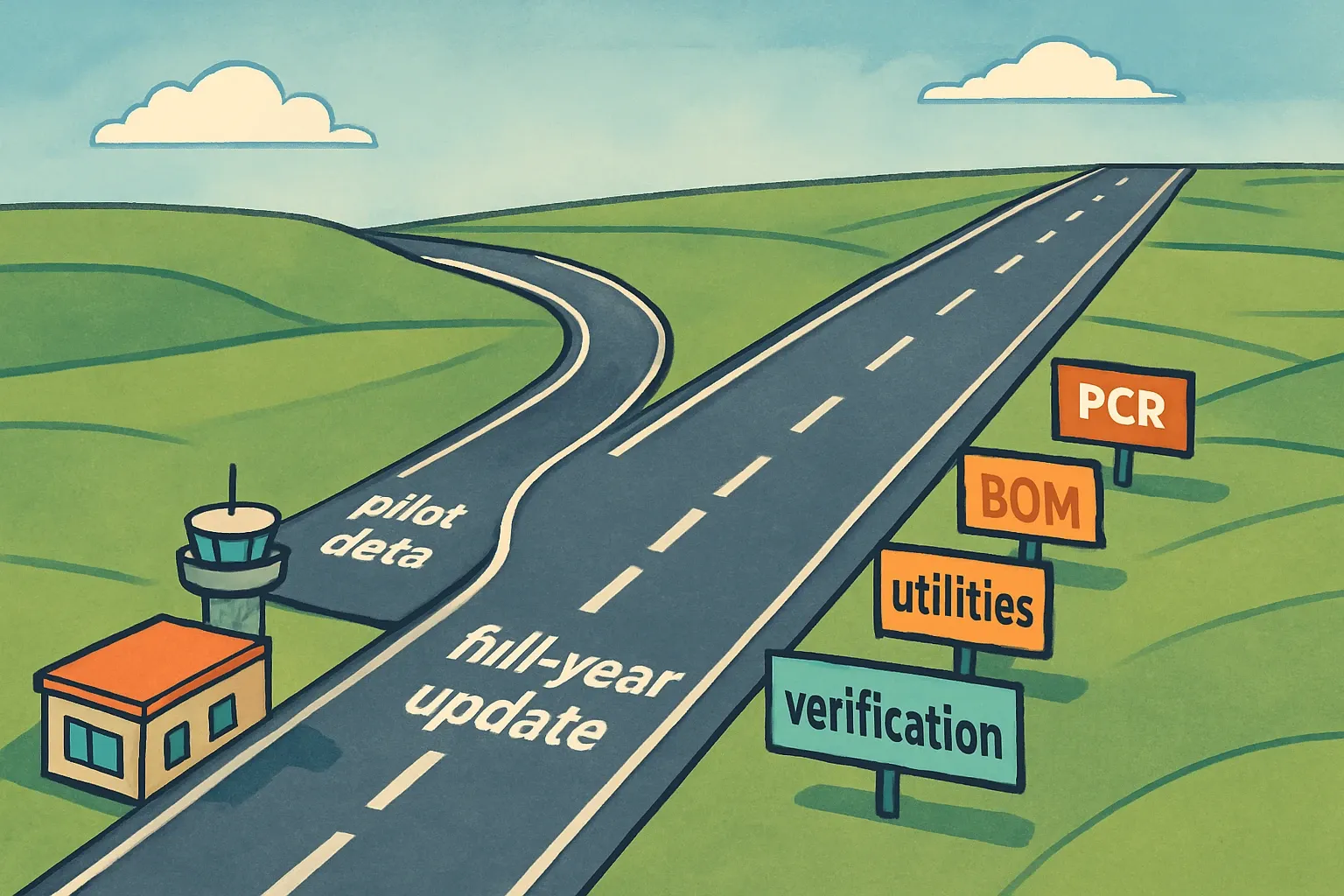
Most program operators maintain a five-year validity window and now ask for an annual internal follow-up to keep declarations accurate, which fits neatly with a yearly product-line review (EPD International, 2025). Build that cadence in: refresh data annually, then re-verify on the renewal cycle or when a material change lands.
What good looks like in practice
- Set design-gate LCA questions: concept, freeze, pilot, launch.
- Build a modular BOM with variant materials and realistic scrap.
- Wire data feeds from meters, ERP, MES, and TMS to your model.
- Regionalize electricity and logistics, not just materials, using current factors like eGRID for plants and official freight intensities for routes (EPA eGRID, 2025) (UK DESNZ Conversion Factors, 2025).
- Choose a partner who does the heavy lifting on data collection instead of handing you a spreadsheet marathon. Protect R&D time, ship enviromental proofs faster, and publish with a program operator aligned to your markets.
Bringing it all together
When EPD and LCA workflows live inside new product development, teams compare options before they become commitments. The result is simple to explain in a bid: the product is spec-ready, backed by third-party numbers, and optimized for embodied carbon from day one. That beats retrofitting disclosures later, every time.