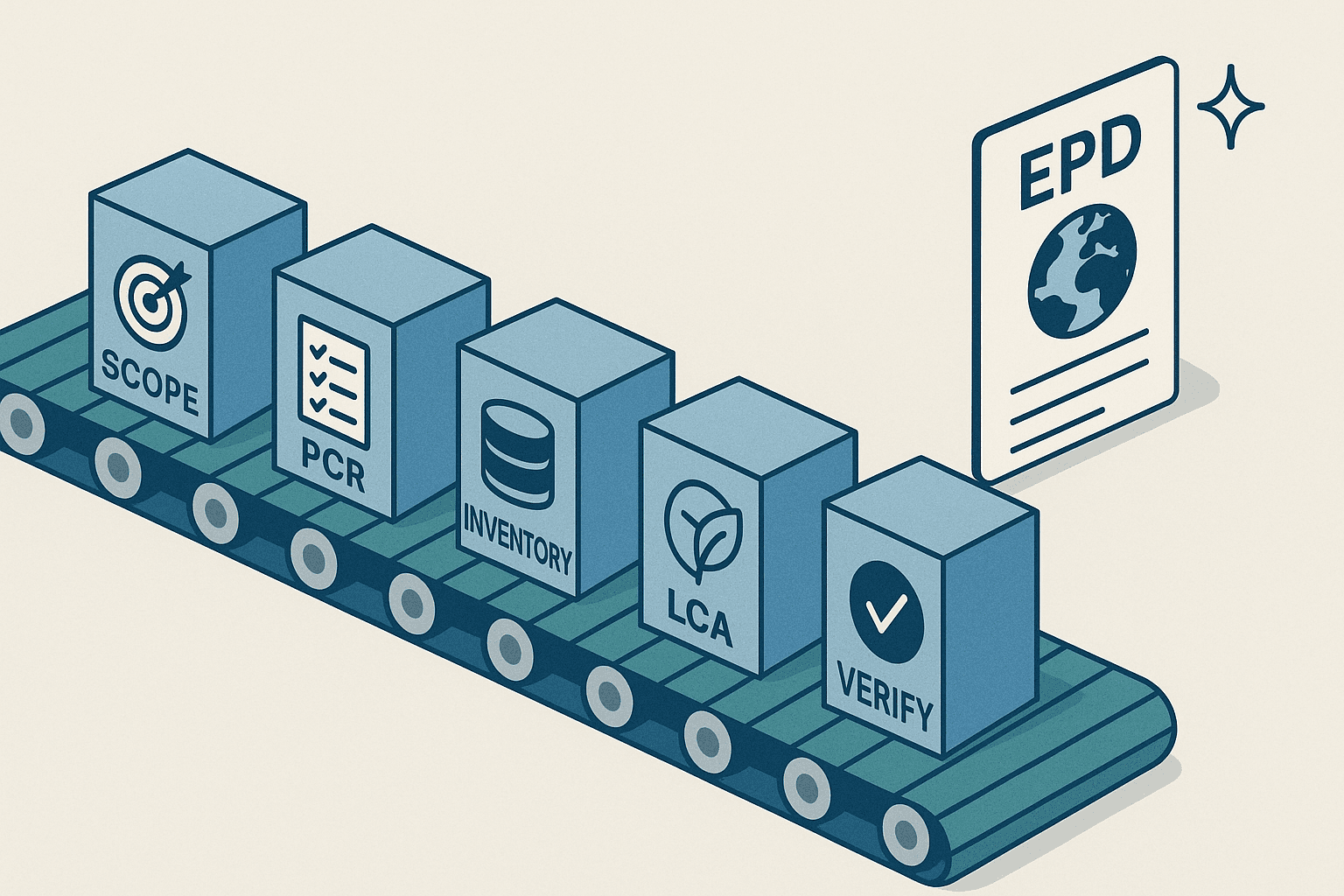
Lock the rulebook once, then certify the tool
A PCR is the rulebook of Monopoly, ignore it and the game falls apart. Freeze the governing PCR, functional unit, reference service life menu, declared modules, and organization details inside the tool. Most programs set EPD validity at five years, which makes a locked core practical for renewal cycles (IBU General Program Instructions, 2024) (IBU, 2024).
Let the right inputs vary inside agreed rails
Keep dynamic fields truly dynamic, but bounded. Bills of materials, plant utilities, transport legs, and packaging can vary within documented ranges tied to real production. Electricity is a good example, since subregional emission factors within the United States differ by more than fourfold, so location specific ranges prevent surprise swings later (EPA eGRID, 2024) (EPA eGRID, 2024).
Automated checks that keep verifiers comfortable
Automated controls should mimic what a careful verifier already checks, then flag exceptions for human review.
- Impact outliers. Compare each run to a rolling product and plant baseline, then flag any category that moves beyond a set band, for example 2 standard deviations.
- Composition integrity. Require materials to sum to 100 percent within a small tolerance and enforce the EN 15804 completeness rule of at least 95 percent mass and energy coverage (EN 15804, 2019).
- Biogenic carbon balance. Validate that reported biogenic carbon flows and credits are consistent with the product’s bio based content and do not create net credits in stages where the PCR forbids it (EN 15804, 2019).
- Functional unit sanity. Block runs if the declared unit or density basis differs from the verified defintion.
Biogenic carbon, handled with guardrails
Biogenic carbon needs its own lane. Track uptake and release separately, keep module labels clear from A1 to A3 through C, and require documentation when storage claims appear. Automation should prevent double counting and force notes when bio content or moisture assumptions change, so reviewers see the why, not just a number.
Bounded models reduce repetitive verifier effort
When the core is locked and checks are codified, verifiers can approve the engine, not every click. Routine runs pass quietly and only edge cases reach a person. It feels like airport PreCheck for your LCA, faster flow with the same security.
What to pre agree with verifiers at kickoff
Set expectations before the first run so everyone knows the rails.
- The fixed parameter set to be hard coded in the tool, including PCR version and system boundary.
- The allowed ranges for dynamic fields, with evidence for each range.
- The anomaly thresholds that trigger manual review and what documentation is required.
- The renewal plan that aligns with the five year validity window and PCR updates (IBU General Program Instructions, 2024) (IBU, 2024).
Why the ranges matter commercially
Bounded models protect comparability, which is what specifiers and auditors care about. Ranges anchored in data reduce rework during bids because results stay predictable across factories and months. Electricity regionalization is a simple example that avoids late stage adjustments, since subregion factors are published and updated on a known cadence (EPA eGRID, 2024) (EPA eGRID, 2024).
Keep rigor aligned with the standards
Use the standards as your north star. EN 15804 sets the completeness floor and the biogenic accounting rules, while ISO 21930 frames how Type III declarations should be verified and communicated. Automated checks that reflect those requirements make audit trails shorter and trust stronger (EN 15804, 2019; ISO 21930, 2017).
Tie it together without tying teams in knots
Lock what must not change and watch what must, with software that flags only the oddities. Verifiers review the model once, then focus on exceptions. The result is a catalog that stays spec ready, quarter after quarter, without trading away rigor.