What actually changed
The Act went live on 24 February 2025. Procurements started before that date continue under the old rules, so there is a transition period where both regimes run in parallel.
Authorities now evaluate the most advantageous tender. That framing invites quality, risk, and sustainability to carry real weight alongside price.
Why manufacturers should care
Public procurement is enormous, which means a steady stream of specs and bids. Gross UK public sector procurement spending reached £434 billion in 2024 to 2025, so even small share shifts move real revenue (House of Commons Library, 2025) (House of Commons Library, 2025).
The Act’s objectives include transparency, value for money, and public benefit. Environmental performance now sits naturally inside that last one, so credible product data is a competitive edge.
Carbon proof points buyers recognise
For central government contracts above £5 million per year, suppliers must provide a Carbon Reduction Plan that states emissions and a net zero commitment, using the new Procurement Act terminology (GOV.UK PPN 006, 2025) (GOV.UK PPN 006, 2025).
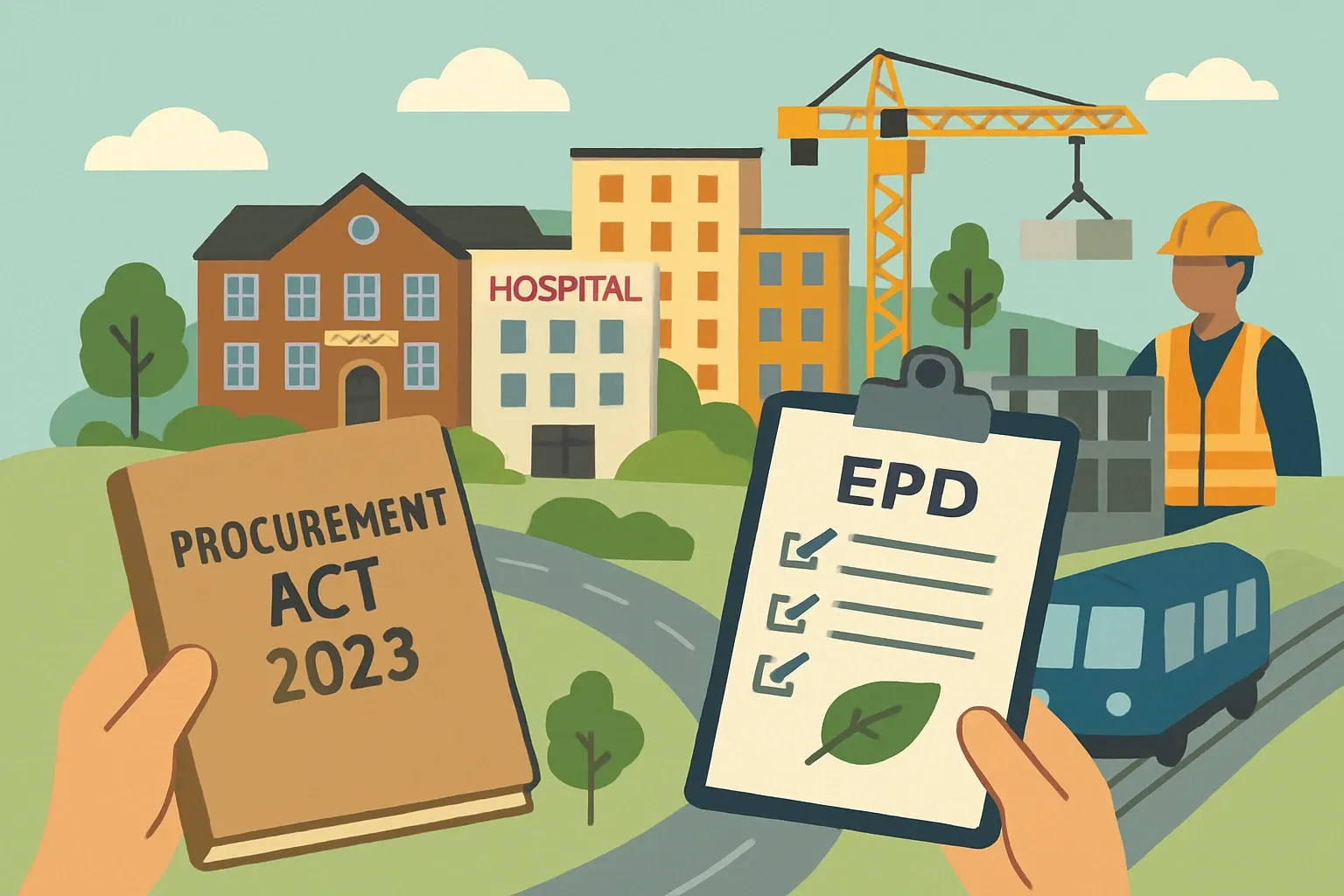
A CRP is organizational. EPDs complement it by proving product‑level impacts with third‑party verification. Together they show both the company’s direction of travel and the footprint of what is being supplied.
Where EPDs plug into the new rules
Technical specifications can reference performance and sustainability characteristics. An EPD is a clean way to evidence embodied carbon claims and material content with clear system boundaries.
Award criteria can assess quality and public benefit. EPDs help translate your process improvements into scoreable points, rather than soft promises.
Want to win more public projects under the new UK Procurement Act?
Follow us on LinkedIn for insights on how EPDs can help you meet compliance and secure tenders.
Life‑cycle costing shows up more often
Authorities can compare whole‑life value, not just upfront cost. When bidders quantify maintenance, replacement, and end‑of‑life assumptions, an EPD’s declared modules keep the math consistent.
If a competitor submits a product‑specific EPD and you do not, evaluators often default to conservative factors for your line. That can drag your score, even if your real footprint is better.
Data readiness buyers will expect
Have a clear reference year, plant utilities, material inputs, transport, and packaging at hand. Make sure declarations align to the PCR your competitors use, or you risk an apples to oranges comparison.
Check validity windows. Anything close to expiring invites clarifications at the worst possible time.
The tender choreography
Signal your EPDs early in market engagement. In selection, the CRP covers the enterprise, while EPDs and HPDs back up product claims. In award, point evaluators to the exact tables they will score, do not make them hunt.
Post‑award, keep a change log. If a formulation or site shifts meaningfully, update your declaration so the contract manager is never surprised.
Quick plays for the 2026 bid season
Prioritize EPDs for catalog items that appear most in frameworks and repeat call‑offs. Start with SKUs that are spec‑sensitive, high revenue, or high carbon.
Align on the PCR your market segment uses, the program operator your buyers know, and the publication language they prefer. Then industrialize data collection so new lines and renewals slot in fast. Speed matters, thier sales team will feel it.
Pitfalls to avoid
Do not submit marketing carbon numbers without third‑party verification. Do not mix cradle‑to‑gate results with cradle‑to‑site in one table. Do not let plant‑level improvements go unreflected in your next update.
If you lack trustworthy figures for a claim, say so and commit to a timeline. Evaluators respect clarity.
The commercial angle
This Act rewards suppliers who show their work. EPDs upgrade your claims from narrative to evidence, which maps neatly to most advantageous tender scoring.
Get your data house in order, publish where your buyers are, and remove friction from the RFP grind. That turns sustainability paperwork into spec wins.