RE2020 in plain English for manufacturers
RE2020 is the French rulebook for energy and whole‑life carbon in new buildings. Designers must compute a building LCA using data from INIES. Your product’s FDES or PEP feeds that LCA, just like a verified ingredient label powers a nutrition score. No EPD on file means the model reaches for default values that include a safety factor, which is intentionally conservative so results don’t look unrealistically low (INIES FAQ, 2025).
What actually changed on January 1, 2025
Two indicators tightened. For construction‑stage carbon, the Ic construction ceiling dropped to 530 kg CO2e/m² for single‑family housing and 650 kg CO2e/m² for multifamily. For operational energy carbon, Ic énergie now sits at 160 kg CO2e/m² for houses, 260 for multifamily not on a district heat network, and 320 for those connected. These values apply based on permit date from 2025 onward and come from the national decree that updated RE2020 requirements (Décret n° 2024‑1258, 2024).
ADEME’s national observatory summarizes the scale of tightening. Compared with 2022 baselines, Ic énergie thresholds fell by roughly 43 to 54 percent for multifamily, about 29 percent for offices on heat networks, and 17 to 42 percent for schools depending on case (ADEME BâtiZoom, 2025). On the construction side, the 2025 Ic construction step is 12 to 17 percent lower than the initial level (ADEME BâtiZoom Ic construction, 2025).
District heat networks and a narrow relief window
Projects connected to classified district heating or cooling networks and permitted before December 31, 2027 can apply a specific allowance tied to the decree. This transitional relief clarifies which Ic énergie table applies and under what network conditions, straight from the government’s official FAQ (RT‑RE‑bâtiment FAQ 213, 2025).
Why EPDs matter more after the 2025 step
Think of the building LCA like a playlist. If too many tracks are generic, the mood shifts. Default environmental data carry a built‑in safety coefficient, so a wall without a product‑specific FDES can weigh more in the model than the same wall with a verified EPD. That directly threatens the Ic construction budget when slabs, rebar, insulation or MEP equipment are modeled with defaults instead of product data. It’s not just compliance. Teams with ready EPDs are specified first because they remove modeling friction in tight‑margin projects.
Struggling with new environmental regulations?
Follow us on LinkedIn for updates that help you navigate compliance and secure more projects.
What’s in scope in 2025
The tightened thresholds apply to new housing, offices and primary or secondary schools. For non‑residential, the energy‑carbon bar notably moves for offices linked to heat networks and for education buildings, which see steeper Ic énergie declines than in housing (ADEME BâtiZoom, 2025). If your catalog sells into these typologies, assume design teams are filtering for products with current FDES or PEP by default.
The EPD supply picture in France
Manufacturers have been publishing fast to keep up. By the end of 2023, INIES reported 3,630 FDES and 961 PEP available, despite large archival waves earlier that year, a sign of sustained growth heading into 2025 (Alliance HQE‑GBC, 2024). More choice means specifiers expect to find a product‑specific declaration for the major quantities in a build.
2028 and 2031 on the horizon
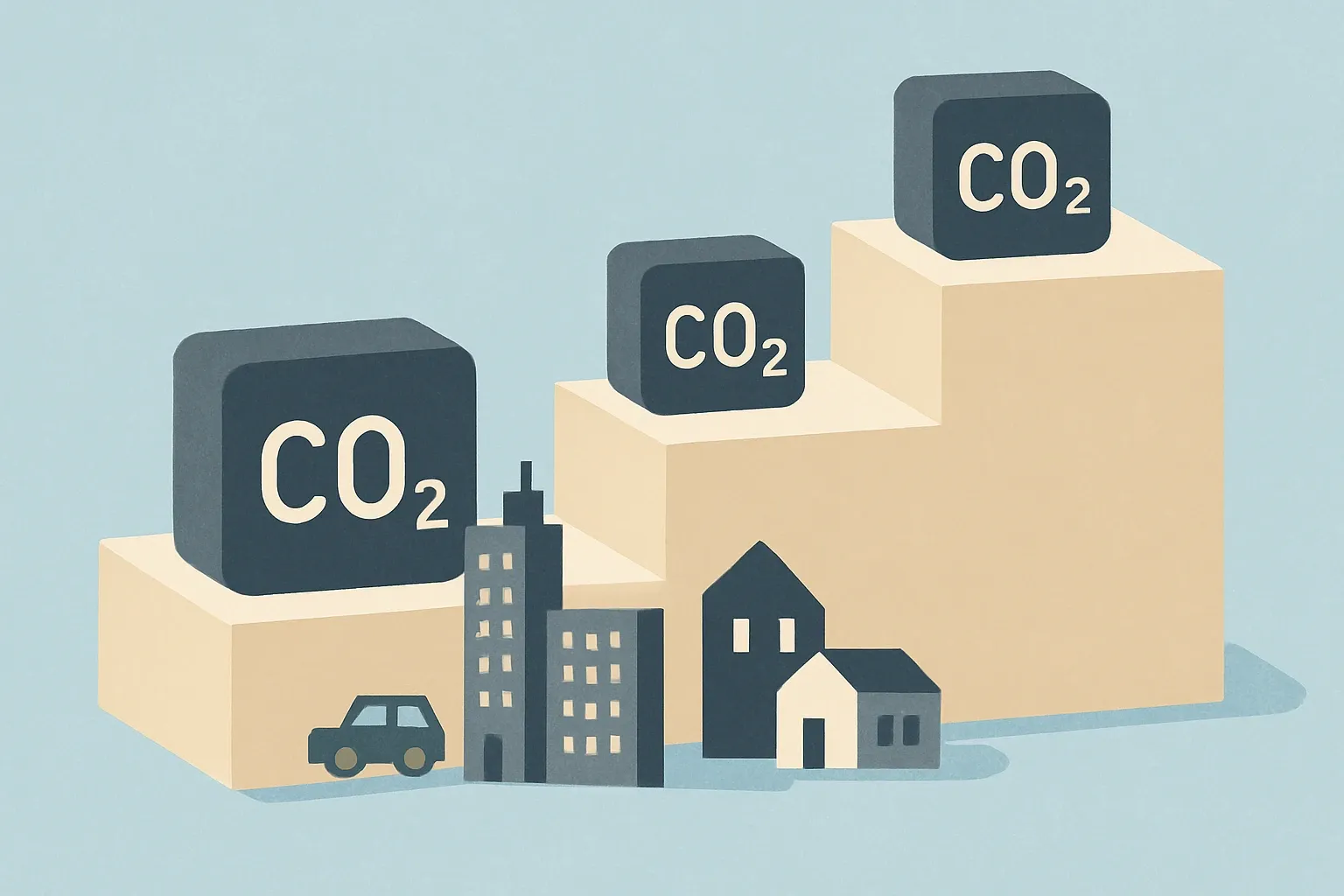
RE2020 is a staircase, not a cliff. Another tightening arrives in 2028, then again in 2031. If you are planning product refreshes or plant upgrades, aim to bank process data now so 2028 recertification isn’t a scramble. The companies that treat 2025 as rehearsal will look calm when 2028 hits, like a team that practiced a two‑minute drill all season.
How to adapt quickly without drama
There is three quick wins manufacturers can act on in parallel.
- Prioritize EPDs where tonnage and embodied carbon run highest. Structure, façades, insulation, cementitious mixes and major MEP dominate Ic construction in most schemes. Replace any defaults in those slots first.
- Make data collection the easy part. Choose an LCA partner who will extract utility bills, production volumes and waste streams from your systems, then project‑manage plant input so your R&D and ops keep building rather than emailing spreadsheets.
- Align to the reference year you can document. For new lines, a prospective EPD can get you into specs now and be refreshed once a full year of production data exists.
A note on “re2020 updates” you will see online
You will see tables, calculators and opinions. Anchor decisions to official markers. The 2025 thresholds are fixed by decree for permits filed from January 1, 2025. ADEME’s observatory summarizes the cross‑sector reductions. The government FAQ clarifies the heat‑network exception window. Everything else is commentary.
Bottom line for specability
FDES and PEP are now table stakes in France. The Ic construction and Ic énergie steps make generic data a liability, especially after the 2025 shift. A focused EPD plan that tackles high‑mass SKUs first, supported by a partner who does the heavy lifting on data, will protect compliance and win more line‑items in French bids. It’s definately worth it.