Public procurement puts climate on the scoreboard
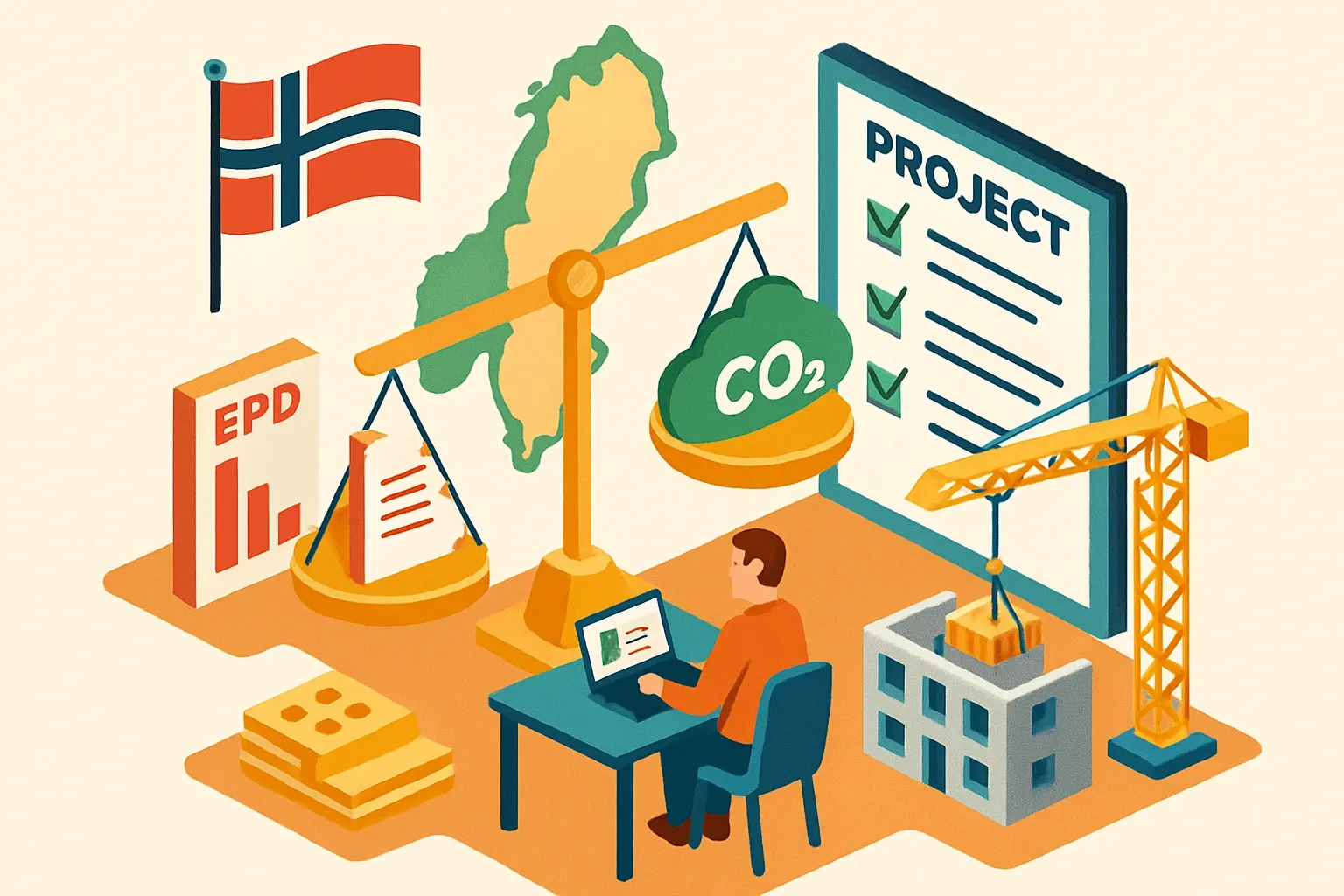
From January 1, 2024, Norwegian contracting authorities must weight climate and environmental criteria at a minimum of 30 percent when awarding contracts, with limited exceptions. DFØ’s guidance explains how buyers apply the rule and how to justify any deviation, which is rare in practice (DFØ Guide, 2025). Early monitoring suggests the share of tenders using the 30 percent weight or environmental criteria rose to about 75 percent in 2024 (OGP, 2025).
What this means commercially is simple. A credible, product‑specific EPD becomes a scoring asset, not a brochure. Sellers without one hand points to competitors before the first technical question lands.
TEK17 makes embodied carbon part of building control
Norway’s building code requires a climate gas account for new residential blocks and non‑residential buildings. The calculation must follow NS 3720 and include A1 to A4, plus B2 and B4 for specified building parts. If project teams cannot source product‑specific data, any generic value must carry a 25 percent uplift, which directly penalizes products that lack EPDs (DiBK TEK17 §17‑1, 2024).
That uplift is the quiet tiebreaker. A product with an EPD can enter the model at its measured GWP. A similar product without one enters higher. Multiply this across concrete, steel, insulation, and interiors and the math changes fast.
Where EPDs live in Norway
EPD‑Norge is the country’s program operator and a founding member of ECO Platform. Its public registry listed 8,240 published EPDs in the portfolio by mid 2025, spanning core construction categories and finishing products (EPD‑Norge, 2025). Manufacturers can also publish with other European operators aligned to EN 15804, but Norwegian buyers and design teams routinely check EPD‑Norge first.
For teams planning multiple declarations, tool‑based EPD workflows are common in Norway’s market. The win is less spreadsheet thrash and faster refresh cycles when PCRs update. That saves engineering time where it really counts.
Navigating Norway’s carbon regulations for project success?
Follow us on LinkedIn for updates that help you secure tenders and stay compliant.
Municipal accelerators you will feel on bids
Oslo has operated fossil‑free sites for years and is now moving toward a regulation that would require at least 30 percent zero‑emission or biogas energy use on major construction sites from 2027, rising to 90 percent by 2030, subject to feasibility tests and exemptions (KlimaOslo, 2025). Even when your customer is a private developer, municipal expectations spill into specs, supplier prequals and site logistics.
Materials spotlight that changes baselines
Cement with carbon capture moved from pilot to market in Norway. Heidelberg Materials’ Brevik line will capture roughly 400,000 metric tons of CO₂ per year and pre‑sold its 2025 evoZero production, supported by the state‑backed Longship and Northern Lights infrastructure. The project’s public funding covers about two thirds of the roughly 30 billion NOK cost, anchoring a new embodied‑carbon pathway in bids (Reuters, 2025).
If concrete is on your bill of materials, expect clients to ask for proof that mixtures reflect the new supply landscape. That proof is usually an EPD.
How manufacturers can align fast
Here is a pragmatic play that respects stretched teams and still hits Norway’s rulebook.
- Map the top twenty SKUs sold in Norway to the TEK17 modules and collect site‑specific utility and material data for a recent twelve‑month period. If a product is new, start with a prospective EPD then backfill to a full year.
- Prioritize categories that dominate A1 to A3 by mass and cost. If you lack EPDs there, TEK17’s 25 percent uplift on generic values makes you look worse on paper.
- Choose a program operator recognized in Norway and align PCRs with what competitors use. This preserves comparability in public tenders and BREEAM‑NOR evidence packs.
Buyer behavior to expect in 2026 tenders
Procurement teams will place climate alongside price and delivery as one of the top award criteria because they must. Many will ask for product‑specific EPDs, not industry averages, to avoid the uplift and to keep TEK17 files audit‑ready. Some state owners publicly report emission cuts year over year, which reinforces this scrutiny. Statsbygg highlighted a 27 percent reduction since 2020 while growing activity, with materials as the biggest lever (Statsbygg release coverage, 2025).
Teams that show clean, verifiable data win time and trust. Teams that send enviromental claims without third‑party verification invite scoring penalties.
Bottom line for specability
In Norway, embodied carbon is no longer a nice‑to‑have slide. Public buyers must score it. Building control requires it. Municipal policy is pushing sites toward zero emissions. EPDs are the currency that makes your product visible in this system and helps your offer move from maybe to yes.