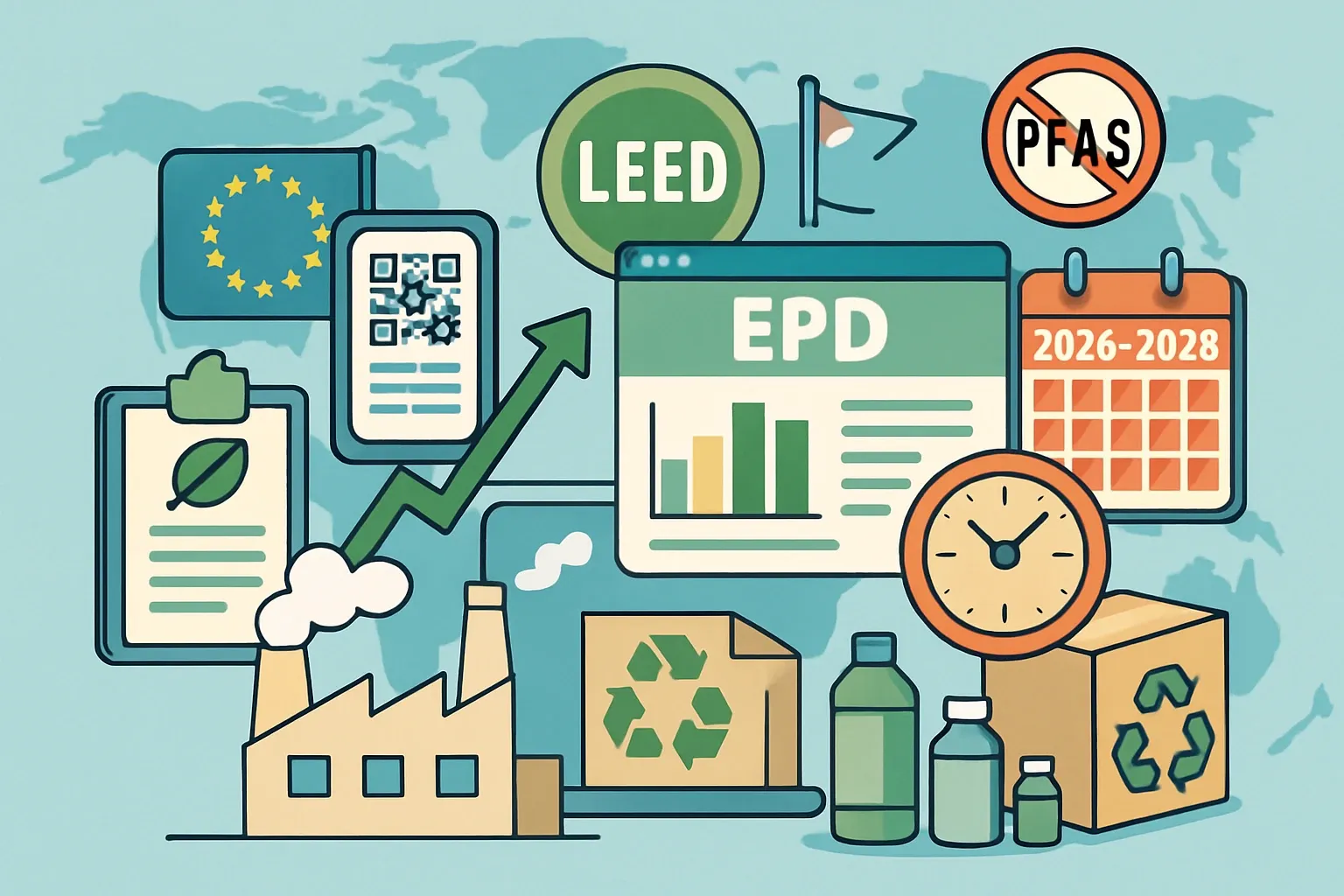
The 2026 to 2028 squeeze, in one view
LEED v5 was ratified by USGBC members on March 28, 2025, with market rollout starting through 2026 activity (USGBC, 2025) (USGBC, 2025). The revised EU Construction Products Regulation applies from January 8, 2026, which begins the long transition to digital product information for construction goods (Government of Ireland, 2026). The EU’s Digital Product Passport registry must be live by July 19, 2026, making machine‑readable product data discoverable to authorities (EUR-Lex, 2024) (EUR-Lex, 2024). The EU also requires life‑cycle GWP disclosure for large new buildings from January 2028, then all new buildings from January 2030 (European Commission, 2025) (European Commission, 2025).
Build a living dataset, not a document graveyard
Think of the EPD as a movie poster and your LCA dataset as the full film. Posters change. The film must stay coherent. Create a product‑level data model that captures site utilities by reference year, batch and recipe variants, supplier materials, transport modes, packaging, and QA links to meters and invoices. Version it. Lock units. Track data owners. That dataset becomes the source of truth for EPDs, RFQs, and regulatory portals.
Sequence work so rules land on ready ground
A clean sequence beats heroics. Do this in order so momentum sticks.
- Publish core product EPDs on the common PCRs used in your category, and normalize facility data into a repeatable model.
- Map your model to jurisdiction outputs such as LEED v5 submittals, EU CPR DoPs, and DPP fields. Use IDs that persist across SKUs and plants.
- Automate refresh and change control so annual rebaselines and supplier swaps do not restart from zero.
Model once, publish many times
Great EPD programs separate data from format. Keep your product inventory modeled by process and site, then push to multiple outputs: Type III EPD, LEED v5 documentation, EU CPR declarations, DPP payloads, buyer scorecards. When a rule changes, you update the mapping, not the plant tour. It feels boring. Boring is fast.
Want to stay compliant and win more specs in the evolving EPD landscape?
Follow us on LinkedIn for insights that help you navigate new regulations and unlock commercial opportunities.
What “LEED v5 ready” looks like at catalog level
LEED v5 rewards product‑specific, third‑party verified Type III EPDs and puts more attention on embodied carbon performance across the spec set. Catalog‑level readiness means coverage on your revenue drivers, clear plant‑to‑SKU traceability, and a simple packet that sales can attach to submittals without hand‑holding. Include declared unit logic, system boundaries, and contact info so reviewers do not bounce your docs on tiny gaps. That saves weeks.
Prep for EU CPR and DPP without guessing every detail
You do not need the final delegated act to start. Align your dataset to stable anchors now. Use persistent product identifiers, record substances of concern, state recycled content and mass balance methods, and store module A1 to A3 GWP with provenance. The CPR applies from January 8, 2026, and construction products will tie into the cross‑sector DPP infrastructure as it phases in through the registry and delegated acts (Government of Ireland, 2026) (EUR‑Lex, 2024).
Don’t ignore U.S. state triggers
California’s SB 54 packaging rulemaking is active, with a 15‑day comment period running January 29 to February 13, 2026 that signals timelines firms must track for producer responsibility planning (CalRecycle, 2026). Minnesota’s PFAS law already prohibits intentionally added PFAS in 11 product categories as of January 1, 2025, and extends to pesticide product registrations beginning January 1, 2026 (MPCA, 2025) (MDA, 2026). If your BoMs, packaging, or coatings could trip these wires, link materials data to compliance flags inside your EPD dataset.
Minimum viable data model for “publish‑anywhere”
Aim for lean and proven, not perfect on paper.
- Product and component IDs that never recycle across versions.
- Site‑level utilities, fuels, and waste for a defined reference year, plus meter evidence.
- Supplier‑specific inputs with transport legs and packaging.
- Impact results by module with library and version references.
- Change log that shows when and why numbers shifted.
Organizational plumbing beats heroics
Real speed is operational. Assign a data steward per plant, a single LCA lead for modeling guardrails, and a reviewer who signs off on units and boundaries. Stand up a quarterly cadence that locks reference data, then pushes updates to operators and portals. Create a short “red file” of high‑risk inputs that can swing GWP so teams know where to focus first. Do this and spec surprises become rare.
Why this matters commercially
Specs are won by teams who can answer carbon questions on the entire catalog, not by a single shiny EPD. Being regulation‑ready is an access strategy. It keeps you in fast‑moving enterprise bids in North America and Europe even as forms evolve. The work is finite. The payoff repeats. And yes, it is definately easier when the heaviest data wrangling is taken off your line teams.