What makes an EPD admissible
An EPD that counts in procurement is a Type III declaration under ISO 14025, developed from a product life cycle assessment and checked by an independent verifier. It must be published by a recognized program operator so specifiers can access the record.
Across construction, alignment with EN 15804 or ISO 21930 is the norm. If your market is North America, ISO 21930 alignment is common. For Europe, EN 15804 is expected.
Scope specifiers actually expect
At minimum, most construction EPDs report cradle to gate results for A1 to A3. Some calls for bids ask for A4 and A5 transport and installation. A few owners go further and request use or end of life modules, but product stage coverage is still the baseline. Clear scoping avoids debates later.
The PCR sets your rulebook
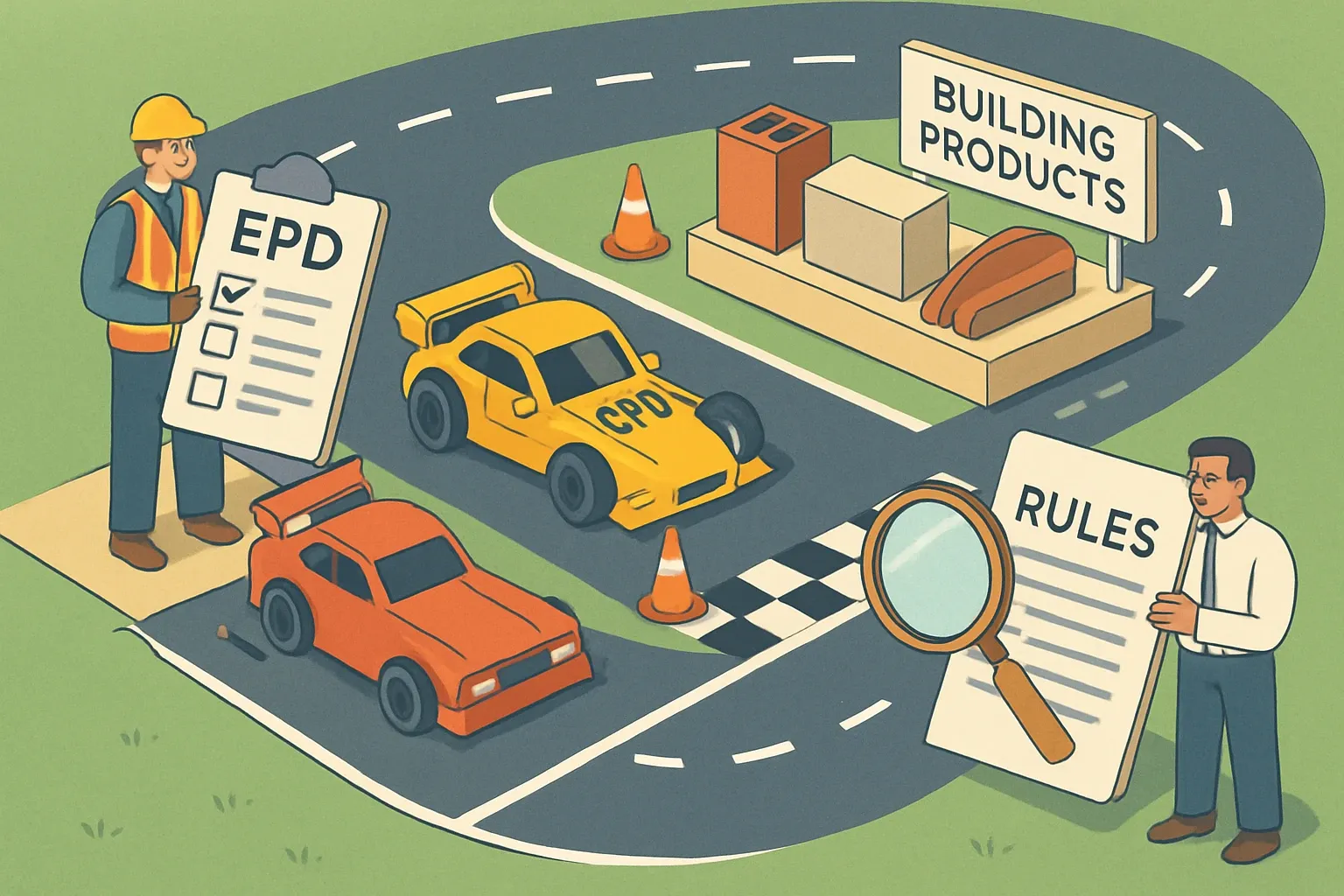
Think of the Product Category Rules as the rulebook of Monopoly. Ignore it and the game falls apart. The PCR defines system boundaries, allocation, data quality, and impact methods for your product family. When several PCRs seem relevant, pick the one your competitors use and that your program operator supports, then check its revision horizon.
Data and evidence you must assemble
Collect one reference year of production data for the declared product and site. That usually means energy by source, purchased materials with suppliers, inbound and outbound transport distances, yields and scrap, water, and waste treatment. For a new line, a prospective EPD can start with partial months and be updated once a full year accrues, provided the PCR allows it.
A great partner does the wrangling and extracts this from ERP, utility bills, and batch records so R and D can keep building product, not spreadsheets.
Want to stay compliant with EPD regulations?
Follow us on LinkedIn for insights that help you win projects and avoid costly pitfalls.
Verification, validity, and renewals
Independent verification is non negotiable for Type III EPDs. Most EPDs are valid for five years, after which they must be reviewed or republished on current rules to stay usable in procurement (ISO 14025, 2006).
PCRs themselves expire on their own cycles. Your EPD does not instantly become invalid when a PCR updates. The next renewal must use the current PCR.
Impact indicators that get checked
Under EN 15804 A2, EPDs report a broader set of indicators, including multiple forms of global warming potential along with acidification, eutrophication, photochemical ozone creation, and resource use. The update increased the core list to 13 environmental impact indicators, which is why buyers now look beyond a single GWP number (EN 15804+A2, 2019).
Where rules require EPDs today
Public owners and large private developers commonly ask for product specific, verified EPDs at bid. Several state and city level Buy Clean policies reference EPDs to demonstrate disclosure and to screen embodied carbon in materials. Federal incentives changed in early 2025, so teams should validate current federal rules for each project and not assume prior IRA era provisions still apply.
Program operator choice and format
Program operators publish and host your EPD, manage review, and ensure format. In the United States, Smart EPD, UL, ASTM, and NSF are widely recognized. In Europe, IBU and Environdec are common. Operator choice should align with your market and the PCR. A credible partner is operator agnostic and will help you publish where your customers actually look.
Avoid delays with these quick checks
Confirm the declared unit matches the PCR and your label claims. Ensure the product name on the EPD is the one your sales team uses in bids. Lock transport assumptions early and document them. Make sure the verifier has seen your allocation logic. A tiny mismatch here can add weeks later, it is annoying and avoidable.
How to pick an LCA partner fit for speed
Look for a team that handles data collection inside your company with white glove discipline. Ask how they project manage facility outreach, and how often they find and correct missing meters or wrong density tables. Favor partners who will work with any operator and who can publish in multiple regions without rework. The right fit definately spares your engineers from becoming part time data clerks.
Bring it together without spinning your wheels
The requirement is simple in principle. A product specific, independently verified, program operator published EPD built on the correct PCR, with product stage coverage and current indicators. Build your playbook once. Then reuse it across your portfolio so every spec that asks for an EPD becomes a fast yes.