What the delegated act actually does
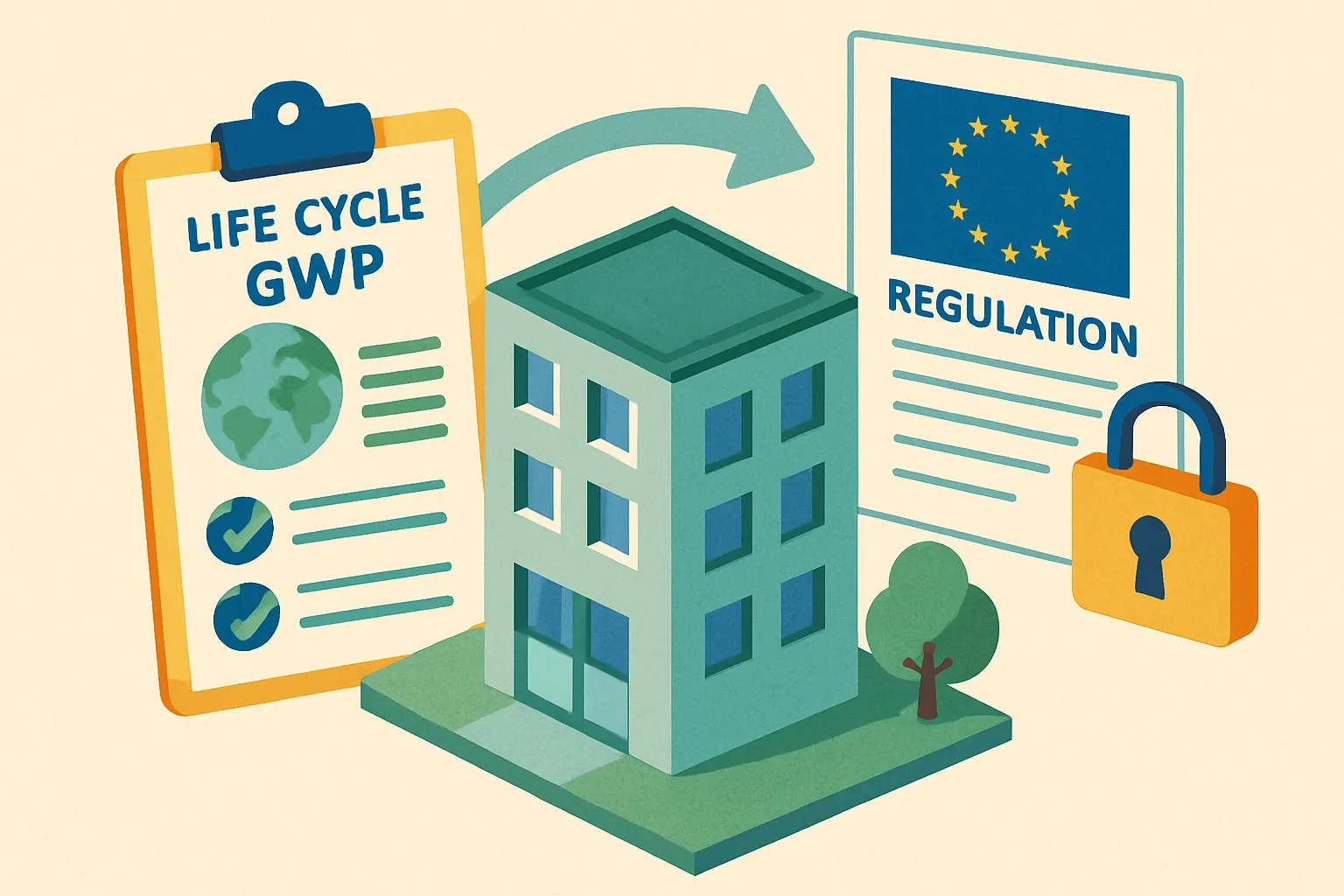
The Commission’s delegated act creates a single calculation playbook for whole‑building GWP, aligned to EN 15978, with results disclosed in each building’s Energy Performance Certificate. It also spells out how national default values and manufacturer data interact so numbers are comparable across countries. Buildings already drive about 40% of EU energy use and over one third of energy‑related emissions, so a common method is a big deal (European Commission, 2024) (European Commission, 2024). citeturn0search5turn0search6
The two dates that matter
From January 1, 2028, life‑cycle GWP disclosure becomes mandatory for new buildings over 1,000 m². From January 1, 2030, the rule covers all new buildings. Member States must show the figure on EPCs, so it will sit next to energy ratings that owners and lenders already read (European Commission, 2025) (European Commission, 2025). citeturn0search2turn0search1
- Over 1,000 m² new buildings: January 1, 2028
- All new buildings: January 1, 2030
A data hierarchy that rewards EPDs
The annex directs teams to use construction product data available under the Construction Products Regulation, with compatible Ecodesign and Energy Labelling data where relevant. It explicitly encourages product‑specific and project‑specific data of higher quality, while telling countries to make generic and default values conservative so they never out‑compete specific data. That is a quiet, powerful nudge toward verified EPD inputs (European Commission, 2025) (European Commission, 2025). citeturn3view0
EN 15978 alignment without the jargon
The act mirrors EN 15978 principles and locks a 50‑year reference study period, reporting in kg CO₂e per square metre of useful floor area. In practice, that means A1 to C stages are in scope, with clear rules for when default scenarios can fill gaps. Your building number must reflect the as‑built design, not a napkin sketch (European Commission, 2025). citeturn3view0
Are EU regulations affecting your project bids?
Follow us on LinkedIn for updates that help you stay compliant and competitive in the market.
Why this tilts specs toward manufacturers with EPDs
EPCs will carry a single, comparable GWP figure. Designers know that plugging generic factors can inflate totals, so they will hunt for verified, product‑specific data to keep projects competitive. If a competitor has current, third‑party‑verified EPDs and you do not, you are asking the team to accept pessimistic assumptions. That gets products sidelined before price even enters the chat.
Construction waste and the materials moment
Construction and demolition waste represents about 40% of the EU’s total waste stream, so shifting product choices at design time is a huge lever (European Commission, 2025). The delegated act aims to make that lever visible in every EPC, which is why materials data quality suddenly matters so much. citeturn0search2
Fastest path to readiness
- Map exposure. List SKUs that appear on EU projects. Prioritise high‑volume products and any lines marketed as low‑carbon.
- Lock your reference year. Pull utilities, production volumes, yield, scrap, inbound freight, and packaging for a clean 12 months. For new lines, start prospective and plan a refresh when a full year exists.
- Close supplier data gaps. Request mill certs, upstream EPDs, and transport modes early. Offer templates so vendors answer in your format.
- Choose the right PCR. Match the norms in your category so specifiers can compare apples to apples.
- Publish with a recognised program operator in your target market. Keep renewal dates on a single calendar.
Choosing an LCA partner that spares your team
Look for ruthless efficiency in data wrangling and factory coordination, not just modelling skills. The partner should quarterback requests across operations, procurement, and EH&S, then deliver third‑party‑verified EPDs on a timetable that matches bid cycles. Speed, completeness, and reliability beat a bargain fee that consumes your engineers’ time. It sounds simple, but it is definately not.
Mind the connectors CPR and Digital Product Passports
The annex ties building‑level carbon math to product data governed by the Construction Products Regulation and by Ecodesign for Sustainable Products. That creates a cleaner handshake with future Digital Product Passport schemas, where product‑level attributes travel with each item. Expect fewer bespoke spreadsheets and more machine‑readable declarations as rules mature.
Open questions to watch
Countries must publish roadmaps for possible GWP limit values by 2027, and they will set national default values that influence early calculations. Watch how each market recognises product‑specific data from other Member States, and how temporary default scenarios are used on complex MEP systems (European Commission, 2025). citeturn0search2
Bottom line for manufacturers
This is a binding step that puts life‑cycle carbon on every new‑build EPC, first for larger projects in 2028, then for all in 2030. Teams that show up with current, product‑specific EPDs will make life easier for designers and cut the risk of being swapped out late in the game. The revenue upside of being specified more often usually dwarfs the credential cost once, sometimes with a single mid‑sized win.