What Denver is testing now
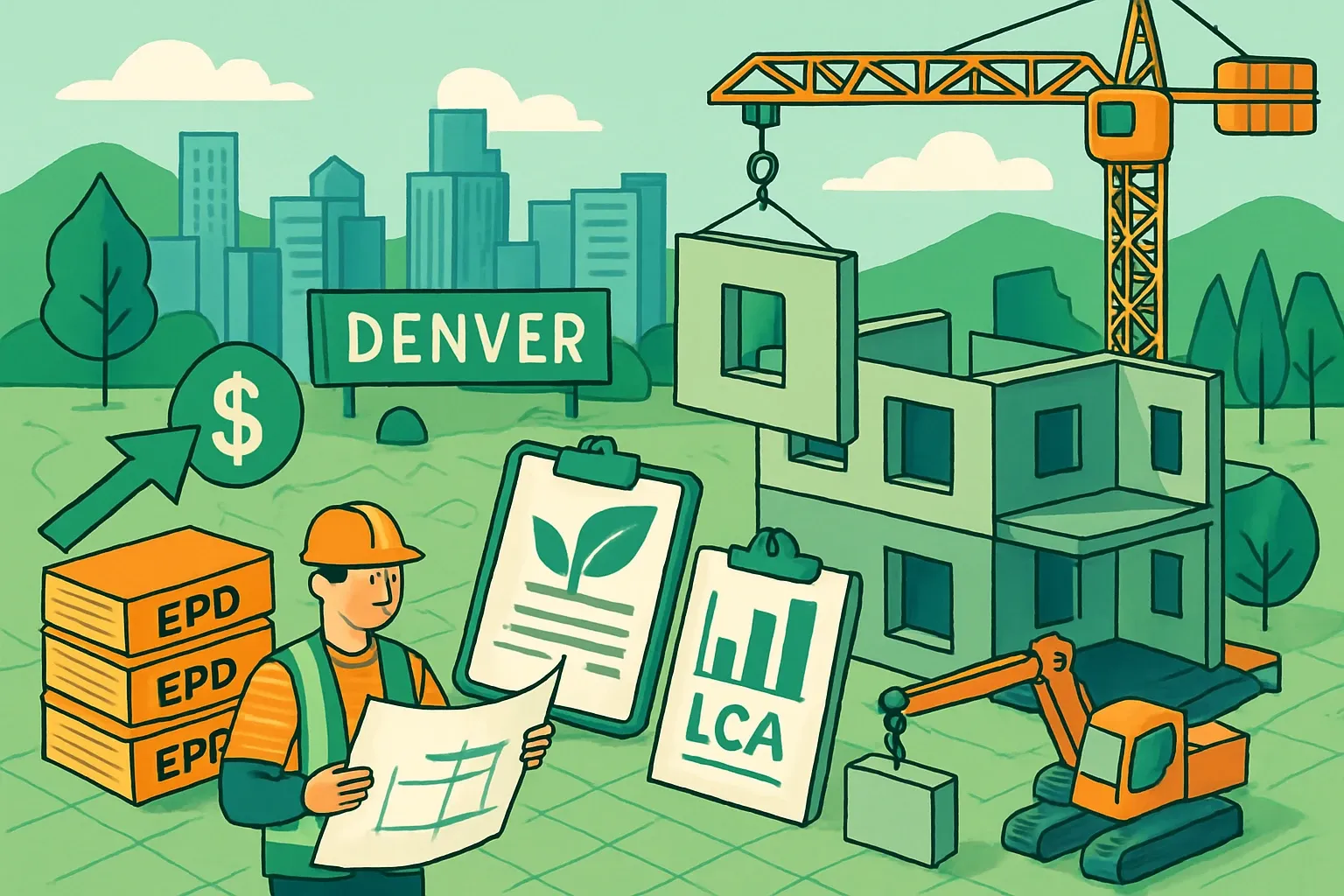
Denver’s Climate Action, Sustainability and Resiliency office launched a voluntary Embodied Carbon Pilot that funds projects which document whole‑building LCA, submit EPDs for key materials, and hit defined reduction targets. Dollars flow from the city’s Climate Protection Fund, which raises at least 40 million dollars per year from a voter‑approved 0.25% sales tax (City and County of Denver, 2025) (City and County of Denver, 2025). The goal is simple: gather real Denver market data on embodied carbon and scale the tactics that actually reduce it.
Where the numbers land
Independent analyses show common design and procurement choices can trim upfront embodied carbon 20 to 40 percent with negligible cost impact in many building types (RMI, 2021). That range is enough to move a project from “interesting” to “fundable” in a competitive pilot. Manufacturers who can document consistent double‑digit reductions against category baselines will see their submittals land first on a busy estimator’s desk.
State policy turbocharges EPD demand
Beyond the city pilot, Colorado’s Buy Clean policy already requires EPDs on eligible materials for state projects and asks teams to select products under maximum GWP limits starting with 2024 design work (OSA, 2025) (OSA, 2025). This creates a single language for carbon in specs: verified EPDs with clear cradle‑to‑gate GWP. Even private developers lean on the same documents to keep bids smooth and to hedge against local requirements arriving next cycle.
A regional tailwind you should not ignore
The Denver Regional Council of Governments is running a multi‑year building policy collaborative funded by a 199.7 million dollar Climate Pollution Reduction Grant that supports higher‑performance codes and standards through 2029 (DRCOG, 2024) (DRCOG, 2024). Translation for suppliers: more jurisdictions in the Front Range will speak in EPDs, PCRs, and WBLCA results.
Concrete, steel, and MEP: the fast‑win trio
Concrete mix design, mill choice for steel, and thoughtful MEP product selection are the quickest levers in new construction. Typical project studies show combined strategies in these packages can deliver the bulk of a 20 to 40 percent reduction without exotic materials or delays (RMI, 2021). Expect Denver project teams to ask for cement‑reduction options, EAF or higher‑recycled content steel, low‑GWP insulations and refrigerants, and transparent A4 transport assumptions.
Want to unlock Denver project opportunities?
Follow us on LinkedIn for insights on EPD compliance and strategies to boost your spec rate.
Why EPDs turn into bids in this market
When a GC or owner must demonstrate reductions to unlock pilot funding, a product without a current, product‑specific Type III EPD often forces them to plug in conservative defaults. That is a scoring penalty and a schedule risk. A reliable EPD removes both, which keeps your SKU from being swapped late in precon. One mid‑sized Denver project win can easily dwarf the cost of getting an EPD off the ground, and teams rarely see the bids they lost because the paperwork was missing.
Picking the right PCR and operator
In most categories, the fastest path is to align with the PCR competitors already use, then publish through a recognized operator common to the US or EU so submittals glide through reviewers. Watch renewal timing so draft updates do not collide with your bid calendar. If a PCR gap exists, generic construction material PCRs can bridge while an industry‑specific rule evolves.
Data collection without derailing production
Whole‑building LCA pressure means buyers will probe your assumptions. Tighten the plant data pipeline around a clear reference year, clean utility bills, transport modes and distances, recycled content attestations, and waste factors. For brand‑new lines, a prospective EPD can get you into specs now, then you refresh once a full year of production data closes. The operational lift should not fall on your most valuable engineers for weeks on end, otherwise the opportunity cost on product work stacks up fast.
Timelines and risk management
EPDs generally carry multi‑year validity, yet what really matters in Denver is having them current before schematic design locks the shortlist. If you sell into mixes, assemblies, or kit systems, stagger renewals so there is always at least one compliant path available during peak bid season. Keep an eye on PCR updates so re‑issued EPDs do not slip right before a guaranteed maximum price. Do not wait until value‑engineering to hunt for carbon wins, they are cheapest to capture during early design.
How to show up ready on Denver pilots
- Ship product‑specific EPDs with clear SKUs and plant scope so submittals are copy‑paste friendly for WBLCA tools.
- Offer two low‑carbon alternates that preserve performance and lead times, each with documented GWP deltas.
- Publish a one‑page “EPD use guide” that explains declarations, allocation choices, and transport assumptions.
The upshot for manufacturers
Denver is turning embodied carbon from theory into procurement criteria. The signal is strong, backed by recurring city funds and statewide rules that normalize EPD‑based selection. If your declarations are easy to verify and your plants can evidence credible reductions, spec friction drops, and win rates rise. If not, even great products get sidelined by paperwork. That would be a shame, really.