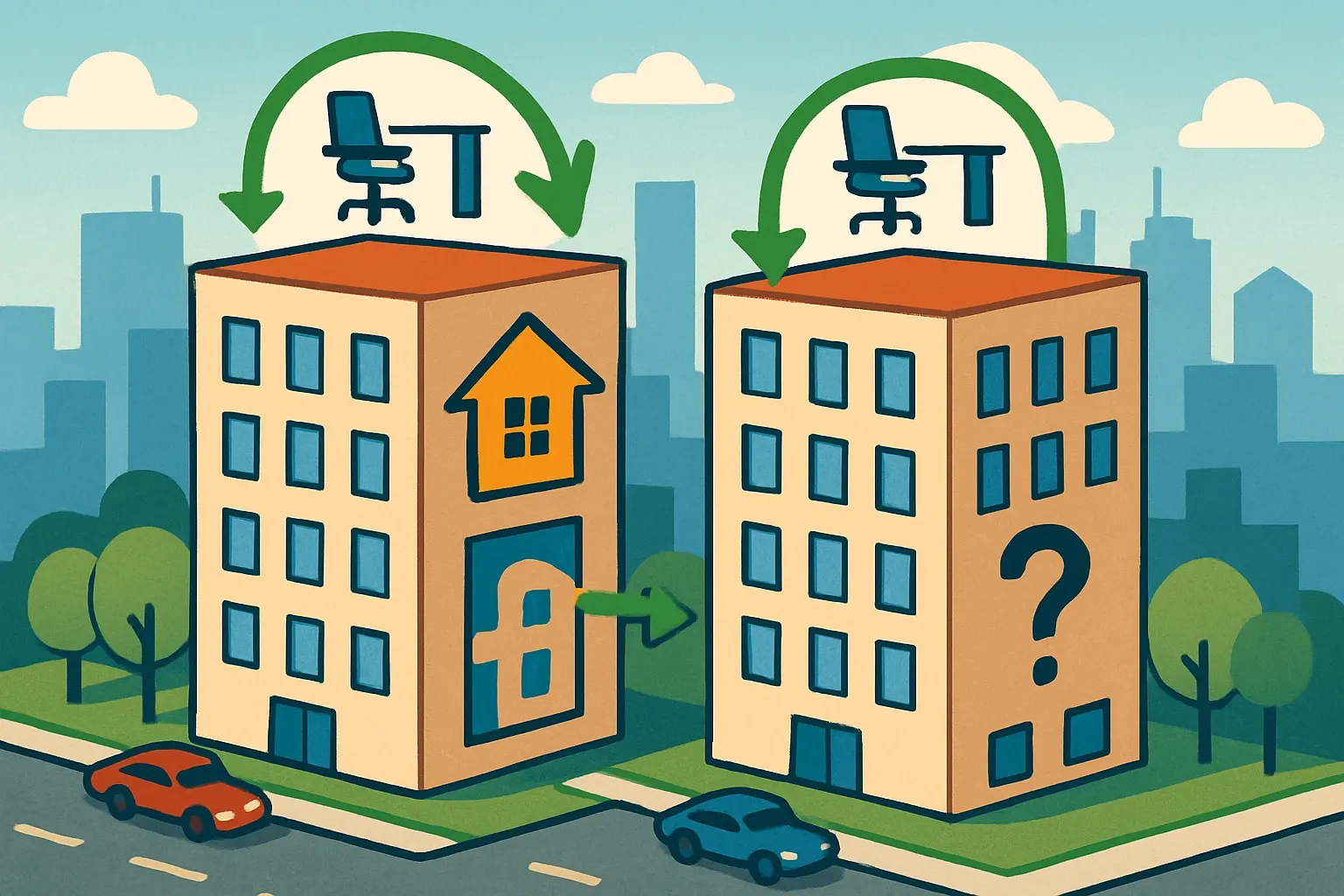
The two programs in plain English
Housing in Downtown gives qualifying office-to-residential projects a 20‑year property tax abatement with program caps that ramp from 2.5 million dollars total across FY24 to FY26, to 5 million in FY27, then 41 million in FY28, with 4% annual growth afterward (Housing in Downtown page, DMPED, 2025) (DMPED, 2025). The law was refined in December 2024 to require competitive awards and extend some timelines (D.C. Law 25‑257, 2024) (D.C. Law 25‑257, 2024).
Office to Anything targets non‑residential conversions of idle offices into hotels, retail, entertainment, and other uses. It offers a 15‑year temporary property tax freeze with a competitive cap that starts at 5 million dollars for 2027, 6 million for 2028, and 8 million for 2029, then grows 4% annually (DOB press release, 2024) (DOB, 2024). The eligible area tracks DC’s Central Washington planning area, which includes all of Downtown and portions of NoMa and Southwest (DOB, 2024).
Why manufacturers should care
These incentives move stalled buildings back into design and permitting. That means fit‑out heavy scopes where material choices are still malleable. Architects will be looking for low‑carbon options they can align to LEED v5 pathways and owner ESG targets without slowing schedules.
If your products have current, third‑party verified EPDs, you help teams avoid defaulting to conservative assumptions that add a penalty in whole‑building carbon accounting. You also become easier to spec for procurement teams that now screen for enviromental proof early, not late.
The housing goal boosts near‑term demand
DC expects Housing in Downtown to deliver most of the goal to add 15,000 new residents Downtown by 2028, estimating roughly 90% of that target through conversions if the pipeline holds (DMPED, 2025) (DMPED, 2025). More residents means more code updates, more MEP retrofits, more interior buildouts.
Want to stay competitive in DC's evolving market?
Follow us on LinkedIn for insights on how EPDs can unlock new opportunities and boost your project specs.
Where EPDs matter most in conversions
Conversions reuse the structure, so interiors and systems dominate the carbon conversation. Prioritize product‑specific EPDs for categories that show up repeatedly across floors and units:
- Gypsum panels, metal studs, insulation, acoustic ceilings
- Flooring systems and adhesives
- Interior paints and coatings
- Doors, glazing refurb kits, window replacements
- HVAC heat pumps, VRF components, and controls
Module A1 to A3 usually carry most of the impact for these products. Reliable transport and installation data for A4 to A5 helps owners model project‑level reductions with fewer assumptions.
Speed plays that keep you in the spec
If a retrofit line is new, consider a prospective EPD with an initial few months of production data, then refresh once a full year is available. Teams that can take over data wrangling across plants, suppliers, and utilities keep internal engineers focused on design tweaks that actually cut impacts rather than chasing spreadsheets.
Picking the right rulebook without drama
Your PCR choice should mirror the competitive set used by peer products and the program operator your customers already trust. In the US, many owners accept publications from Smart EPD, while European‑tied portfolios often prefer IBU. Agnostic publishing is fine as long as verification is robust and the PCR aligns to the product family and timeline.
Mind the caps, then work backward from bid dates
Both programs are competitive and capped, so being early helps. Permitting and financing gates push teams to lock specs faster than on ground‑up projects. That favors manufacturers with EPDs already on the shelf, or a clear, low‑friction plan to publish before the construction documents freeze.
Bring it together
DC’s pair of incentives creates predictable demand for conversion‑ready materials with transparent footprints. Line up your EPD roadmap to the scopes that repeat across office floors, keep data collection painless, and you will be speficied more often when Downtown buildings get a second act.