What this law actually does
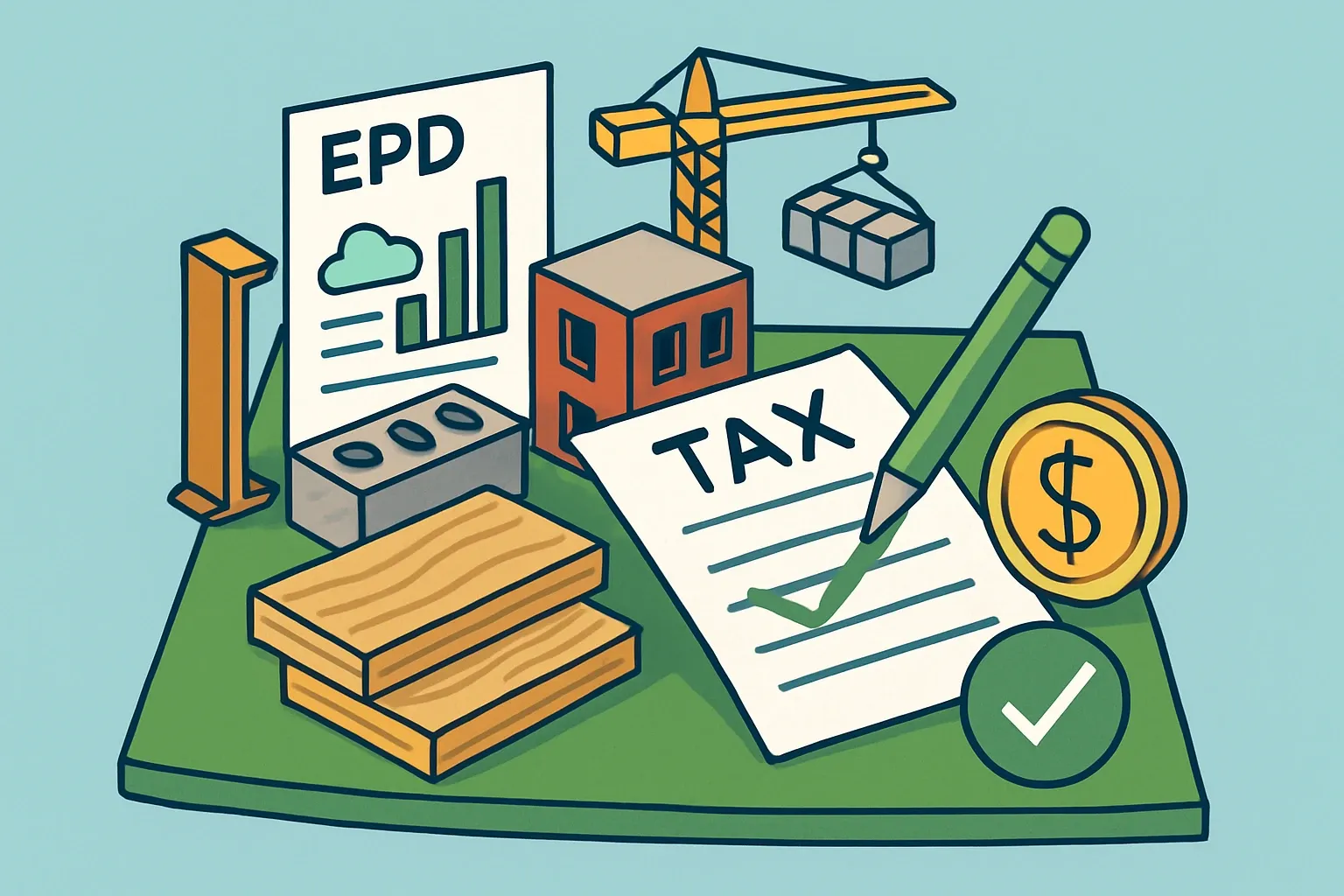
SB 22-051 created a state sales and use tax exemption for eligible decarbonizing building materials. The exemption started on July 1, 2024 and applies to all sales statewide that meet the rules, not only public projects (Colorado Revised Statutes 39 26 731, 2024) (CRS 39 26 731, 2024). The state rate is 2.9 percent so that is the line you can remove from qualifying invoices (Colorado General Assembly, 2025) (Colorado General Assembly, 2025).
EPDs are your ticket to the exemption
Colorado ties the tax break to embodied carbon. Products must have a current Type III EPD aligned to ISO 14025, ISO 14040, ISO 14044, and ISO 21930 and the EPD’s GWP value must be at or below the state limit for that material category (OSA Buy Clean Colorado Act Policy, 2025) (OSA Policy, 2025). If you already publish credible EPDs, you are halfway to the finish line.
Which materials qualify
Eligible categories today include asphalt and asphalt mixtures, cement and concrete mixtures, glass, post tension steel, reinforcing steel, structural steel, and wood structural elements. The Office of the State Architect sets the maximum GWP limits per category and updates the limits on a set cycle.
The list that unlocks tax free sales
A product only gets the exemption if it appears on the state’s Eligible Decarbonizing Building Materials list used by sellers at checkout. Manufacturers submit EPDs to the Office of the State Architect. The office reviews and shares list updates with the Department of Revenue, beginning August 2024 and then on the first Monday of each month (OSA Sales and Use Tax Exemption, 2024) (OSA SUTS Exemption, 2024). Plan for at least one week of state review after submission before sellers can see your items in the system (OSA SUTS Exemption, 2024).
Local taxes still matter
The exemption is for the state portion. Some local jurisdictions may also exempt the same items if they choose to adopt the language, others may still charge local tax. Your sales ops team should verify location specific rates in the state’s GIS tool before quoting or invoicing.
Want to leverage Colorado's EPD tax exemptions for your products?
Follow us on LinkedIn for updates on compliance and strategies that help you win bids and unlock new revenue.
How to get on the list fast
- Confirm the right material category and the applicable GWP limit from the OSA resources.
- Produce a product specific Type III EPD that follows the relevant PCR and reports GWP for stages A1 to A3.
- Submit the EPD and product details through the OSA EPD submission process. Manufacturers recieve confirmation requests if clarifications are needed.
- Watch for the next monthly refresh so sellers can recognize your products automatically in SUTS.
Timelines you should mark
The exemption applies to qualifying sales on and after July 1, 2024 (CRS 39 26 731, 2024). The Office of the State Architect must review GWP limits by January 1, 2026 and then every four years, which can ratchet thresholds downward over time (OSA Policy, 2025). The statute that created the exemption is scheduled to repeal on July 1, 2034 unless extended, so build this into pricing and long term product plans now (CRS 39 26 731, 2024).
Turning policy into revenue
This is a clean pricing story for teams that sell concrete, steel, glass, or wood elements. At the 2.9 percent state rate, a one million dollar qualifying shipment keeps roughly twenty nine thousand dollars in the buyer’s budget that can tip a bid your way, and a one and one half million shipment saves about forty three thousand five hundred dollars. Local taxes may still apply, yet the state line item alone is real money.
Common confusion to clear with buyers
SB 22 051 also created assignable income tax credits for heat pumps and energy storage. Those credits are separate from the building materials exemption and they do not affect whether an EPD based product qualifies for the sales and use tax break on materials. Keep the conversations separate so no one misfiles paperwork.
What to ask your LCA and EPD partner
Choose a partner that will organize plant data collection across shifts, translate it into a defensible LCA, and publish a Type III EPD with a respected program operator. Ask if they will map your products to Colorado’s categories, pre check against current GWP limits, and manage the submission package so your SKUs show up in the seller database without a scramble.
Final take for manufacturers
Colorado’s rule rewards teams that turn embodied carbon transparency into a sales lever. Publish strong EPDs, get listed, and give sales an extra closing tool that competitors without EPDs cannot match. The paperwork is the work, yet the payoff shows up on every qualifying invoice.