CleanBC in plain English
B.C. is driving to cut province‑wide emissions 40% below 2007 levels by 2030 (Province of British Columbia Climate Change, 2025). Within that, buildings and communities are slated to reduce more than half by 2030, which puts materials and design choices squarely in the spotlight (Province of British Columbia Buildings and Communities, 2025).
Operational rules tighten, embodied carbon follows
The Zero Carbon Step Code sets a timeline to make all new buildings zero‑carbon by 2030. The first rung, EL‑1, is already in force for new permits issued on or after March 10, 2025, requiring modeled and disclosed operational GHGs for most new buildings (Province of British Columbia Zero Carbon Step Code, 2025). When operations get cleaner, embodied carbon becomes the tiebreaker in specs.
Where you will see embodied carbon in the wild
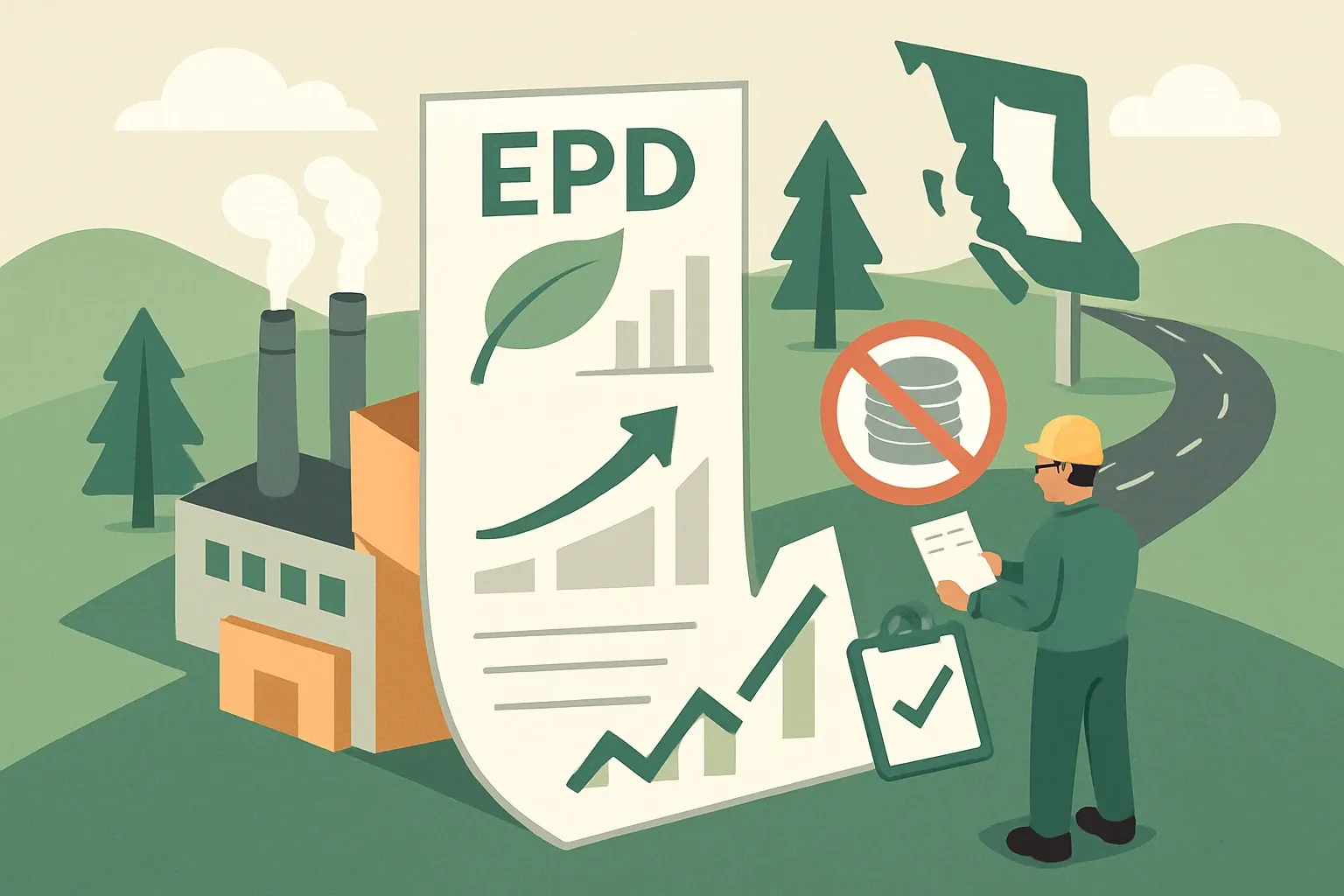
Municipalities are moving. Vancouver’s Building Performance Standard brings onsite carbon limits to large existing commercial buildings starting in 2026, with office at 25 kg CO2e/m²‑year and retail at 14 kg CO2e/m²‑year, pushing electrification and favoring low‑carbon materials in retrofits (City of Vancouver Energize Vancouver, 2026). The City of Langford already requires Type III, third‑party verified EPDs for concrete on city projects, making transparency a de‑facto bid requirement.
Federally, Canada’s Treasury Board updated its Standard on Embodied Carbon in Construction in 2025 to add whole‑building LCA and requirements for structural and reinforcing steel. That expands the circle of materials where EPDs and category‑specific rules will matter in federal work.
Why this changes your sales math
When projects track embodied carbon, products without product‑specific EPDs can trigger conservative defaults or percentage adders, which makes them less competitive even before price is discussed. In Vancouver, buildings represent nearly 60% of citywide emissions, so owners are under pressure to decarbonize envelopes and systems now (City of Vancouver Energize Vancouver, 2026). Showing dependable EPD data shortens the back‑and‑forth and keeps you in play.
Want to stay ahead of CleanBC's new requirements?
Follow us on LinkedIn for insights that help you navigate regulations and secure more specifications with product-specific EPDs.
Dates that should be on your wall
- March 10, 2025: EL‑1 measure‑and‑disclose requirement applies to most new buildings in B.C. (Province of British Columbia Zero Carbon Step Code, 2025).
- 2026: Vancouver onsite GHGi limits begin for large offices and retail, tightening future retrofit specs (City of Vancouver Energize Vancouver, 2026).
- 2030: All new B.C. buildings must be zero‑carbon at start of construction (CleanBC Zero‑Carbon Buildings, 2025).
- 2032: All new B.C. buildings must be net‑zero energy ready under the Energy Step Code (CleanBC Net‑Zero Energy Ready, 2023).
What counts as proof in B.C.
EPDs, full stop. For concrete, steel, wood products, insulation, glazing, and finishes, owners and cities are increasingly asking for product‑specific, third‑party verified Type III EPDs that follow the dominant PCR for your category. The federal standard’s 2025 update also signals WBLCA deliverables on major projects, so your declarations need to plug cleanly into building models.
Prep checklist to de‑risk bids
- Map product lines to PCRs competitors already use, then confirm expiry windows so renewals do not collide with 2029‑2030 project peaks.
- Lock your LCA reference year and orgainze plant‑level data sources early, including electricity mix, fuels, transport, and waste streams.
- Build a short path to publish under a program operator your customers accept in Canada and cross‑border work in the U.S.
- Package EPDs so specifiers can verify quickly, including digital access and version control.
The energy backdrop still matters
CleanBC’s Low Carbon Fuel Standard keeps ratcheting down fuel carbon intensity, with diesel and gasoline targets 18.3% below baseline in 2025, which lowers upstream emissions in freight legs you report in LCAs (Province of British Columbia LCFS Requirements, 2025). Cleaner logistics can help your next EPD beat your last one without plant changes.
Choosing an LCA and EPD partner, B.C. edition
Prioritize partners who do the heavy data lifting across plants and ERP systems so your engineers stay focused on production. You want speed to publish, credible modeling, and operator‑agnostic publishing to fit different owner preferences. Ask for proactive PCR tracking, renewal roadmaps timed to 2030 milestones, and the ability to compile WBLCA‑ready datasets that slot into city or federal templates.
Bring it home
Set a 90‑day plan. Pick the first three SKUs that move volume in B.C., collect one clean data year, select the prevailing PCR, and publish. Then rinse for adjacent mixes or assemblies. With the Roadmap clock ticking and municipal policies stacking up, the manufacturers who make carbon easy to verify will keep winning specs while others are still explaining what they meant to do.