What AB 2446 actually does
AB 2446 tasks the California Air Resources Board with measuring and then cutting the embodied greenhouse gas emissions of materials used in new buildings. The current roadmap sets three anchors. Adopt the measurement framework by December 31, 2026. Publish a sector strategy by December 31, 2028. Hit a 40 percent net reduction in building‑material emissions by December 31, 2035 (CARB Staff Presentation, 2025).
Why this matters commercially
Embodied carbon already represents a large slice of building emissions, and it grows as operations decarbonize. Globally, buildings drive about 39 percent of energy‑related emissions, with 28 percent from operations and 11 percent from materials and construction (WorldGBC, 2024). Teams that can show credible, third‑party verified EPDs avoid punitive default assumptions during carbon accounting and stay competitive in specs where targets are tight.
Who will likely report first
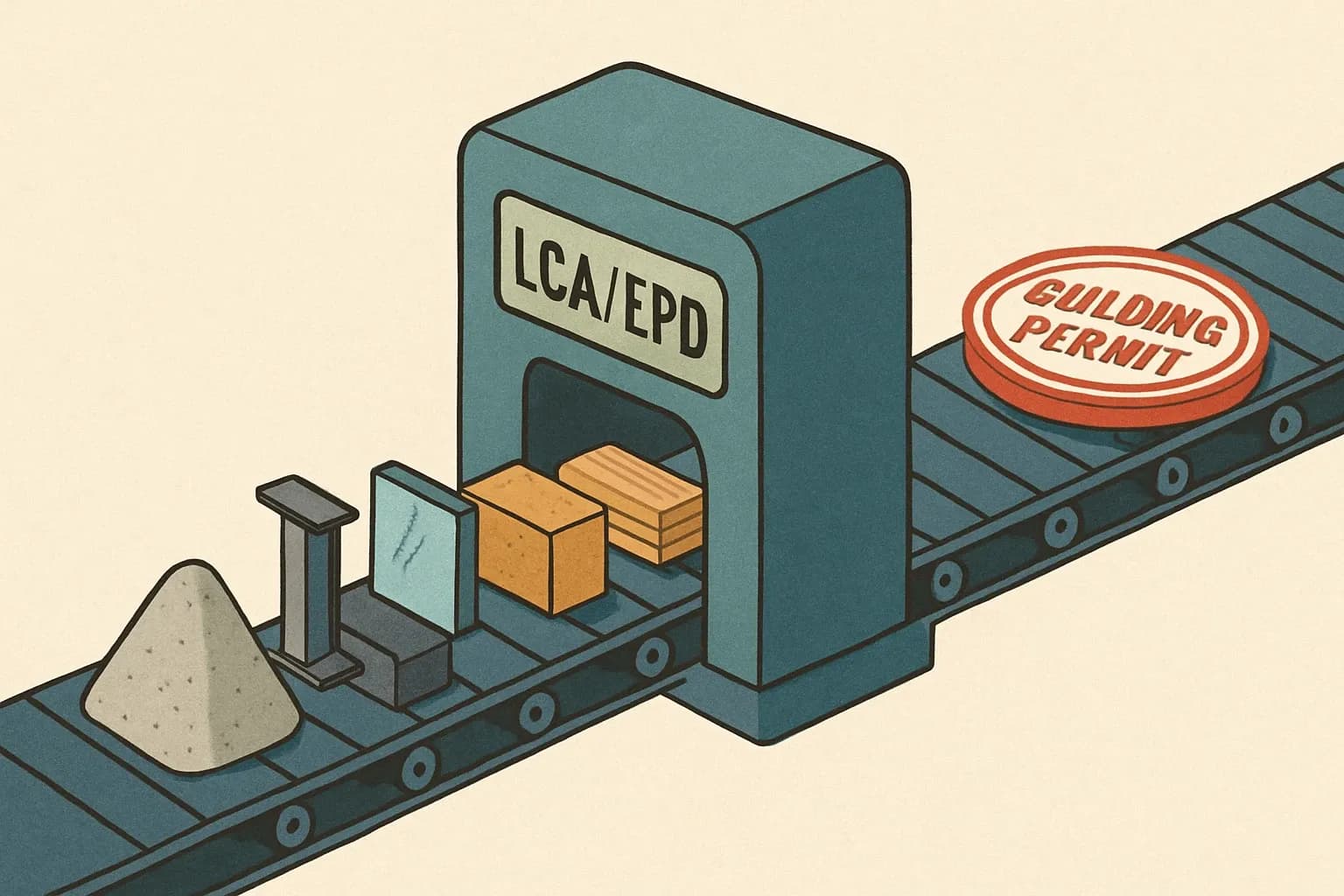
CARB’s staff concept focuses early reporting on high‑impact materials, phasing in categories already familiar to green procurement programs. Phase 1 reporting covers the 2026 data year for these sectors, with submissions due in early 2027. Materials include:
- Cement and concrete
- Iron and steel products
- Glass products
- Asphalt pavement and shingles
- Insulation
- Wood and wood products
That sequencing, and the due‑by‑Q1‑2027 milestone, appear in CARB’s October 30, 2025 technical slides (CARB Staff Presentation, 2025).
Navigating California's new EPD regulations?
Follow us on LinkedIn for straightforward updates that keep you compliant and competitive.
Project and manufacturer triggers to watch
The statute anticipates two reporting lanes. Covered projects submit material quantities and, for larger nonresidential jobs, a whole‑building LCA. Manufacturers submit EPDs or similarly robust LCAs. Staff materials reference thresholds of five or more new residential units or 10,000 square feet of new nonresidential space for project reporting, and propose revenue screens for manufacturers and importers to determine who reports. The slides show $10 million for manufacturers and $1 million for importers as a working concept, not final rule (CARB Staff Presentation, 2025).
EPDs are the language of compliance
CARB explicitly calls for Environmental Product Declarations to quantify product‑level carbon. Staff propose accepting several reporting methods initially then moving to EPD‑only reporting starting with the 2030 reporting period. If your category lacks consistent, current EPDs, expect conservative default intensities that make bids harder to win (CARB Staff Presentation, 2025).
Practical prep: make data collection painless
Most delays come from chasing plant data. Pick a partner who will actually gather utility bills, mass‑balance flows, and supplier EPDs across facilities, not just hand you a template to fill. Agree on a clean reference year, align on the right PCR that peers are using, and decide early where the EPD will be published so reviewers and formats are locked. Sales should flag projects that will need an EPD months ahead, otherwise you find out at submittal time and everyone scrambles.
Fast wins manufacturers can bank now
Set up a single source of truth for meter data, fuels, and production volumes. Map which SKUs roll into which EPDs so you avoid rework when formulations shift. Ask suppliers for upstream EPDs and verification timetables. Run a screening LCA to spot the biggest levers, like clinker substitution in cement or scrap content in steel, then prioritize the two or three interventions that move the needle the most. Teams often recieve the benefits within one bid cycle when the EPD removes a carbon penalty from procurement models.
How this plays with other buyers
California’s CALGreen updates already nudge embodied‑carbon accounting on certain projects, and federal buyers are sharpening EPD quality expectations for concrete, asphalt, glass, and steel under EPA’s C‑MORE program. That alignment means cleaner, verifiable EPDs open more doors with public owners and private developers at the same time (EPA C‑MORE 2024).
Deadlines without the drama
Treat 2025 to mid‑2026 as your EPD build window. Use 2026 as your first complete reporting year for Phase 1 materials if you are in scope, with submissions due shortly after year‑end. Watch CARB’s rulemaking, because definitions like “covered project,” the final revenue thresholds, and data schemas will be finalized in regulation. The headline goal remains a 40 percent net cut in building‑material emissions by 2035, and the measurement rails are being laid now (CARB Staff Presentation, 2025).
Bottom line for specability
EPDs will become table stakes for California projects that meet the coverage thresholds. Get them done with a process that removes friction inside your organization, so R&D and plant leaders can focus on actual reductions while the paperwork keeps pace. It is easier to stay in the spec when your carbon numbers are credible, current, and easy to verify.