What the law actually does
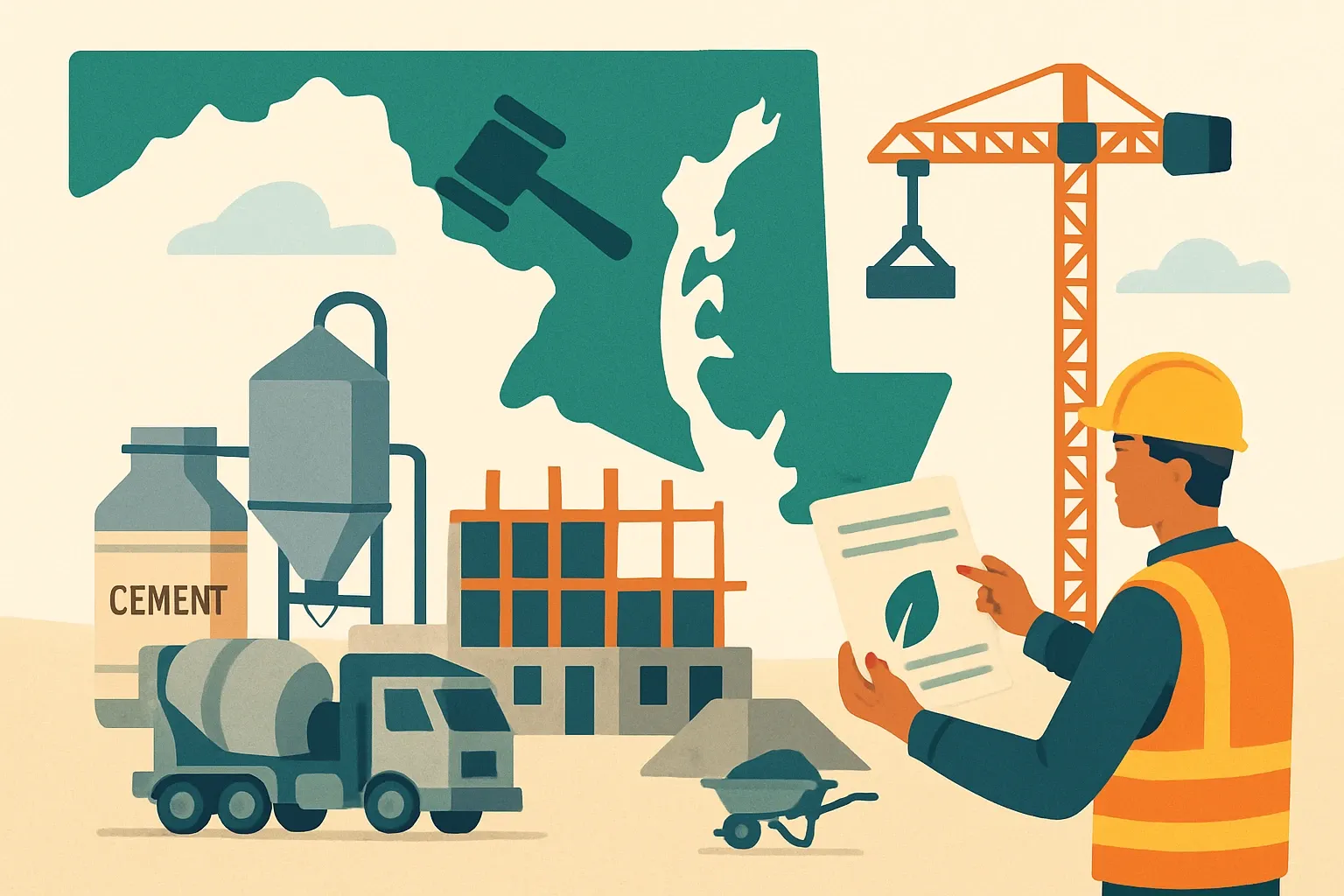
The Buy Clean Maryland Act requires concrete and cement producers supplying eligible state capital projects to file Environmental Product Declarations and meet maximum acceptable global warming potential values once set by the state. The scope is narrow by design: eligible material means any cement or concrete mixture for an eligible project (Maryland Code §4‑901, 2024).
Dates that drive your sales calendar
Producers had to submit facility or product EPDs to the Department of General Services by December 31, 2024. DGS, in consultation with MDOT, must establish maximum acceptable GWP for concrete categories by January 1, 2026. Contract clauses that require compliant mixes and pre‑installation EPD submittals apply to solicitations and awards from July 1, 2026 (MDE, 2026) (MGALeg HB261, 2023).
What counts as a compliant EPD
The statute expects facility‑specific, third‑party verified, product EPDs for the actual mix being installed. Submittals must arrive before installation. DGS will set GWP limits using industry average baselines derived from nationally or internationally recognized EPD databases, and can grant waivers only for feasibility, major cost impact, major schedule impact, or sole‑source situations. Treat waivers as exceptions, not a business plan (MDE, 2026).
How specs and bids will shift
Expect solicitations to name the cement or concrete mixture category and require an EPD that shows the GWP falls at or below DGS limits. That compresses decision time on mix design and documentation. Teams with EPDs ready at bid get evaluated on performance and price. Teams without them get screened out early, or asked for waivers that rarely land.
Selling concrete in Maryland or competing for state projects?
Follow us on LinkedIn for insights on EPD compliance and strategies to ensure your mixes get spec'd and not VE'd out.
If you sell concrete in Maryland, do this next
- Map which mixes touch eligible state capital work in the next two quarters. Tie each to a plant.
- Confirm EPD coverage, reference year, and declared modules. If anything is missing, start the data pull now so verification is smooth.
- Pre‑align mix designs to likely GWP limit bands so estimators can quote with confidence the day a solicitation drops.
Data to gather without the drama
Pull twelve months of utilities, clinker and SCM ratios, admixtures, transport, yields, and waste. For new mixes, assemble at least a few months of production and lock a plan to refresh the EPD once a full year is available. Keep lab break data and batch tickets handy. Clean inputs mean faster LCA modeling and fewer verifier questions.
Money on the table you should not miss
Maryland created an Environmental Product Declaration Assistance Fund to help producers develop EPDs. It is administered by the Department of Commerce and targeted at eligible materials under the Act. Program parameters may change with budget cycles, so check status before counting on it in a bid pipeline (MDE, 2026).
Timeline watchouts most teams miss
EPDs typically last five years, yet project schedules can stretch. If an EPD will expire during construction, budget a refresh so submittals stay compliant through installation. Also watch for DGS updates to GWP limits. The law instructs the state to base limits on industry averages, so limits can tighten as the market improves.
What great execution looks like
Winning teams treat the LCA and EPD workflow like a critical path activity. They streamline plant data collection, decide on the right PCR and program operator early, and keep mix‑specific documentation packaged for submittals. That turns the EPD gate into a green light instead of a scramble at award. Little stuff like naming conventions and file hygiene sounds boring, but it saves bids, it really does.
Bottom line for Maryland suppliers
If your concrete shows up on state capital projects after July 1, 2026, show up with an EPD and a GWP number that clears DGS limits. Get your data house in order now so estimators can quote faster, spec writers gain confidence, and procurement has nothing to hold against your submittal. The Act rewards teams who remove friction for buyers rather than create it.
(Sources for numeric details: eligible material definition and effective sections in 2024 code; filing deadline, GWP‑setting date, and pre‑installation EPD requirement in statute and agency guidance. See MGALeg HB261, 2023 and MDE, 2026.)