The rule in one page
HF 2310 established Minnesota Statute 16B.312, which requires EPD submission and sets maximum global warming potential limits for key construction materials purchased on eligible state projects. Eligible projects include new state buildings over 50,000 square feet, major renovations over 50,000 square feet that exceed 50 percent of assessed value, and trunk highway work adding or rebuilding two or more lane‑miles (Revisor of Statutes, 2025) (Revisor of Statutes, 2025).
What’s covered, and where limits start
The first material categories are concrete, carbon steel rebar, structural steel, asphalt paving mixtures, and concrete pavement. Minnesota set initial limits effective January 15, 2026 for ready‑mix concrete used in buildings and for rebar. Example values include 264 kgCO2e per m³ for normal‑weight 3000 psi mixes, 312 kgCO2e per m³ for 4000 psi, and 0.755 tCO2e per ton at the mill for rebar, with a 30 percent allowance for documented high early strength needs (Minnesota Department of Administration, 2026).
Dates that change your bids
These limits and EPD submittals apply to projects advertised on or after July 15, 2026. The Task Force recommends reviewing and tightening limits roughly every two to three years as market data improves (Environmental Standards Procurement Task Force Report, 2025) (Environmental Standards Procurement Task Force Report, 2025).
EPDs are the ticket to compete
Minnesota defines EPDs as Type III, third‑party verified, and supply‑chain specific, covering at least 80 percent of A1 to A3 impacts for the product. That definition steers teams toward product‑specific EPDs with dependable upstream data instead of generic averages that undercut comparability (Revisor of Statutes, 2025) (Revisor of Statutes, 2025).
Want to stay ahead with Minnesota's EPD requirements?
Follow us on LinkedIn for insights that help you unlock compliance strategies and win state-funded projects.
Not every limit is set yet
Where the state lacks robust data, disclosure is still required even if a formal cap is “TBD.” The concrete table, for example, sets building ready‑mix limits now, while CMU, precast, and concrete pavement rely on EPD disclosure to inform future thresholds. Steel beyond rebar posts current benchmark values and targets formal limits as data matures (Minnesota Department of Administration, 2026).
“Buy Fair” shows up in procurement mechanics
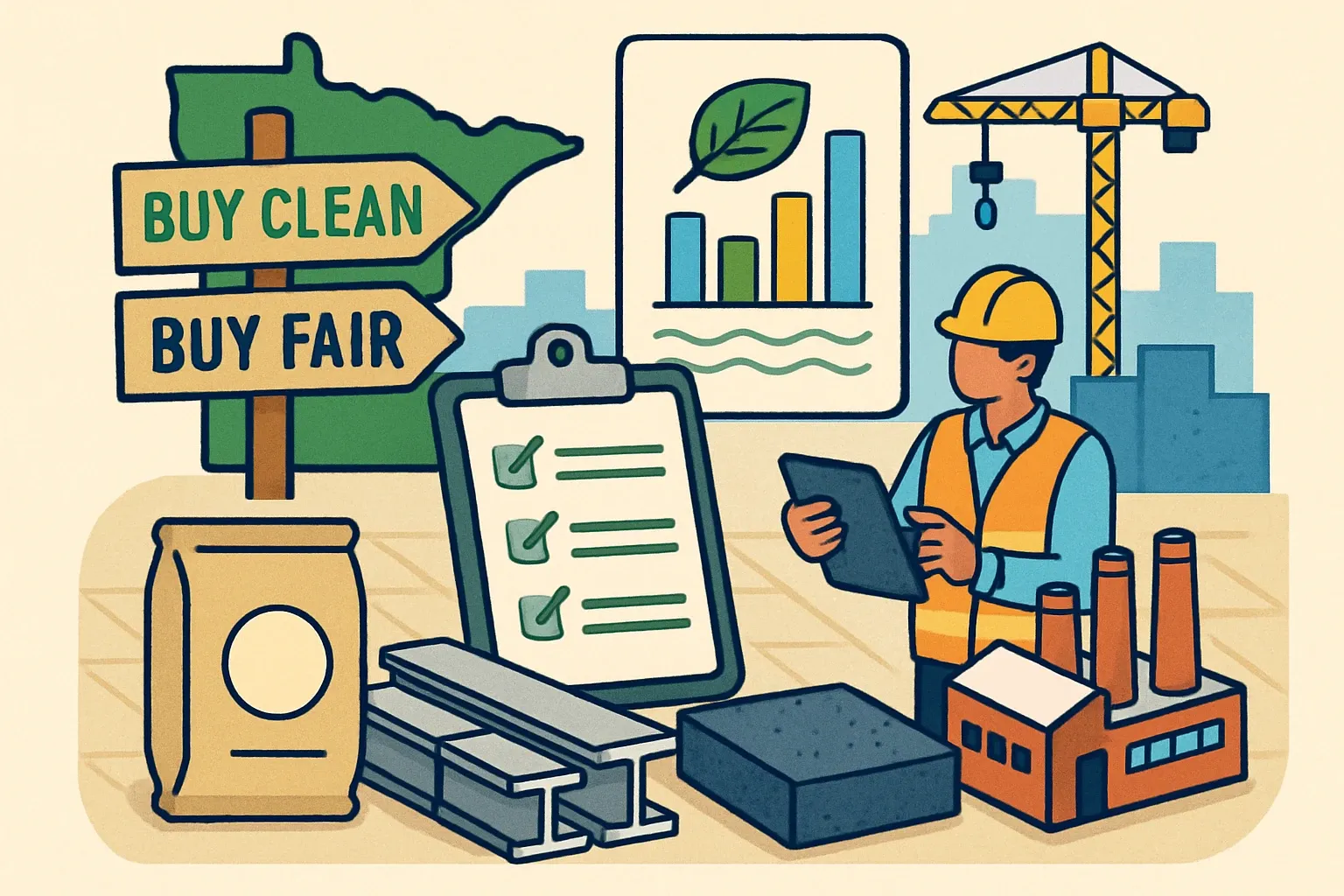
The law bakes equity into process. The pilot asks for supplier codes of conduct and working conditions, and procurement will preference materials mined, made, or assembled in Minnesota. Think of it as carbon plus conduct, not carbon alone.
Grants that lower the barrier
Minnesota is funding EPD creation. Awards up to $49,999 for individual manufacturers and up to $150,000 for industry groups were offered, with $255,000 from Administration and $310,000 from Transportation earmarked in the last round. The report notes additional rounds to allocate remaining funds as implementation continues (Minnesota Department of Administration, 2025). If you missed the first window, keep paperwork ready so the next one is not a scramble.
How to get audit‑proof fast
- Map products to the right PCR early, especially for mixes by compressive strength and rebar by scope. A good LCA partner will check what competitors use and flag expiry timelines.
- Lock your 2024 or 2025 reference year data scope. Pull utility, raw material, transport, and yield data plant by plant. Definately capture admixture dosages and SCM variability for concrete.
- Decide program operator and verification path. UL, ASTM International, Smart EPD, IBU and others are common, and the operator choice does not change your duty to deliver supply‑chain specific EPDs.
- Systematize submittals. Minnesota will collect EPDs electronically and tie them to bid documentation, so name, scope, and version control matter more than ever (Environmental Standards Procurement Task Force Report, 2025).
Commercial reality check
On state work, an EPD closes the data gap that forces buyers to assign conservative carbon penalties. On private work in Minnesota, the same EPDs accelerate decarbonization goals and can keep products in spec when carbon targets tighten mid‑design. Teams that land credible EPDs first tend to spend less time fighting substitution and more time winning the next line‑item.
What this means for your next quarter
If Minnesota is on your sales map for concrete, steel, or asphalt, run an internal readiness sprint now. Pick the right PCR, set a clean data pull, and get verification on the calendar. It is a lot of moving parts, but with the right white‑glove partner handling data wrangling and QA, you keep engineers focused on mix performance while your EPDs move from promise to published on time.