What people mean by “EPD Mediterranean”
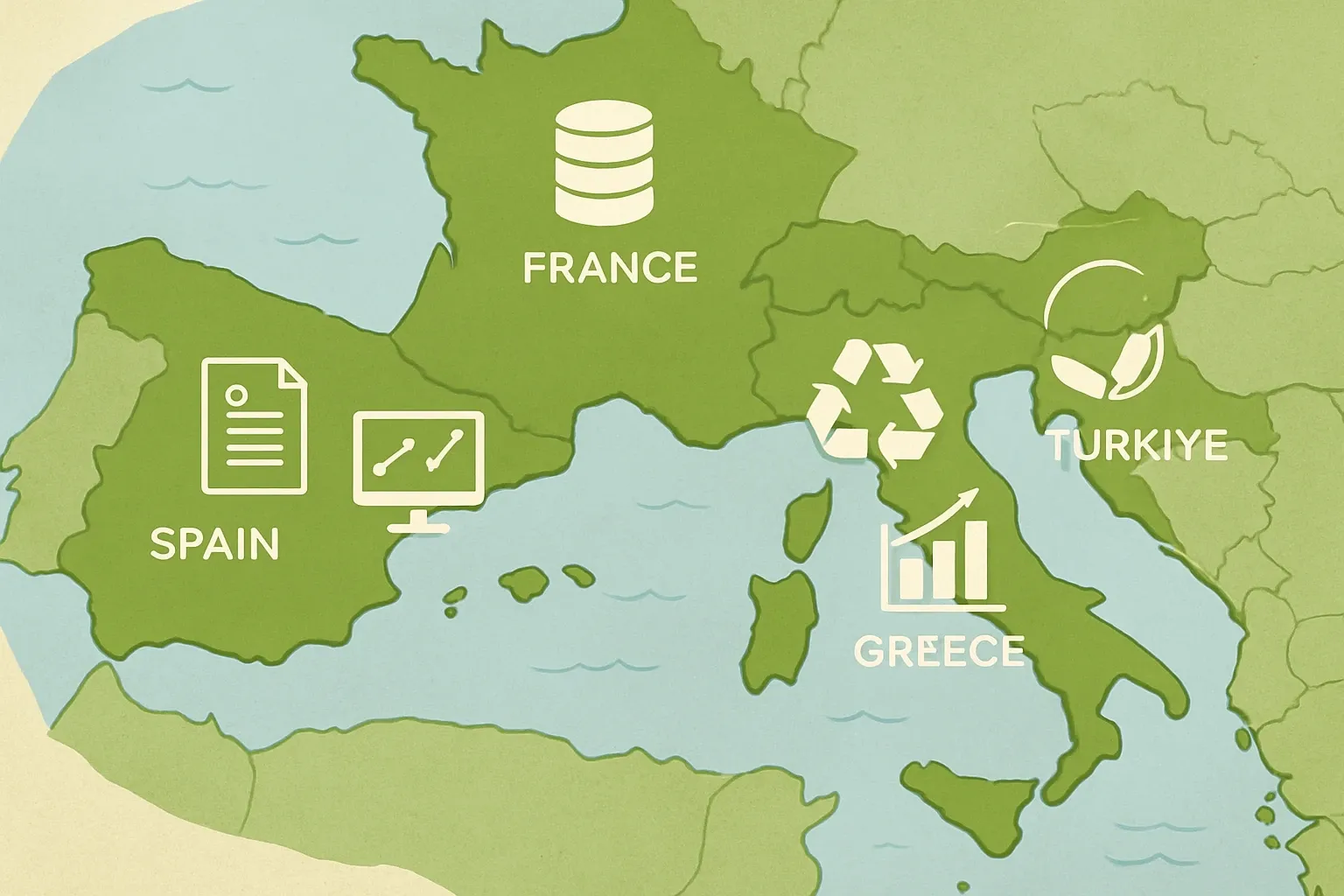
Searches often circle around Italy, Spain, France, Portugal, Greece, Türkiye, Malta, Cyprus, and Israel. The common thread is EN 15804 and program operators recognized across Europe. If your team types epd mediterranean into a browser, they usually want to know where to publish and what each country’s modelers actually use.
The rulebook in one line
EN 15804+A2 is the baseline for construction EPDs in Europe. France adds a national complement and, from January 1, 2026, INIES keeps only A2‑format FDES active for RE2020 workflows, with A1 archived earlier than their nominal expiry (Cerema, 2024).
France
For building products, FDES and PEP are verified and published in INIES. As of November 16, 2025, the database lists 5,326 FDES and 1,728 PEP used in permitting‑grade modeling for RE2020 (INIES, 2025). Publishing there means practitioners model your product as it is, not with generic penalties.
Spain
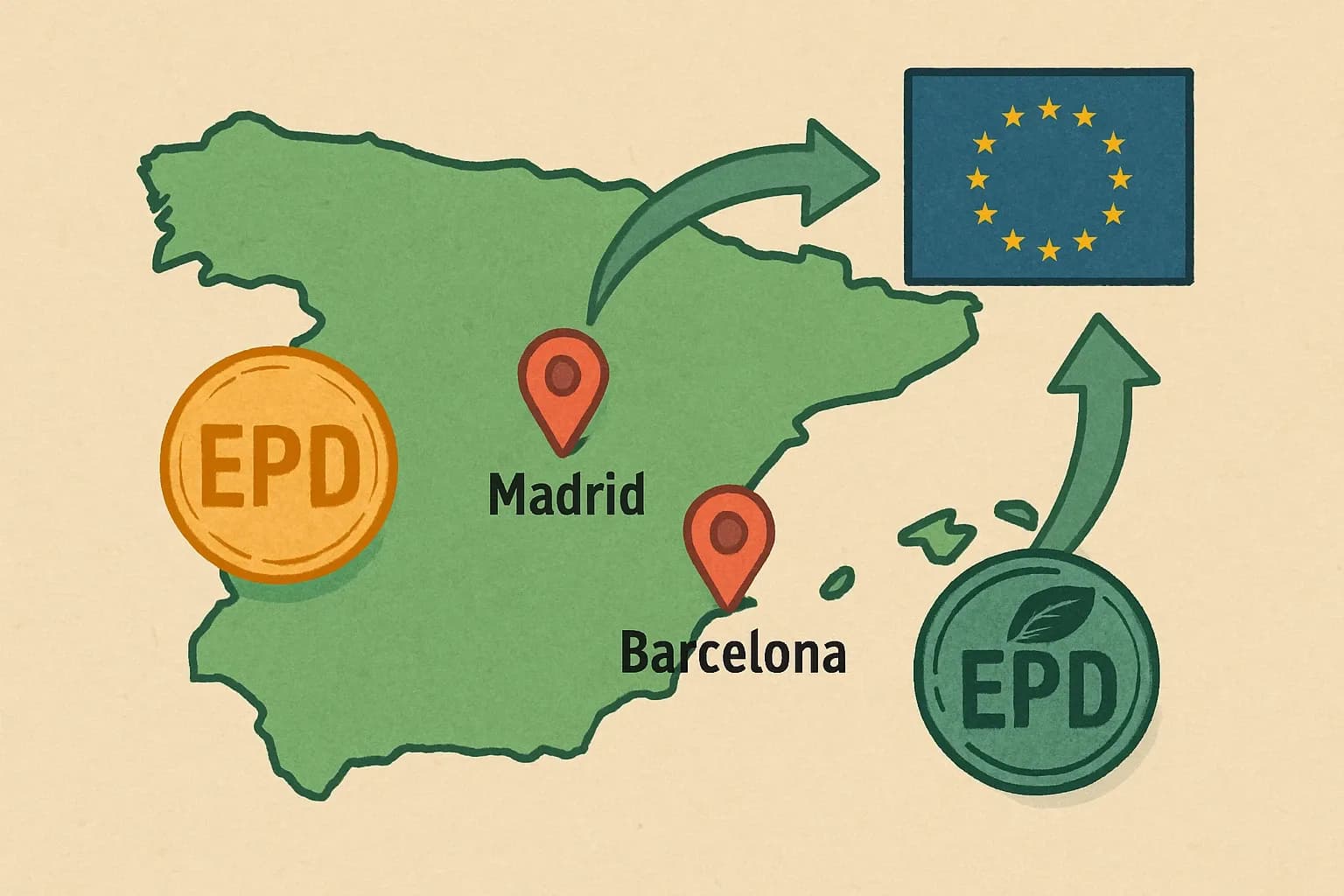
AENOR’s GlobalEPD is widely used and recognized through ECO Platform. ECO Platform lists GlobalEPD with 421 EPDs as of July 1, 2025, while Catalonia’s DAPconstrucción shows 190, giving specifiers local data paths for common materials (ECO Platform, 2025).
Italy
EPDItaly has scaled quickly and announced 1,000 published EPDs on November 6, 2025, spanning far beyond core construction categories (EPDItaly, 2025). Public procurement via CAM Edilizia often rewards or requires verified environmental evidence, where an EPD is a straightforward way to document compliance.
Portugal
The DAPHabitat program is established and part of ECO Platform. ECO Platform places it at 54 EPDs as of July 1, 2025, with recent additions covering cement, cork insulation, and building components (ECO Platform, 2025).
Thinking of expanding into Mediterranean markets?
Follow us on LinkedIn for insights on EPD requirements that can help you win tenders and unlock new opportunities.
Türkiye
EPD Türkiye reports 856 EPDs, 62 climate declarations, and 176 companies, reflecting strong uptake across cement, steel, glass, and finishes as of late 2025 (EPD Türkiye, 2025).
Greece, Cyprus, Malta, Israel, and North Africa
Manufacturers commonly publish with The International EPD System or IBU, which are broadly recognized across Europe. The International EPD System reported more than 10,000 valid EPDs in 2024, with Italy, Spain, and Türkiye among the top countries, a helpful signal for regional acceptance (EPD International, 2024).
Where your data must live to be used
France’s RE2020 tools pull directly from INIES, so a European PDF on its own will not be enough. In Spain and Portugal, design teams often ask for ECO Platform recognized records to simplify comparability. In Italy, CAM Edilizia procedures in public tenders lean on third‑party verified documentation. If a modeler cannot find your EPD in the registry they use, your spec becomes fragile.
Timelines and expiries that trip teams up
A2 alignment is the big one in France through 2025. Plan verifier availability, language needs, and any national complements early. Renew before sellers hit a bid window. Old but valid EPDs work commercially until close to expiry, yet few buyers will parse the nuance if a competitor shows a fresher, A2‑aligned sheet.
Digital EPDs are coming fast
The International EPD System began publishing fully digital EPDs in 2025, noting 62 digital records by late May. Digital formats speed QA and enable downstream reuse in BIM and takeoff tools without hand‑copying numbers (EPD International, 2025).
Regulations that shape demand in 2025–2026
EU‑level sustainability reporting timelines shifted in 2025, with a two‑year delay for many CSRD filers. That changes who reports when, not the on‑the‑ground need for product‑level EPDs in construction projects that use national databases and EN 15804 rules (EU Council, 2025). Treat reporting as a parallel track and keep product EPD work moving.
Picking a program operator for the Mediterranean
Match the operator to the sales map. If France is key, target INIES with FDES or PEP and A2 alignment. For Spain, GlobalEPD plus ECO Platform recognition helps. In Italy, EPDItaly is mainstream for construction. Portugal leans on DAPHabitat. Türkiye has a dedicated national route via EPD Türkiye. Regional projects with mixed markets often start with The International EPD System, then port to national hubs.
The commercial angle
An EPD places your actual impacts into the tools that drive design, tender scoring, and carbon caps. That removes punitive defaults and keeps you in contention when low‑carbon targets tighten. The cost of one high‑quality EPD is often dwarfed by a single mid‑sized project win. We focus clients on ruthlessly efficient data collection so their most valuable people stay on the floor while the paperwork moves. It’s definitly the stress‑saving route.
A quick action plan
Pick the 2024 or 2025 reference year, map data owners, and settle early on operator and PCR. Check whether you need national complements, especially in France. Ask for a verification calendar and a publication slot, then coordinate internal reviews against the bid calendar.
Keep momentum without wheel‑spinning
Mediterranean markets reward credible, registry‑visible data that modelers can pull in seconds. Get the format and venue right once, then replicate across your portfolio. That is how EPDs stop being a compliance chore and start becoming a repeatable sales advantage.