Switzerland’s EPD basics in one minute
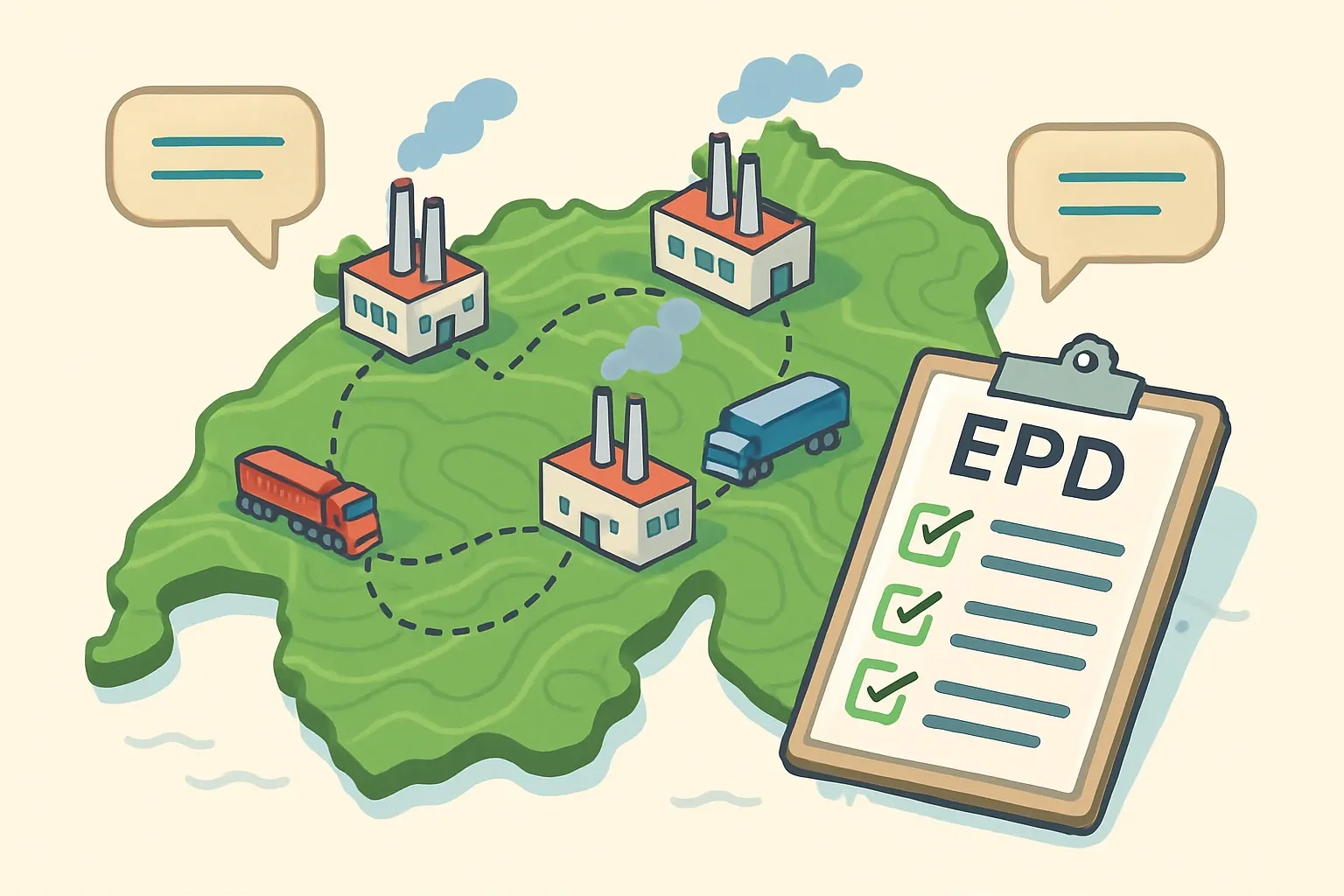
Switzerland aligns building‑product EPDs with EN 15804. Declarations verified by established European program operators are widely accepted because most are members of ECO Platform, which harmonizes rules and formats. Publish in English plus German or French when possible so public clients and cantonal reviewers can use your file without extra steps.
EPDs are not the only game. KBOB publishes national life‑cycle data used across public procurement. Your EPD often replaces a generic KBOB line item in calculations when it fits the scope and quality rules. Think of KBOB as the house baseline and your EPD as the manufacturer override where allowed.
Where EPDs show up in tenders
Public buyers increasingly score embodied carbon alongside cost. Switzerland’s construction and civil engineering activities generate the majority of national waste by mass, which keeps pressure on low‑impact materials. In 2020, about 82 percent of Swiss waste came from construction and civil engineering, roughly 87 million tonnes total, based on official European reporting (EEA, 2025).
KBOB guidance sometimes names thresholds that de‑risk bids. For reinforcement steel, sample specifications reference greenhouse‑gas intensities at or below 0.6 kg CO2e per kg and a recycled content of at least 99 percent steel scrap in certain cases (KBOB, 2024). If your product‑specific EPD beats the generic baseline and meets such criteria, it can unlock preference in scoring.
Program operators Swiss teams actually use
Manufacturers targeting Switzerland commonly publish with operators recognized by ECO Platform. The International EPD System, IBU, EPD‑Global powered by EPD‑Norway, and PEP ecopassport for electrical gear are frequent choices. Their scale shows market trust. As of July 1, 2025, The International EPD System listed 12,749 ECO EPDs, IBU 2,565, EPD‑Global 3,716, and PEP ecopassport 4,740 on ECO Platform’s roster (ECO Platform, 2025). Choose the operator your specifiers already recognize in your product category, then focus on verification quality and metadata completeness.
Data hubs you will hear about
KBOB’s “Ökobilanzdaten im Baubereich” underpins many Swiss calculators and client baselines. ECO Platform validates operator alignment and makes recognition explicit. Project teams may also consult pan‑European libraries like ÖKOBAUDAT for benchmarking. Global tools appear in conversations as well. Make sure your EPD has the XML or machine‑readable format that portals prefer so nobody retypes figures.
Navigating EPD requirements in Switzerland?
Follow us on LinkedIn for insights that help you get specified and win more tenders.
Standards, labels, and what they ask for
Swiss projects frequently reference EN 15804 for EPDs and SNBS or Minergie‑ECO for building‑level targets. These systems reward transparent product data, verified system boundaries, and declared modules that match the use case. If your EPD is cradle‑to‑gate with options, state it clearly. If you have plant‑specific data, flag it. Reviewers look for third‑party verification and a current PCR. When a PCR expires mid‑cycle, the EPD stays valid until its own expiry, then must renew under an updated rulebook.
How KBOB data and your EPD interact
Procurement models typically start with KBOB generic values. When a compliant product‑specific EPD is available and aligned to the same functional unit and system boundary, it can replace that line in the calculation. That switch is where commercial value appears. The team no longer carries a penalty from conservative generic data, and the bid gains room on embodied‑carbon metrics without cutting performance or price.
Publishing choices that reduce friction
Pick the operator common in your category. Provide German and French documentation if you can. Supply the PDF and machine‑readable file so owners can ingest values quickly. Include a short methodology note mapping your declared unit to KBOB conventions so reviewers do not have to guess. Small details like consistent plant addresses, grid mixes, and transport distances save reviewers hours and avoid back‑and‑forth emails.
Timelines and the hidden bottleneck
Most schedules slip on data collection inside the manufacturer, not on LCA modeling. Teams lose weeks chasing utility bills, scrap rates, and transport legs across plants. A partner that handles the outreach, reminders, and QA inside your org will move the calendar from months to weeks. That speed matters when a tender drops with a 30‑day clock.
What to prepare before you even start
- A clean reference year for production volumes, energy, water, waste, and co‑product handling.
- Bills of materials by SKU with supplier locations and regular transport modes and distances.
- Evidence for electricity mixes at each site and any on‑site renewables.
- Packaging specs, primary to tertiary, and typical end‑of‑life assumptions.
- A list of target tenders or owners, plus language and file requirements for submissions.
Budget and ROI without the guesswork
Exact costs vary by scope and verification path. What is consistent is the payback pattern. Even one mid‑sized project that scores product‑specific EPD credit can offset the effort. If solid operator choice and white‑glove data wrangling get you published faster, you are in more bids this quarter, not next year. That is the commercial angle that keeps leadership engaged.
Bringing it all together
Switzerland rewards clarity. Align to EN 15804, publish with a recognized operator, map your results to KBOB conventions, and deliver files that import cleanly. If you do the unglamorous work of gathering site data once, verification becomes repeatable. Do that, and your EPD stops feeling like paperwork and starts acting like a spec multiplier. It is definately worth it when tenders get tight.