What “Scandinavia” means for EPDs
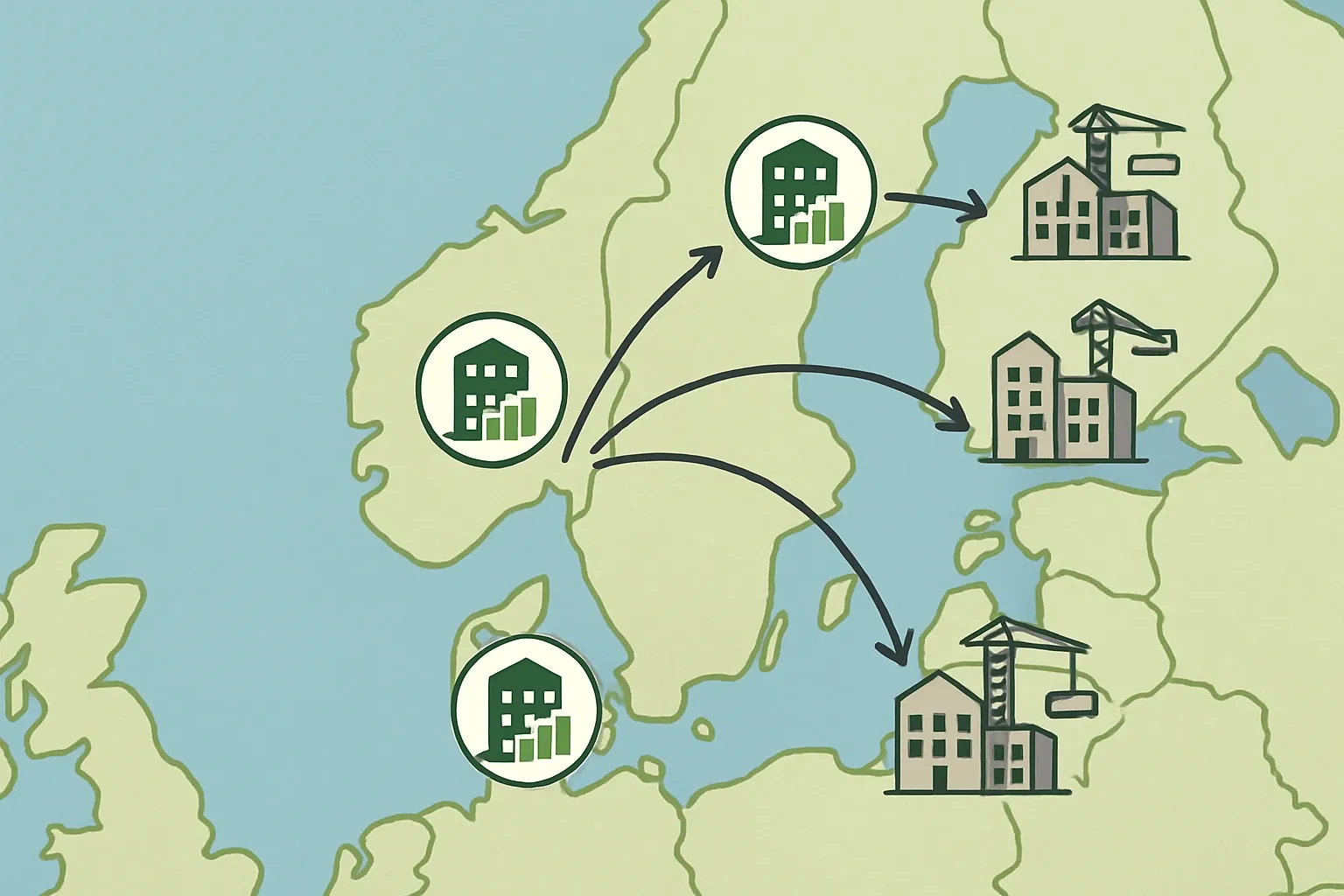
Scandinavia in this guide covers Denmark, Sweden, and Norway. EPDs here follow ISO 14025 and EN 15804 A2. Most buyers expect third‑party verification and digital datasets that plug into building LCA tools. Think of the PCR as the rulebook and the program operator as the referee. If you are googling epd scandinavia, this is the field you are stepping onto.
Who runs the registries producers actually use
Three names dominate daily workflows.
- EPD International, based in Sweden, the largest cross‑sector registry in the region, widely recognized across the EU.
- EPD Norge, Norway’s national program with deep coverage in concrete, steel, wood, and finishes. Its front page shows 8,240 EPDs in portfolio, a practical signal of market maturity (EPD Norge, 2025) (EPD Norge, 2025).
- EPD Danmark, Denmark’s program operator under the Danish Technological Institute, with a public database and growing use of digital formats for LCAbyg imports.
Denmark: binding CO2 limits now shape specs
Denmark moved from “calculate” to “comply.” Since January 2023, large new builds had a CO2 cap of 12.0 kg CO2e per m² per year. As of July 1, 2025, differentiated limits apply to most new buildings, plus a separate cap for the construction stage. Examples for 2025 limits, in kg CO2e per m² per year, include 6.7 for single‑family housing, 7.5 for apartments and offices, and 1.5 for the construction process alone. Policymakers have flagged tighter tiers in 2027 and 2029 (Social‑ og Boligstyrelsen, 2025) (Social‑ og Boligstyrelsen, 2025).
What it means commercially. If an LCA must pass a threshold, product‑specific EPDs become the safest proof. Generic data can push a project over the line or force a redesign late in the bid. Teams increasingly shortlist products with ready, digital EPDs because they shave days off LCA iterations.
Selling building materials in Scandinavia?
Follow us on LinkedIn for insights on EPDs that can help you win specs and navigate compliance in Denmark, Sweden, and Norway.
Sweden: climate declarations today, proposed limits next
Since January 2022, new buildings require a climate declaration that reports embodied impacts for the construction stage. Sweden’s regulator proposed limit values that could start as early as July 1, 2025, and to expand the scope across more life‑cycle modules in 2027. The proposal includes building‑type‑specific caps, for example 375 kg CO2e per m² GFA for multi‑dwelling blocks under A1 to A5, with tightening every five years. These figures are proposals, not yet law, but they set the trajectory many clients already plan against (Boverket, 2023) (Boverket, 2023).
Practical takeaway. If Sweden is on your roadmap, publish EN 15804 A2 EPDs and keep datasets machine‑readable. When caps land, being late by six months can feel like showing up to the heist after the credits roll.
Norway: mandatory climate accounting, and a 25% hit on generic data
Norway’s building code TEK17 requires a climate gas account for new apartment and commercial buildings using NS 3720. Authorities explicitly recommend using third‑party EPDs and require a 25% uplift when generic database values are used if not already uplifted. The required modules cover A1 to A4 plus B2 and B4 for specified building parts, with construction site waste in A5, and a 50‑year reference period (DiBK, 2025) (DiBK, 2025).
What it means for bids. That 25% penalty makes generic data a risky placeholder. An own EPD can remove the uplift and unlock better whole‑building results without exotic design changes.
Program operator choice in Scandinavia
All three programs align with EN 15804 A2 and ECO Platform checks. Choosing where to publish is less about prestige and more about buyer habits, verifier availability, and digital data options. Many teams in the region accept EPDs from any credible operator, provided the EPD is current, verified, and downloadable in a digital schema.
Where EPDs move the needle on revenue
Public projects and large developers now gate decisions with LCA thresholds or disclosure rules. Without an EPD, your product often has to be modeled with generic values that add a numeric handicap. With an EPD, the team can model your actual performance and avoid penalty factors. One mid‑sized project win often repays an EPD’s total effort. We see this accross categories like concrete mixes, insulation, and coatings.
How to accelerate without chaos
Most delays come from data wrangling, not modeling. Treat EPD creation like a product launch. Give someone authority to collect plant data, utility pulls, and bill of materials for a clear reference year. Lock PCR selection early by checking what competitors use. Build a publication plan with the operator your customers already search in. And insist on a digital file alongside the PDF, so it flows into Danish LCAbyg or Swedish project tools without retyping.
Quick starter checklist for Scandinavia
- Confirm the reference year and plants in scope. No fuzzy edges.
- Map which projects face Denmark’s 2025 caps. Prioritize those product lines.
- For Sweden, plan for proposed caps and broader modules, then budget verification capacity.
- For Norway, replace generic datasets where a 25% uplift would hurt the building LCA.
- Publish with an operator your buyers already use, and include a digital dataset.
Tie it together
If you sell into Scandinavia, EPDs are not a nice‑to‑have. They are your ticket past disclosure gates and, in Denmark, through hard caps. Norway’s 25% uplift on generic values makes the business case obvious. Sweden’s proposals point in the same direction. Move EPD work upstream, keep it clean and digital, and your products stay in the spec while others wait on paperwork that should have shipped yesterday. If that sounds hard, it is. It is also very doable, and definately worth it.