Who they are, what they sell
The Steel Network (steelnetwork.com) manufactures light gauge steel framing solutions in the United States, with facilities in North Carolina, Texas and Arizona. Their catalog centers on connectors and systems for head‑of‑wall deflection, slab bypass, lateral drift, rigid connections, shear walls, and specialty members like MidWall and VertiTrack.
From product pages alone, TSN appears to serve roughly a dozen product families with hundreds of individual SKUs. That range spans named lines such as VertiClip, DriftTrak, DriftClip, VertiTrack, StiffClip, BuckleBridge and more.
EPD status today
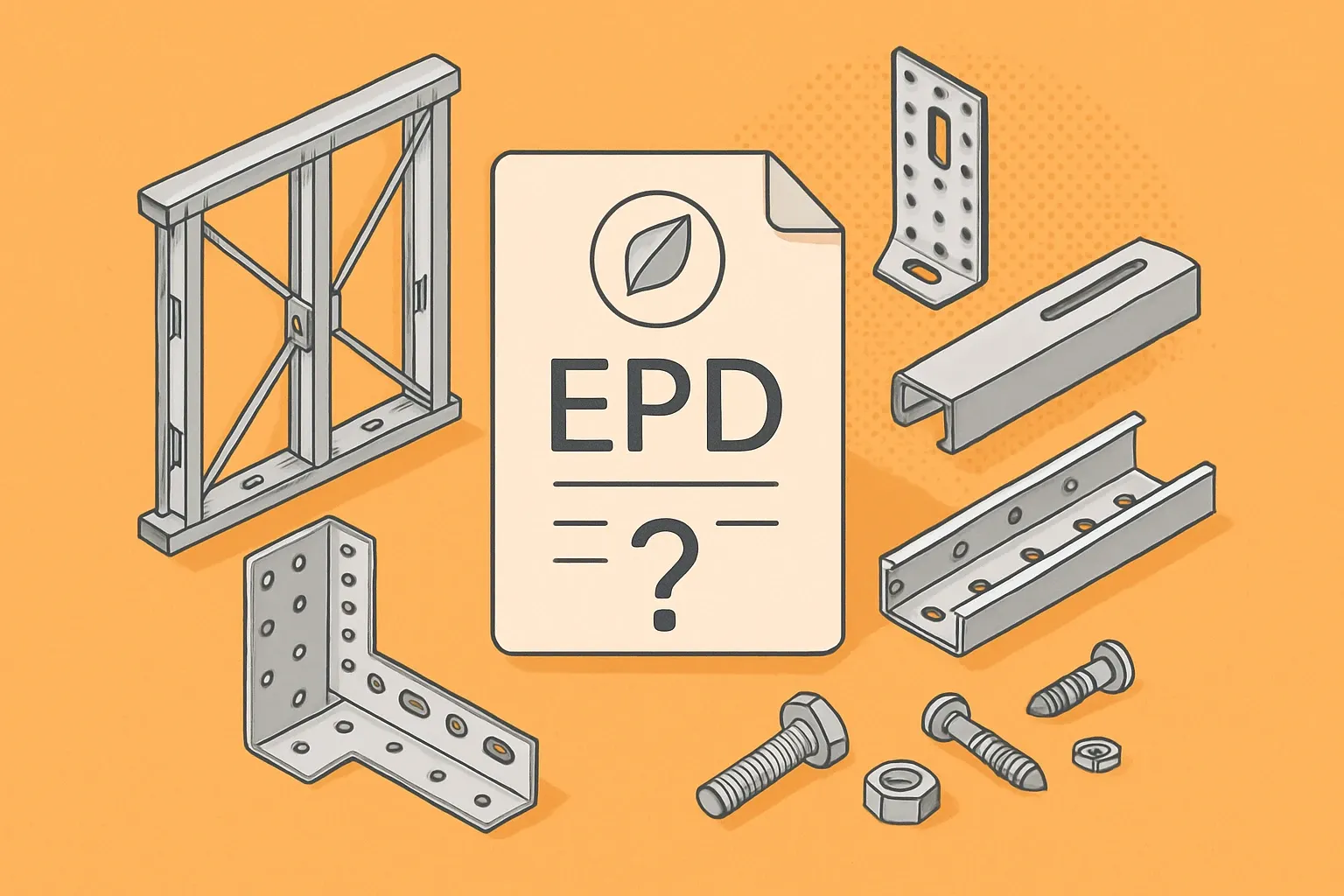
TSN participates in the Steel Framing Industry Association’s industry‑wide EPD for cold‑formed steel framing, verified by SCS Global Services. The current SFIA EPD version was updated on September 15, 2025 and remains valid through May 27, 2026 (BuildSteel, 2025) (BuildSteel, 2025). Earlier coverage notes TSN’s inclusion as a listed participant, which enables use of that industry‑wide declaration on projects that accept it (BuildSteel, 2025) (BuildSteel, 2025).
What the SFIA EPD does and does not do
An industry‑wide EPD is useful when a project team needs a credible baseline quickly. It represents average performance for a category, not a specific product line made at a specific plant. Many owners, GCs and AEC firms still prefer product‑specific EPDs when they are comparing functionally similar items, since those documents reflect actual site and supply choices.
For TSN’s portfolio, that means studs and track covered by an industry‑wide EPD can satisfy disclosure on many jobs, while specialty connectors and prefabricated systems may see stronger spec performance with product‑specific EPDs. If a submittal reviewer is choosing among similar clips, a competitor’s product‑specific EPD can be a tie‑breaker that avoids default penalties in project carbon accounting.
Competitive benchmark in cold‑formed steel
Several direct competitors publish product‑specific EPDs across framing systems, frequently including clips and connectors. Examples include ClarkDietrich, which launched a low‑embodied‑carbon line supported by a dedicated EPD portfolio in 2024 (PR Newswire, 2024) (PR Newswire, 2024). Marino\WARE highlights a product‑specific Type III EPD and a low‑carbon variant positioned for LEED optimization (Marino\WARE, 2025) (Marino\WARE, 2025). SCAFCO publicly lists EPD documentation within its LEED resources, signaling product‑specific coverage for framing components (SCAFCO, 2025) (SCAFCO, 2025).
Work for The Steel Network or competing against them?
Follow us for product-by-product EPD insights to see which connectors and systems get spec'd and where you can close competitive gaps.
Where TSN’s coverage looks strong
For commodity framing like studs and track where industry‑wide EPDs are commonly accepted, TSN can compete today using the SFIA document. That keeps bids compliant on many projects, especially where teams only need disclosure and are not comparing optimized low‑carbon variants.
Likely gap, illustrated
Consider VertiClip SL, a recognizable head‑of‑wall deflection connector. On projects that score embodied‑carbon reductions at the product level, a reviewer may prefer a functionally equivalent clip from a brand with a product‑specific EPD. ClarkDietrich’s EPD scope has historically included clips and connectors within its cold‑formed steel systems, which can simplify submittals for those assemblies (ClarkDietrich, 2024) (ClarkDietrich, 2024). In a head‑to‑head spec, that paperwork advantage can matter.
Commercial stakes on LEED v5 projects
Design teams are under pressure to hit carbon targets without slowing schedules. When a product lacks a product‑specific EPD, modelers often have to fall back to conservative defaults. That adds friction. Even one missing declaration in a high‑volume SKU can push a bidder to substitute a covered alternative, especially in healthcare, higher‑ed, and office fit‑outs where repeatable details are standardized across dozens or hundreds of openings.
How widely TSN competes
TSN most often goes up against cold‑formed steel mainstays like ClarkDietrich, CEMCO, SCAFCO, Marino\WARE and Telling. In many applications, the competition is not only likekind clips, it is also system choices. Bypass drift solutions might be swapped for slotted track, or a pre‑assembled deflection track might replace a clip‑plus‑track field build when submittal simplicity and inspection speed take priority.
A pragmatic EPD playbook for TSN‑style portfolios
- Start with the highest‑volume connectors used across many details, then aggregate similar SKUs into a single product‑specific EPD using representative sizes. That captures the bulk of submittals quickly.
- Extend to prefabricated track systems where a single EPD can unlock many repetitive head‑of‑wall conditions. This is where reviewers most appreciate one clean document per system.
- For shear wall and rigid connectors, evaluate whether a small number of mass‑market configurations account for most demand. Prioritize those for the next wave.
- Keep the industry‑wide SFIA EPD active. It remains the safety net when a job allows category averages, and its renewal cadence is predictable (BuildSteel, 2025).
Where to read their sustainability notes
TSN maintains a LEED and disclosure page with links to EPD and HPD resources, helpful for submittal packages (TSN LEED data). They also publish enviromental updates and product news on their site’s Sustainability and News posts.
Bottom line for specability
TSN offers breadth in connectors and movement systems that specifiers recognize. Coverage via the SFIA industry‑wide EPD keeps them compliant in many cases, yet product‑specific EPDs for core clips and pre‑assembled tracks would reduce friction and protect margin in competitive alternates. The fastest wins come from targeting the handful of details that repeat on every floor, then scaling coverage across the family tree.