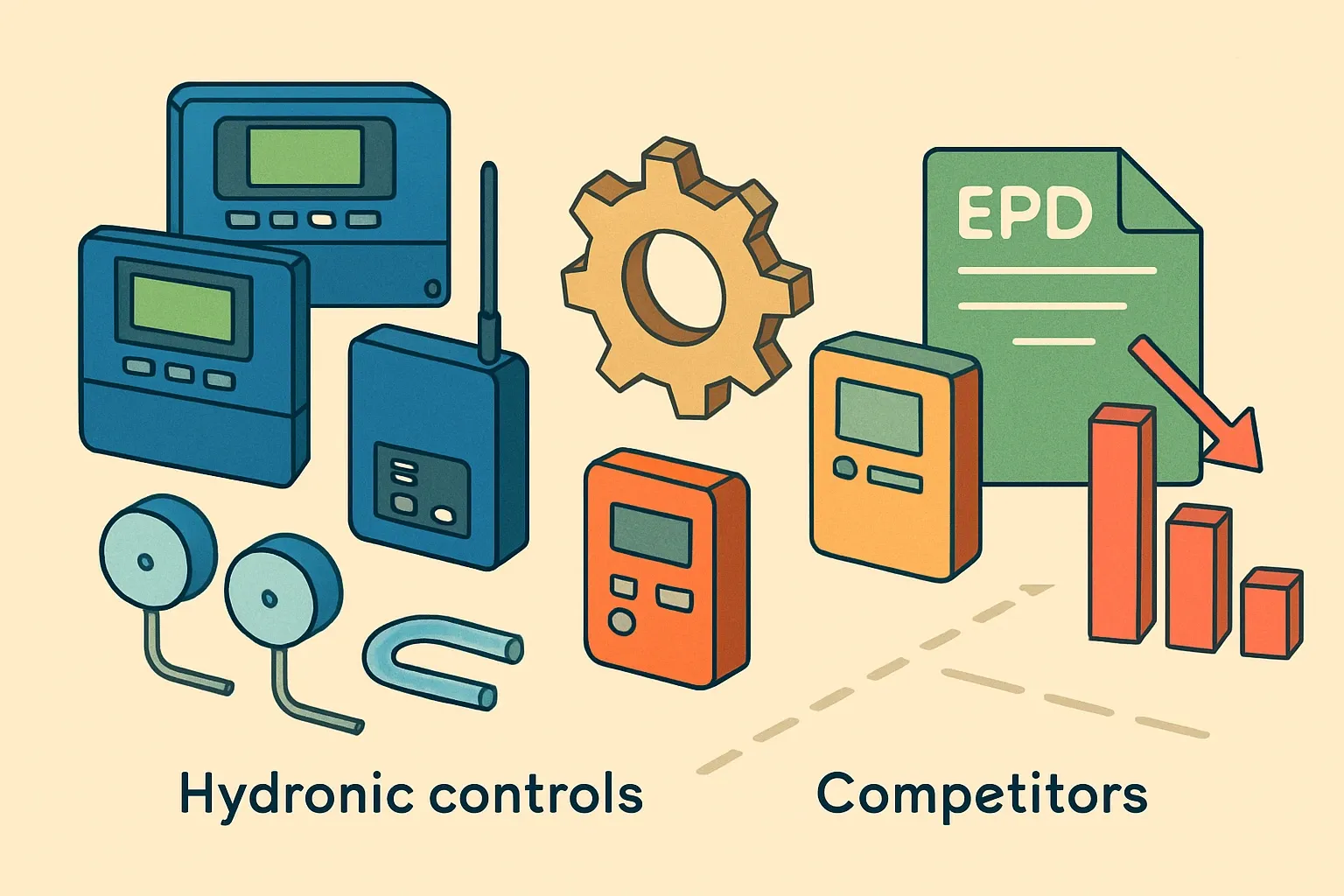
Who Tekmar is and what they sell
Tekmar sits squarely in building controls for water‑based heating and domestic hot water. Flagship lines include Smart Boiler Control 294 and 289 for steam, mixing controls like the 356, setpoint controls such as the 170, and a suite of sensors and accessories. They also market heat‑pump system controllers that coordinate air‑to‑water and water‑to‑water equipment. In plain speak, Tekmar makes the brains that tell pumps, boilers, and zones what to do.
Product breadth at a glance
Across boiler controls, mixing, setpoint, heat‑pump coordination, snow‑melting, and accessories, Tekmar participates in roughly half a dozen control categories with dozens of individual SKUs. That breadth helps them show up in multifamily, small commercial, hospitality, and education projects. Thermostats and user interfaces round out the stack.
EPD coverage today
We could not locate any published, product‑specific EPDs for Tekmar controls as of December 18, 2025. That does not mean they are impossible, only that none appear available to specifiers through the usual channels right now. By contrast, many electric radiant and heat‑trace brands publish verified EPDs for floor‑heating cables and related controllers, and electrical majors publish PEPs for control devices. The net effect is simple. In projects that score materials on disclosure or embodied‑carbon accounting, a control without an EPD often forces teams to assume conservative impacts, which can nudge selection toward a comparable SKU that does have one.
Why this matters in LEED v5 era
LEED still rewards product transparency. Under the current market practice, project teams often target the EPD credit that calls for at least 20 qualifying products, with product‑specific Type III EPDs weighted as 1.5 products. Being the control brand with a verified, product‑specific EPD can be the tie‑breaker that gets listed on the submittal, not the cutting‑room floor (USGBC, 2024, Building Product Disclosure and Optimization — EPDs) (USGBC, 2024). LEED v5, ratified in 2025, keeps disclosure in play while elevating embodied‑carbon performance across the bill of materials. Controls are small, yet on tight carbon budgets even small wins stack up.
Work for Tekmar or competing brands?
Follow us for a product-by-product analysis to see which Tekmar controls get VE'd out against competitors like nVent and Uponor, and learn where EPD gaps could impact your specs.
Likely bestseller without an EPD and who already has one
A safe example is Smart Boiler Control 294, a hero product for central or volume DHW that can orchestrate up to sixteen boilers when paired with expansion modules. If it lacks an EPD, it risks being swapped when owners or GCs standardize on products with published declarations. Electric radiant competitors in similar application spaces often publish EPDs for heating cables and sometimes their room controllers, making them easier to clear procurement hurdles in offices, hospitality, healthcare, and education where documentation is non‑negotiable.
Competitive set you will see on specs
Expect to meet nVent RAYCHEM in electric snow‑melt and floor‑heating applications, and Uponor where hydronic radiant and snow‑melt piping is in scope. In building‑wide controls and room devices, Schneider Electric, Siemens, and Johnson Controls show up frequently. Some of these manufacturers publish product‑level EPDs or PEP ecopassports for relevant devices, which lowers friction when carbon accounting is required.
A quick reality check on volume and complexity
Controls are compact and multi‑material. That means modeling bills of materials, electronics, and packaging accurately, then aligning to the right rulebook. For electrical and electronic equipment, many manufacturers use the PEP ecopassport framework, with declarations typically valid for 5 years, which fits electronics refresh cycles well (PEP Association, 2024). For construction‑facing products, EN 15804 or ISO 21930 based EPDs are common in North America and Europe.
What a pragmatic EPD path looks like for controls
Start with one or two high‑runner SKUs per family, such as the steam or multi‑boiler controllers. Pick the reference year, lock data from PCB and enclosure suppliers, and capture plant energy and yields. Your LCA partner should benchmark competing PCR options, including whether a PEP or EN 15804 path is the better fit, then publish with a program operator your customers recognize. The heavy lift is data collection inside the factory and upstream in the supply chain. Teams that offload that wrangling get to a publishable declaration faster and with fewer meetings.
Parent‑company signal on sustainability
Watts, Tekmar’s parent, maintains an active sustainability program and public reporting. Their 2024 CSO update cites a 950 metric ton reduction in absolute GHG emissions year over year, alongside hazardous‑waste intensity improvements, which signals a culture that can support product‑level disclosures when prioritized (Watts CSO Update, 2024) (Watts, 2024). You can also explore Watts’ broader ESG hub here, which outlines strategy and recognition badges like Newsweek’s America’s Greenest Companies [link] (Watts Sustainability).
The commercial takeaway
If Tekmar wants to win every spec where materials transparency is a checkbox, publishing EPDs for the top controls is a fast lever. It reduces submittal back‑and‑forth, keeps distributors from steering to EPD‑ready alternates, and supports LEED v5 ambitions on projects that care. Done right, the time to a validated declaration is shorter than many teams expect, and the revenue unlocked can easily outpace the effort. It’s definately worth a look.