Who PGH is and what they sell
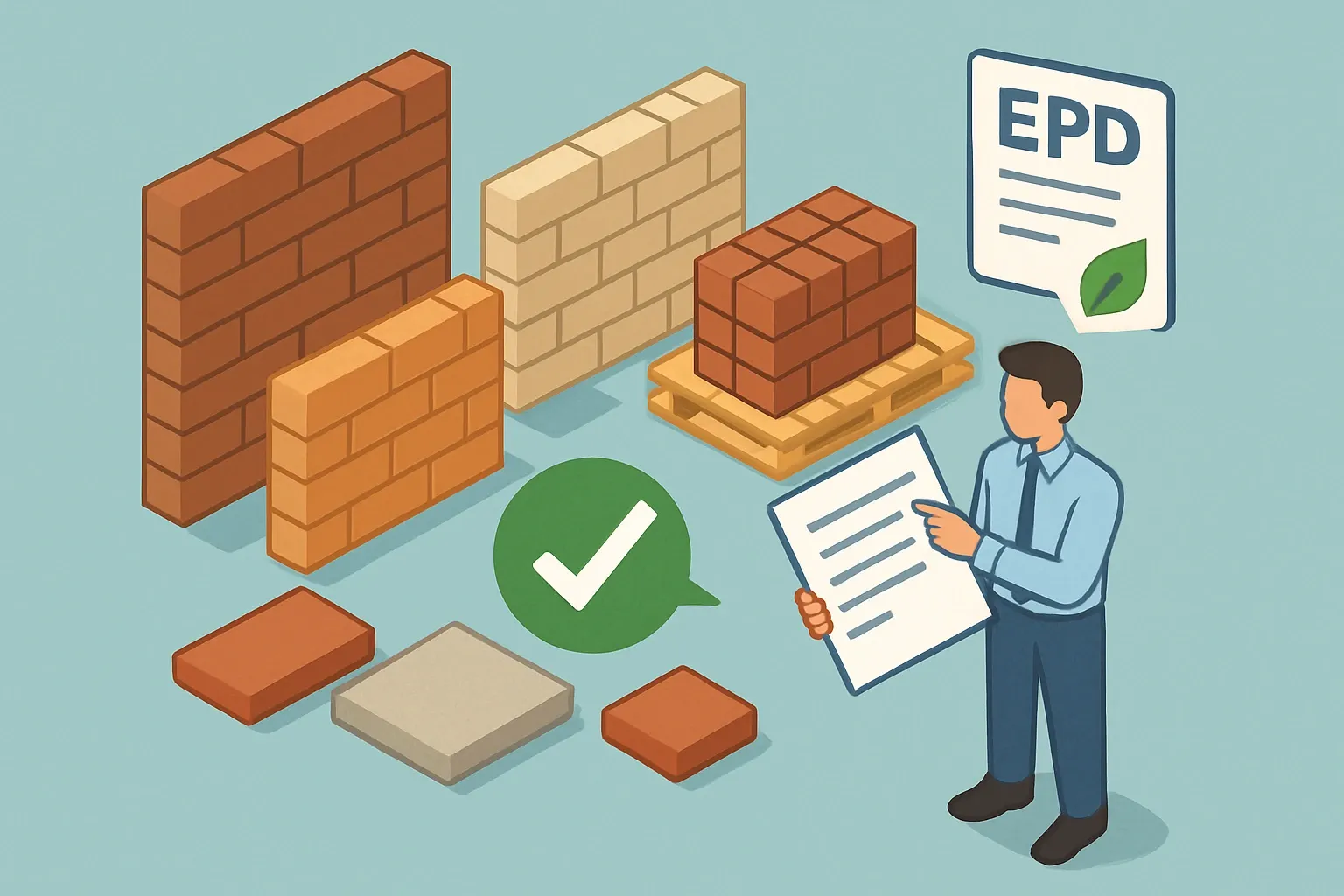
PGH Bricks & Pavers focuses on clay masonry for walls and landscapes. The portfolio centers on pressed and wirecut face bricks, pavers, and architectural specials for residential and commercial building. Think color, texture, and format variety rather than entirely different material families.
Breadth of the range
The catalog spans multiple product series and finishes across standard and premium lines. Based on typical shade and size permutations, the total SKU count sits in the hundreds rather than single digits. That variety helps designers match context, but it only helps you win if those choices are easy to specify.
EPD status today
As of December 11, 2025, we could not locate current, product‑specific EPDs publicly attributable to PGH Bricks & Pavers in widely used registries. That does not mean none exist, only that buyers cannot readily find and reference them during bids. Specifiers don’t want to guess, they want proof. Thats a filter you can control.
Why that gap matters commercially
Many owners and GCs now prefer or require product‑specific EPDs in bid packages to streamline carbon accounting for LEED v5‑aligned goals. Without an EPD, teams often default to conservative generic factors that can push a brick line off the shortlist in favor of a comparable option that is documented.
Work for PGH Bricks & Pavers or competing against them?
Follow us for a product-by-product analysis to see which brick SKUs get spec'd and where EPD gaps may lose you bids.
Competitors you’ll see on the same projects
Locally, Austral Bricks and Midland Brick frequently show up in clay masonry schedules, with niche players like Littlehampton on design‑driven jobs. Internationally, Ibstock and Wienerberger appear on global firm templates, especially where EPDs are common in submittals. Concrete masonry can also substitute in some facades, which brings Austral Masonry into play.
Where EPD‑ready alternatives already exist
Concrete masonry and segmental systems from Austral Masonry carry multiple current EPDs in EPD Australasia, making them easy to reference in tenders (EPD Australasia, 2027). In Europe, Ibstock lists several current brick EPDs via EPD Hub and Egernsund Wienerberger lists over 20 brick EPDs through Danish Technological Institute, which influences global spec packages (EPD Hub, 2029) (Danish Technological Institute, 2027).
A likely best‑seller risk scenario
If a mainstream PGH face brick without an EPD competes against a look‑alike brick with an EPD on a campus or healthcare build, the documented option often gets the nod to keep materials credits and carbon reporting clean. In some cases, a designer may pivot to a concrete masonry veneer with an available EPD to avoid delays.
Fast path to close the gap
- Pick the reference year and facilities. Aim for one full year of production and utilities to avoid rework.
- Align on the right PCR used by your competitive set so results compare cleanly in bids. A good LCA partner will benchmark competitor PCRs before modeling.
- Publish with a recognized operator where your buyers look first. In Australia that is often EPD Australasia, while global practices also recognize EPD Hub and EPD International.
What good looks like for brick EPDs
Tight data collection across clay preparation, forming, drying, firing, and packaging. Clear product mapping so each series and size family is covered without publishing unnecessary SKUs. Sensible grouping that mirrors how estimators buy, so quotes can cite an exact EPD ID with zero back‑and‑forth.
Bottom line for commercial teams
PGH’s range is broad and specification‑worthy, yet the current discoverability of EPDs puts them at a disadvantage wherever documentation gates bids. Closing that gap is straightforward when data collection is painless and the PCR choice mirrors competitors. The payoff shows up in faster approvals and fewer substitutions, which is where wins quietly stack up.