The company in one line
Multistack is a US‑based specialist focused on modular chillers and heat‑pump technology for commercial buildings. Think oil‑free magnetic‑bearing chillers, heat‑recovery units, and packaged air‑to‑water heat pumps built to scale up like Lego.
Product range, at a glance
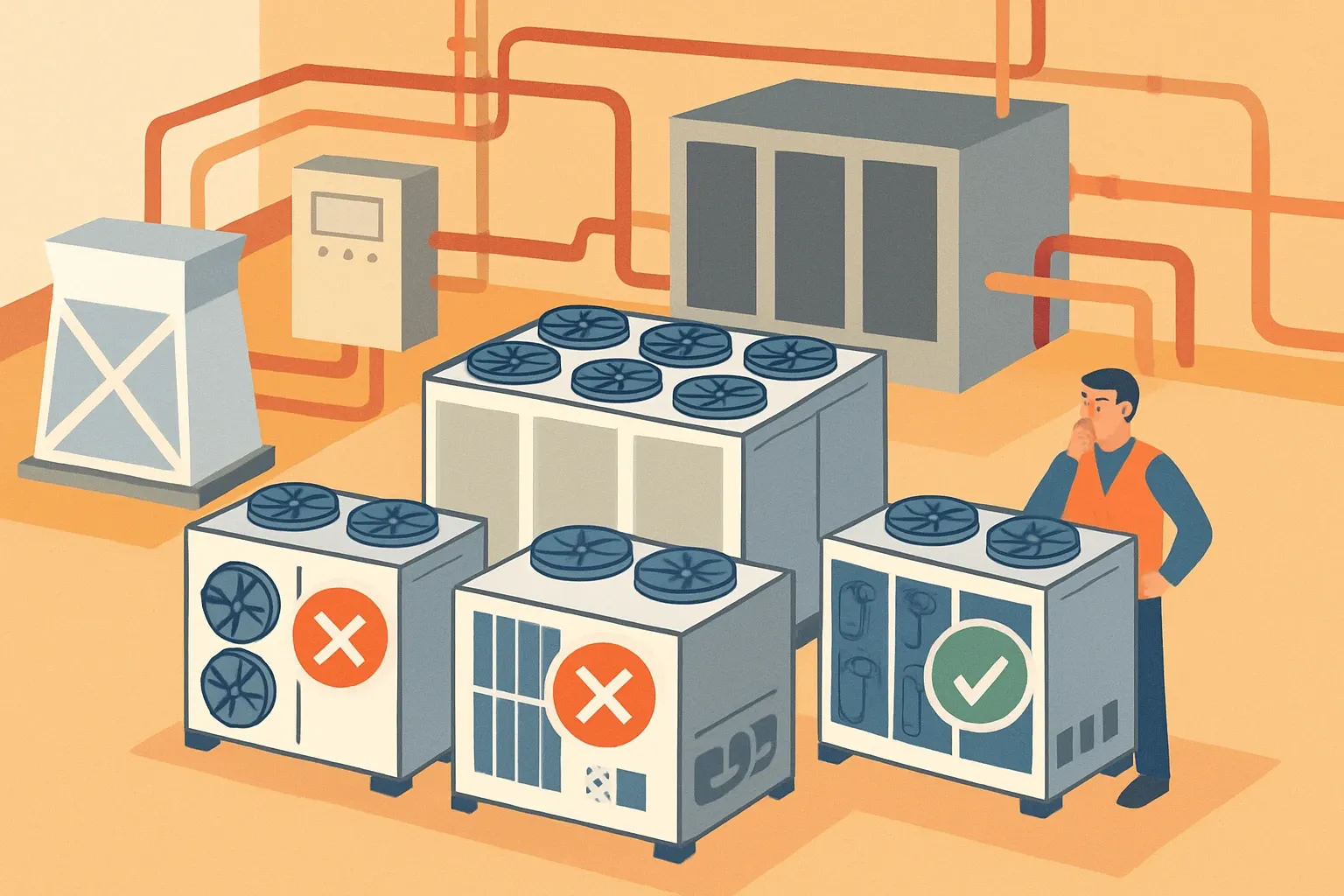
Across several families, Multistack covers water‑cooled and air‑cooled modular chillers, dedicated heat‑recovery chillers, and heat‑pump offerings for space conditioning and domestic hot water. Portfolio depth sits in the dozens of SKUs rather than hundreds, which keeps the range focused and easy to navigate.
How well are these products covered by EPDs
As of December 2025, we do not see product‑specific EPDs for Multistack equipment in major public catalogs that AEC teams typically check when they need documentation. That includes the Association P.E.P catalog, INIES, NSF, UL, and US‑centric registries many owners now reference. Public evidence is sparse, and if an EPD exists behind the firewall of a private portal, it is not helping the specifiability problem.
Why gaps matter on real bids
Many projects now set embodied‑carbon budgets or prefer products with verified, product‑specific EPDs. Without one, project teams often default to conservative factors and sometimes add an extra accounting penalty, which makes substitution more likely and price‑only comparisons harsher. LEED v5 keeps EPDs in the conversation, so the absence shows up right when decisions are made.
Who Multistack runs into on specs
Common opponents on chiller and heat‑pump packages include Trane, Carrier, Daikin Applied, Aermec, Johnson Controls York, Smardt, and Mitsubishi Electric Hydronics. Several of these already publish product‑specific EPDs for large chillers and related equipment, which tilts the playing field in documentation‑driven competitions.
Work for Multistack or selling against them?
Follow us for a product-by-product analysis of EPD coverage and competitive positioning against Trane, Carrier, and more.
Evidence from peers already publishing
- Trane’s Ascend and Sintesis air‑cooled chiller lines appear with current EPDs in the P.E.P operator’s library through 2029 (Association P.E.P, 2029) (Association P.E.P, 2029).
- Carrier’s AquaForce Vision 30KAV series lists multiple chiller models with EPDs expiring in 2028 in INIES (INIES, 2028) (INIES, 2028).
- Carrier’s AquaEdge 19DV water‑cooled centrifugal chiller is published with NSF International through 2029 (NSF International, 2029) (NSF International, 2029).
- Aermec shows a broad slate of packaged water‑chiller EPDs across sizes under Association P.E.P with current validity into 2029 (Association P.E.P, 2029).
These examples are not about performance claims, they are about paperwork readiness. When a spec calls for product‑specific, third‑party verified EPDs, the fastest path to “yes” often wins.
Likely best‑seller at risk
Multistack’s oil‑free, modular magnetic‑bearing chillers are tailor‑made for healthcare, higher‑ed, life‑science and office retrofits where phasing, redundancy, and low sound matter. Those same sectors increasingly filter on EPD availability. If an equivalent tonnage Trane or Carrier model has an EPD on file, it can jump the queue in carbon‑scored vendor screens even before the first submittal lands.
What to prioritize first
- Start with one high‑volume family, for example the modular air‑cooled or water‑cooled chiller line, and build a product‑specific EPD template that can scale to adjacent sizes.
- Pick the common PCR your competitors already use so reviewers can compare apples to apples and your next renewal is predictable.
- Decide on the program operator by market, Smart EPD for many US owners and IBU or INIES for EU‑facing projects both work, then keep the same channel for line extensions to reduce reviewer churn.
- Treat data wrangling as the critical path. Utilities, bills of materials, and process scrap for a defined reference year unlock speed. A white‑glove LCA partner that handles internal outreach and publishing saves engineering hours and cuts calendar time, which is the real cost.
Coverage by category, simple scorecard
- Modular water‑cooled and air‑cooled chillers, visible EPD coverage today appears limited for Multistack, strong among peers noted above.
- Heat‑recovery chillers and air‑to‑water heat pumps, similar story, peers show live EPDs in the catalogs cited while Multistack’s public footprint looks thin.
If an internal or private EPD exists, surface it. If not, the first declaration on a flagship tonnage becomes a sales tool immediately.
The commercial upside of closing the gap
One product‑specific EPD in a high‑run model can flip more than one bid cycle, because it removes a persistent documentation objection and keeps your equipment in play without last‑minute exceptions. We see teams earn back the EPD investment with a single mid‑sized project, sometimes faster, and the process is definately smoother once the first model is through review.
The short path forward
Pick the top seller, lock the PCR and operator, collect one clean reference year of data, then publish and replicate across sizes. Keep the cadence tight so renewals never sneak up. Your competitors have already turned paperwork into a feature, and the sooner Multistack does the same, the fewer specs slip away for avoidable reasons.