Who they are
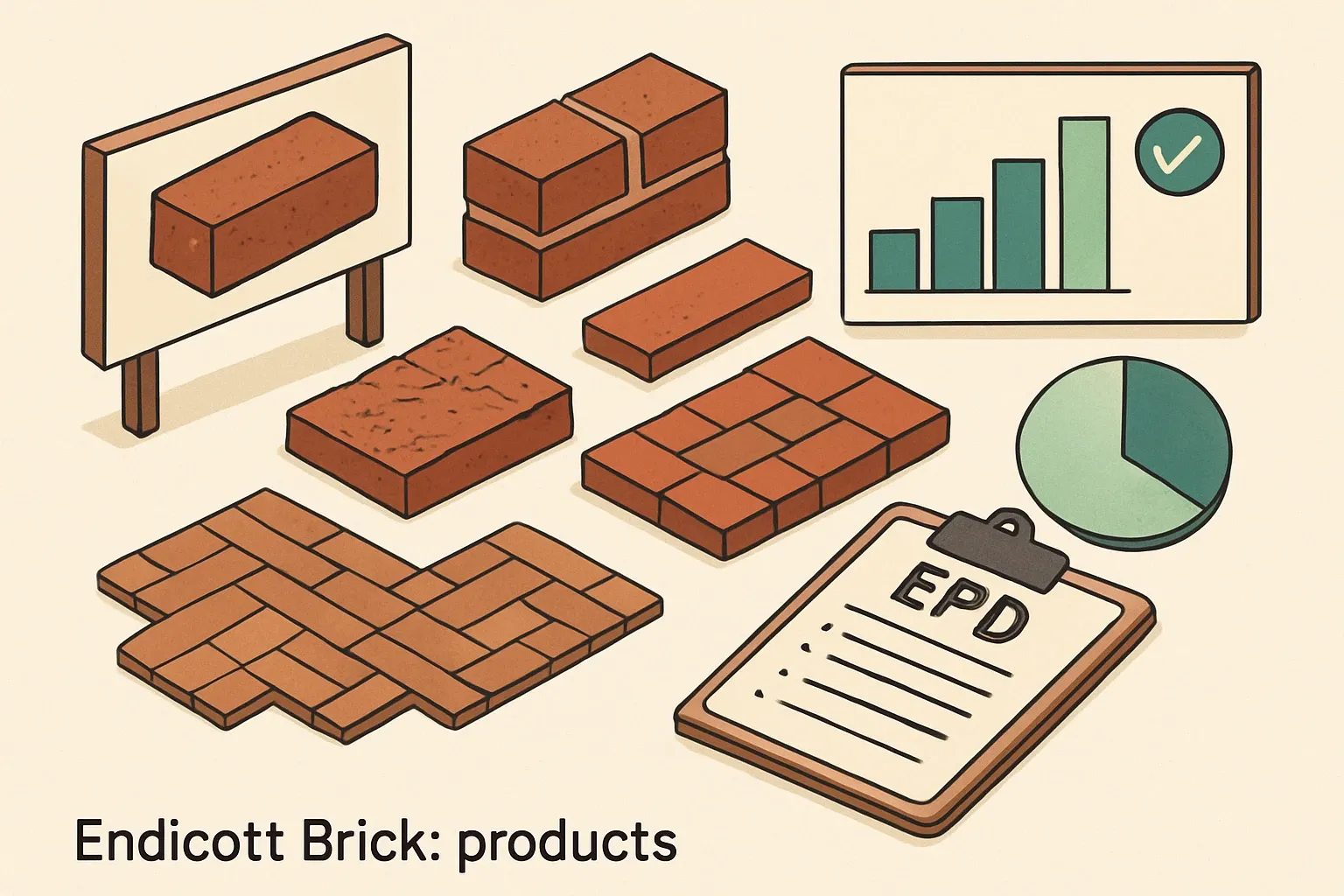
Endicott Clay Products is a Nebraska-based, family-run manufacturer known for architectural face brick, thin brick veneers, pavers, glazed finishes, and special shapes. The catalog spans classic reds through deep charcoals and whites, with multiple textures that play nicely in precast, rainscreen, and veneer assemblies (company profile).
What they sell
Endicott focuses on clay masonry. Expect several product families rather than a sprawling multi-material portfolio. Across colors, sizes, and textures, the total SKUs land in the hundreds. In addition, they market a recycled-brick stabilized pathway aggregate aimed at landscapes where permeability and a natural aesthetic matter (Pathway Aggregate).
EPD status today
Endicott participates in the Brick Industry Association’s new Industry Average EPD for clay masonry products covering face brick, thin brick, pavers, and structural clay tile. The 2025 update is cradle to grave with a 150‑year reference service life and uses data representing 39.3% of U.S. production by 2023 output (BIA, 2025) (BIA, 2025; Business Wire, 2025). This is useful on projects that accept industry-average declarations.
Where coverage is thin
We did not find public, product‑specific or plant‑specific EPDs for Endicott as of December 19, 2025. That gap matters when specifiers want product‑ and plant‑level results, or when owners set stricter procurement criteria under corporate carbon policies. On those bids, an industry‑average EPD can keep a product in play, yet a product‑specific declaration often keeps it preferred.
At Endicott or competing against them?
Follow us for product-by-product EPD analysis to uncover which brick lines win specs and where gaps could cost you bids.
Why that matters for specs in 2025
More owners ask design teams to evidence embodied carbon with third‑party verified data. Without a product‑specific EPD, teams may apply conservative default values, which can make a material look heavier on paper than it truly is. That penalty nudges them to shortlist alternatives that publish product‑specific results. One missed shortlist is invisible revenue.
Likely best sellers at risk
Thin brick and face brick in popular neutrals are frequent front‑runners. If a best‑selling thin brick lacks a product‑specific EPD, design teams can pivot to another thin brick brand with a published declaration, or even swap to terracotta or porcelain systems that commonly publish EPDs. That is not just a sustainability story, it is a spec‑stickiness story.
Competitors you meet at the table
In commercial work, Endicott often runs against Glen‑Gery, General Shale, Acme, Belden, Pine Hall Brick for pavers, Summit, Triangle, and regional thin brick specialists. On projects with tight embodied‑carbon guardrails, the brand that puts credible, recent EPDs in the submittal package tends to win the tie.
What a fast EPD rollout could look like
- Start with one high‑volume face brick and one thin brick line to maximize spec impact. Choose plants with stable processes and good utility metering.
- Align to the PCR used by peer EPDs so buyers can compare apples to apples, then schedule verification with a recognized operator.
- Make data collection the critical path. The easiest programs shoulder the internal wrangling so engineering and operations stay focused on throughput. That is how timelines shrink without quality tradeoffs.
A note on Endicott’s sustainability angles
The stabilized pathway aggregate made from recycled brick and an organic binder is a smart circular move. It signals a materials story that would pair well with product‑specific EPDs for headline brick lines. Put simply, marketing has a stronger hand when enviromental data matches the design narrative.
Final take
Endicott is a focused brick pure play with breadth across face brick, thin brick, pavers, and glazed offerings. Industry‑average coverage via BIA is in place for the core categories (BIA, 2025). The commercial upside now sits in moving one or two flagship products to product‑specific EPDs, then repeating for the next wave. That keeps favorites on the spec and avoids last‑minute swaps when carbon targets tighten.