Who Dickson is and what they sell
Dickson is the flooring arm of French textile maker Dickson‑Constant, best known for design‑forward woven vinyl surfaces. The offer centers on commercial tiles and planks, broadloom‑style rolls, and made‑to‑order rugs, plus acoustic backings and a growing set of bio‑based options like the 2025 Boréal collection. The aesthetic spans subtle tweeds to bold graphics, built for heavy‑traffic interiors.
How focused is the catalog
This is a concentrated play. Dickson is not a generalist across carpet, rubber, wood, and LVT. They specialize in woven vinyl for interiors, with colorways and textures that add up to dozens of SKUs across a handful of design ranges. That focus helps designers coordinate floors and rugs from the same weave family without hopping brands.
EPDs today: what exists and what’s missing
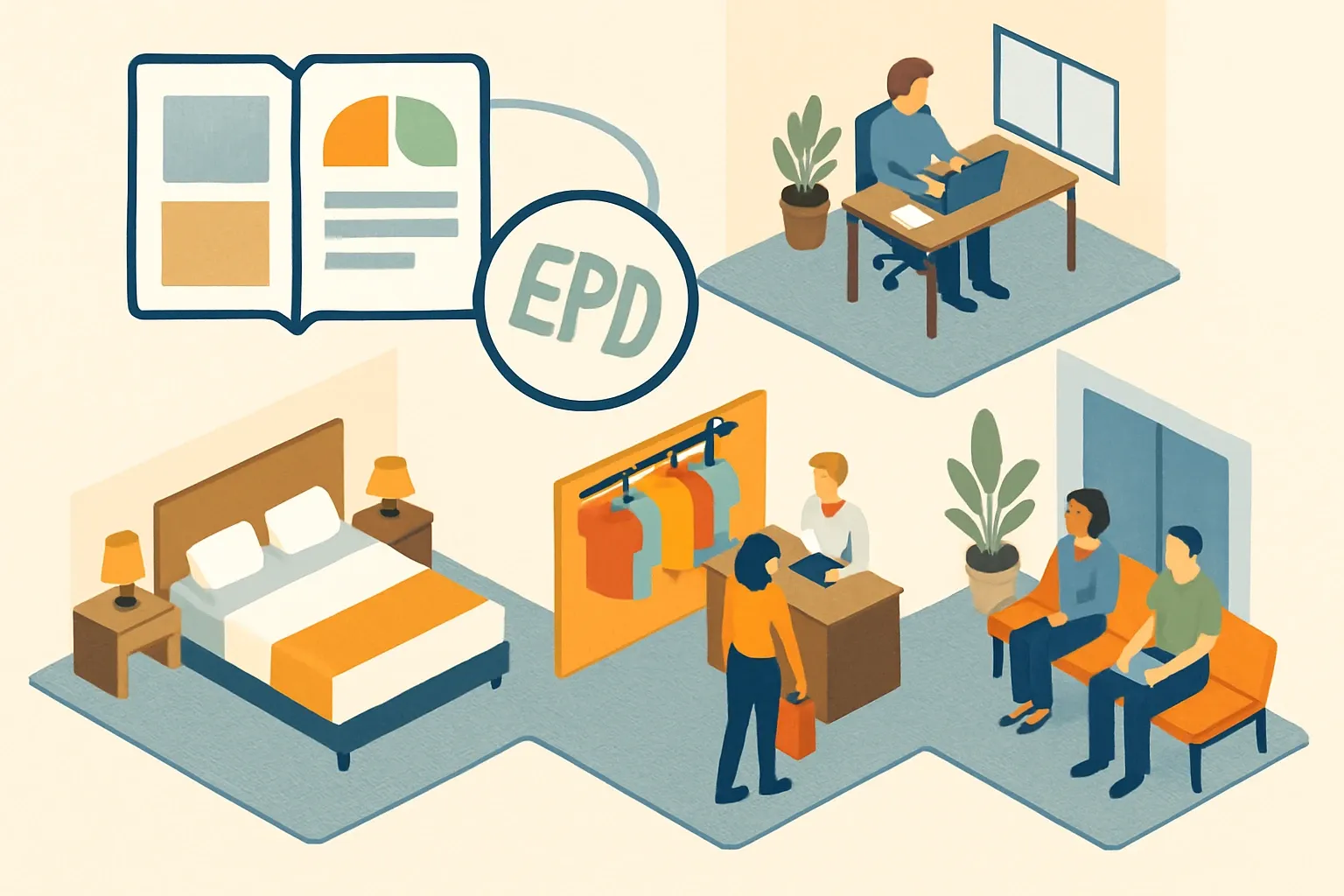
Based on publicly visible records, Dickson has an environmental declaration for its woven vinyl flooring published through France’s INIES program, and separate declarations for solar‑protection textiles under the parent company. Coverage appears portfolio‑level rather than SKU‑by‑SKU. In practice, that means many colorways, formats, and backing variants are not individually named in program‑operator listings right now.
Dickson also highlights a woven‑flooring LCA on its site, which is helpful for conversations but does not replace a third‑party verified, product‑specific EPD when LEED documentation is required (USGBC Credit Library, 2024). If your spec hinges on counting weightings, that distinction matters.
Why EPD coverage matters commercially
LEED’s materials credit still rewards breadth of disclosures. Projects typically need at least 20 qualifying products from five manufacturers, and a product‑specific Type III EPD with external verification counts as 1.5 products toward that total (USGBC Credit Library, 2024). LEED v5 was ratified on March 28, 2025 and keeps the disclosure emphasis while tightening embodied‑carbon outcomes, so having verified EPDs remains a fast pass through materials reviews (USGBC, 2025).
At Dickson or competing against them?
Follow us for product-by-product EPD analysis to see which woven vinyl SKUs get spec'd and where EPD gaps could impact your bids.
Likely best sellers that could be exposed
Design‑led ranges that show up in offices and hospitality, including acoustic‑backed tiles and planks, are strong candidates for your project lists. Where we could not find product‑specific EPDs per backing or per weave, submittals may default to conservative values. That can push a procurement team to swap in a like‑for‑like material that carries a verified EPD to keep the credit on schedule. No one likes last‑minute substitutions.
Competitors you’ll meet in the spec arena
- Bolon, another woven‑vinyl specialist, publishes multiple product‑specific EPDs with a European program operator and is common in the same hospitality and workplace briefs.
- Broad‑portfolio players such as Tarkett, Shaw Contract, Interface, and Forbo often propose resilient or textile alternatives in the same spaces. They typically field deep benches of current EPDs across many platforms, which gives them flexibility when a project tightens disclosure rules.
- Chilewich appears in design‑centric projects with woven floor textiles and does have declared coverage for select backings. Availability varies by SKU and backing, so teams double‑check early.
Sustainability stance and signals
Dickson communicates a broader “Greenovation” program with goals on PFAS substitution, recycled content loops, and scope 1 and 2 reductions. If you want to see how they frame their roadmap, their sustainability hub is here: Greenovation. For materials teams, that page is useful context during owner reviews.
What this means for getting specified more often
Specifiers prize predictability. A product‑specific, third‑party verified EPD removes friction in LEED material counts and avoids penalties that come with generic assumptions. If a project is aiming high on LEED v5 while tracking embodied carbon across the bill of materials, a verified EPD keeps your woven vinyl in play rather than forcing a late alternate. It’s not just compliance. It’s speed through approvals and fewer price‑only battles.
A practical playbook if you’re on Dickson’s team
- Map the portfolio by format and backing, then prioritize EPDs for the top ten revenue SKUs that drive most quotes.
- Align on the dominant PCR used by competitors in resilient and woven categories so reviewers can compare apples to apples.
- Choose a program operator familiar to your target markets to streamline reviewer trust. Publish once, reuse the documentation everywhere.
- Make data capture a white‑glove process so R&D and plant teams aren’t buried in spreadsheets for months. Speed matters when a bid is live.
Bottom line
Dickson brings a clear, design‑first woven vinyl story and a focused lineup measured in dozens of SKUs. EPD coverage is present but not yet comprehensive at the SKU level, which can slow submittals on projects that reward product‑specific declarations. Close those gaps and the brand’s specability jumps. For specifers, that’s the moment when the right look also becomes the easy choice.
Small note for teams tracking credits. Product‑specific Type III EPDs still earn the 1.5x weighting toward the materials disclosure tally in current LEED guidance (USGBC Credit Library, 2024).