Who they are
AluK Group and FEAL both play in architectural aluminum. AluK is a system house known for windows, doors, sliding solutions, and curtain walling. FEAL manufactures aluminum profiles and supplies façade and fenestration systems across similar applications.
Across catalogs, they cover several categories that typically matter to commercial projects, from windows and entrances to stick curtain walls and accessories. SKUs stretch from dozens of named systems to hundreds of profile variations.
What’s covered by EPDs today
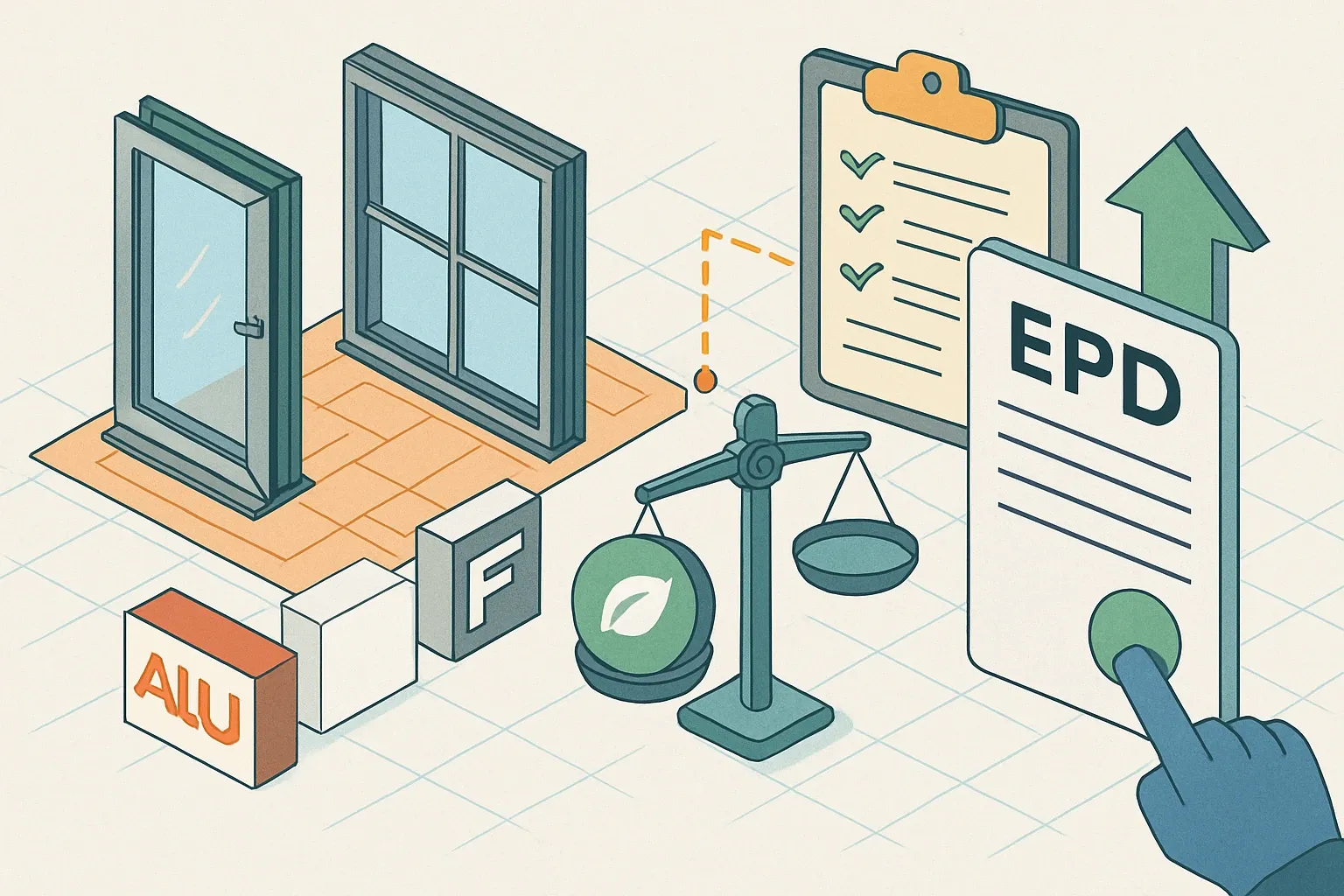
As of December 19, 2025, publicly listed EPDs show AluK with product EPDs for its C67K and C77K turn and tilt windows and the SL50 stick curtain wall, both under EPD International AB. FEAL lists a current EPD at ift Rosenheim covering aluminum profiles for windows, doors, and façades.
Most program operators set EPD validity at 5 years, so portfolios tend to refresh on that cadence (IBU General Program Instructions, 2024) (IBU, 2024). If a PCR updates, the next renewal typically aligns to the newer rule but the existing EPD remains valid until expiry.
Where coverage looks strong
Windows have a foothold. The AluK C67K and C77K declaration gives specifiers a product‑specific route for common window packages. Classic stick curtain wall is also supported through SL50, which helps on mid to high rise projects where a system EPD is often requested.
Work for AluK or selling against them?
Follow us for a product-by-product EPD analysis to understand which systems get VE'd out against Kawneer or YKK AP and where you can close critical gaps.
Likely gaps worth closing
Sliding doors, thermally broken entrance doors, storefront framing, and unitized curtain wall do not appear with current AluK system EPDs. FEAL’s profile EPD is useful for semi‑finished material accounting, yet many project teams still ask for system‑level declarations that match the installed assembly. That distinction often decides whether a product sails through material credits or triggers conservative assumptions.
Why the gaps matter to sales
LEED v5 drafts and many owner policies continue to prefer product‑specific EPDs in material selections. When a system lacks one, design teams often apply default or penalized factors in carbon accounting, which can push a product out of contention even if performance is solid. No one wants to lose a spec on paperwork, but it happens, definately.
Competitive set on typical projects
On North American and EU jobs, AluK and FEAL often meet Kawneer, YKK AP, Schüco, and Reynaers in the same bid room. Those competitors publish broad EPD portfolios that cover storefronts, entrances, windows, window walls, and curtain walls. For example, storefront and entrance systems with current EPDs are common at Kawneer and YKK AP, while Schüco posts both system and profile declarations across windows and façades.
A concrete example of missed spec risk
Entrance doors and storefronts are frequent early‑scope packages on offices, education, and healthcare. Without a product‑specific EPD for an AluK door or storefront, a specifier can default to a competitor with a current entrance or storefront EPD and keep the submittal clean. That swap preserves schedule, protects the project’s carbon target, and quietly reroutes revenue.
Fast path to close the distance
Start where volume meets visibility. Prioritize EPDs for the highest‑run sliding system, the main thermally broken entrance door, and the go‑to storefront family. Pick the same PCRs competitors use so comparability is clear to reviewers. Treat data collection like a production run by locking a reference year, pulling utilities and scrap consistently, and lining up supplier declarations early.
A well‑orchestrated partner can simplify the internal lift by coordinating plants, ERP pulls, and supplier outreach, then publishing with the operator most accepted in your target market. The result is speed, fewer internal interrupts, and declarations you can bid with confidence.
Bottom line for specability
AluK and FEAL already have credible footholds in windows and profiles. Expanding to entrances, storefronts, sliding systems, and unitized curtain wall would better mirror how project teams actually buy. Closing those gaps turns EPDs from a compliance checkbox into a reliable lever for wins.