What we looked for, and what we found
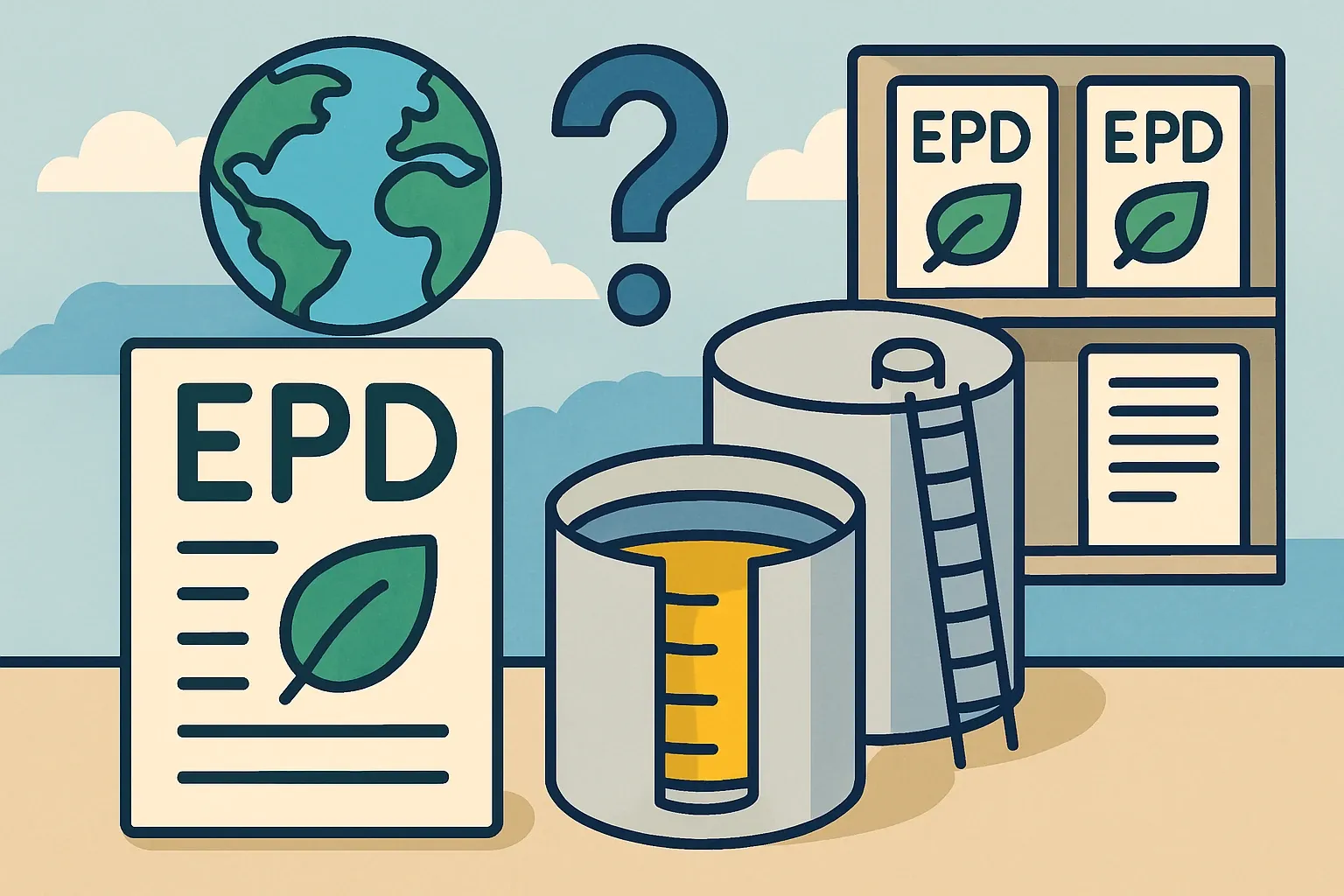
We scanned the public libraries of leading EPD program operators for an industry‑wide Environmental Product Declaration that explicitly covers tank linings as a product class. Nothing turned up. What does exist are product‑specific EPDs for individual immersion‑grade epoxies and protective coatings, often used on tanks, but no association‑level baseline that a whole sector can adopt.
Why a sector average EPD for tank linings is rare
Tank linings are not one recipe. Chemistries range from bis‑A and novolac epoxies to vinyl esters and polyurethanes. Service conditions swing from potable water to aggressive hydrocarbons, from ambient cure to elevated‑temperature cycles. Substrates vary between carbon steel and concrete. One average tends to be a blunt instrument that fits nobody well, so sector groups have not published a shared EPD here.
United States and Canada: product‑specific rules, real examples
North American coatings EPDs are commonly published under program operators that accept the Architectural Coatings PCR or technical‑chemical cPCRs. Several mid‑market protective brands already publish product‑specific EPDs for immersion‑capable coatings used on tanks.
- Carboline Carboguard 635 VOC lists an Environmental Product Declaration on its product page. The coating is an immersion‑grade epoxy used across industrial service, including tanks (Carboline product page).
- Specialty Polymer Coatings SP‑2888 RG, widely used for internal pipe and tank work, publishes an EPD in its product documents library (SPC product details).
These are product‑specific EPDs. They let specifiers model actual impacts for a declared formulation instead of a generic proxy. That typically improves how a whole‑building LCA treats your scope and it avoids the hidden penalties many owners apply to unknowns.
At Carboline or competing in tank linings?
Follow us for product-by-product EPD comparisons to see which tank lining coatings get spec'd and where EPD gaps may impact your bids.
Europe: similar story, different operators
Across Europe, protective and immersion‑capable coatings are published under EN 15804‑aligned programs. You will find many coating EPDs, yet none that declare a sector average for “tank linings” as a distinct category. A quick illustration from the Nordics is Carboline Norge’s heat‑resistant immersion‑grade coating with an EPD valid to 2029, hosted by EPD Norway (THERMALINE 440 record).
If a sector average appears later, should you use it?
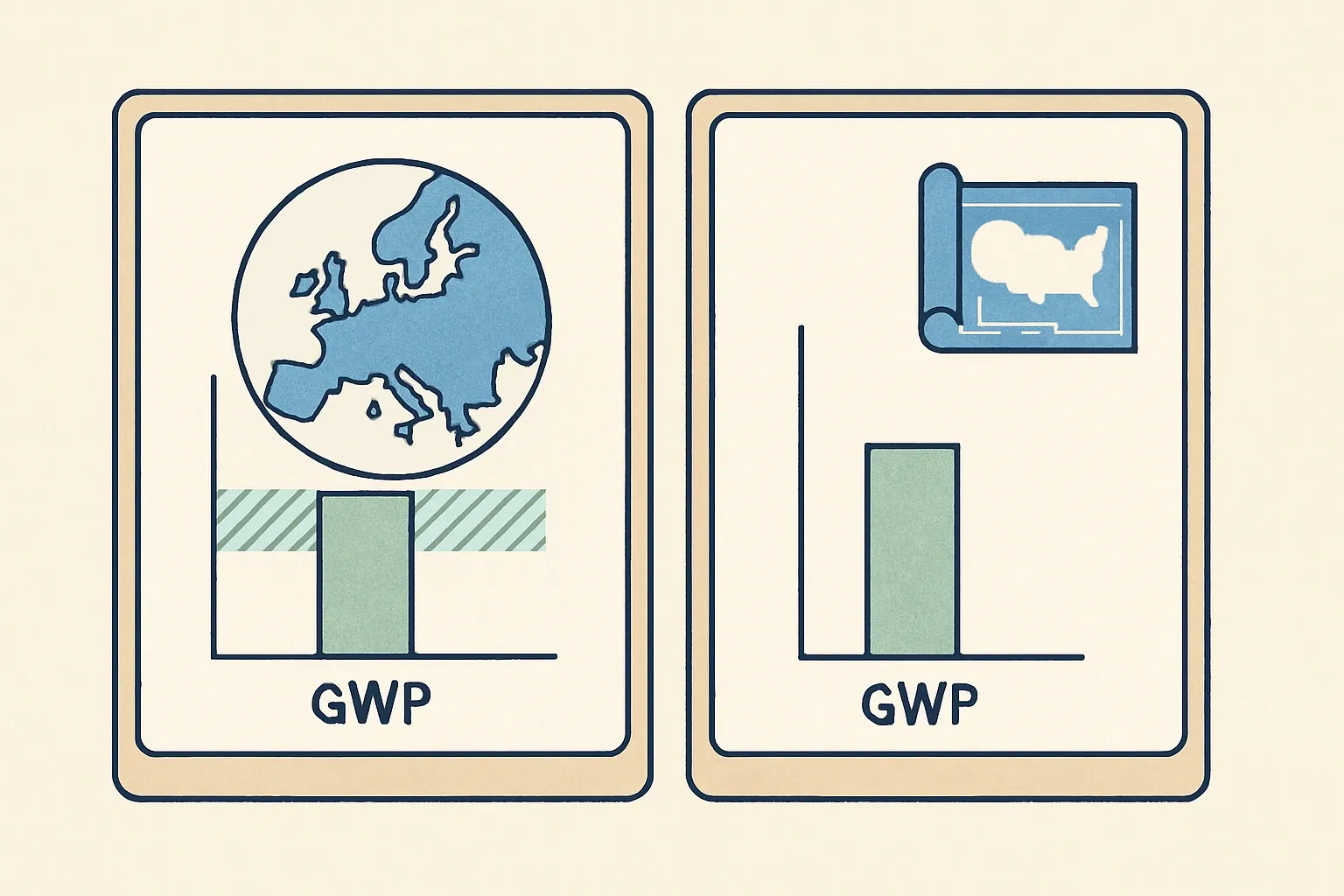
Industry‑wide EPDs are designed to be conservative. They protect the average, not the best. When a model uses a conservative baseline, your product starts behind on embodied carbon and related metrics even if your chemistry or plant energy mix performs better. A product‑specific EPD shows your real number. That is the number project teams can actually select for carbon budgeting.
Commercial takeaway for tank projects
On bids that require EPDs, teams must choose between a product with verified, product‑specific data and a product that forces them to plug in a pessimistic default. Most choose speed and certainty. A product‑specific EPD makes you the easy button and it tends to pay back fast on even one mid‑sized storage job. It is definately the kind of document that keeps you in the last round of substitutions.
Getting to a product‑specific EPD without the grind
Pick the right PCR and program operator for your market. For North America, coatings often rely on the Architectural Coatings PCR or a technical‑chemical cPCR. In Europe, many protective coatings use Part B requirements for coatings with organic binders. A strong LCA partner will benchmark the PCR your competitors use, plan data pulls around a defined reference year, and handle verification logistics so your technical team can stay on production.
Positive examples you can point to today
If leadership wants proof that peers already moved, point them here:
- Carboguard 635 VOC, Environmental Product Declaration linked on the manufacturer’s page (Carboline).
- SP‑2888 RG Brush Grade, Environmental Product Declaration in the product documents (Specialty Polymer Coatings).
- Thermaline 440, EPD listed by EPD Norway through 2029 for an immersion‑capable epoxy phenolic (EPD Norway record).
None of these are sector averages. They are better. They are specific, verifiable, and spec‑ready.
Bottom line for “tank linings EPD” searches
There is no industry‑wide or sector average EPD for tank linings available from the major operators as of December 2025. If tank work is strategic, commission a product‑specific EPD for your top lining system. It removes modeling penalties, signals reliability to project teams, and helps you win specs where a generic placeholder would have kept you out.