The quick answer
Industry‑wide EPDs for vinyl flooring are available. In North America, the Resilient Floor Covering Institute (RFCI) published 2024 industry‑wide EPDs for Luxury Vinyl Tile (LVT) gluedown, LVT looselay, and rigid‑core vinyl categories SPC and WPC (RFCI, 2024) (RFCI, 2024). In Europe, the Multilayer Modular Flooring Association (MMFA) issued association EPDs for Vinyl‑HDF in 2024 and Vinyl‑SPC in 2025, both verified by IBU (MMFA, 2024; MMFA, 2025) (MMFA, 2025).
What these “sector average” EPDs actually are
An industry‑wide or sector‑average EPD aggregates data from multiple manufacturers to describe a representative product. It helps design teams when a product‑specific EPD is not available. EPDs typically carry a five‑year validity window under EN 15804 or equivalent program rules (IBU, 2025) (IBU, 2025). PCRs that govern flooring also review on roughly five‑year cycles, which is why you’ll see refreshes announced periodically (UL Solutions, 2025).
North America snapshot: where to point people
RFCI’s 2024 portfolio lists nine resilient categories, including LVT gluedown, LVT looselay, SPC rigid core, and WPC rigid core. All follow the UL Part B Flooring PCR and are third‑party verified. Practical takeaway for sales and spec teams: if a project asks for an EPD on “LVT” or “rigid‑core LVT,” you can supply the RFCI industry‑wide document while a product‑specific one is in progress (RFCI, 2024) (RFCI, 2024).
Europe snapshot: what exists today
MMFA now offers association EPDs for vinyl sub‑categories. Vinyl‑HDF floor covering is valid from June 4, 2024 to June 3, 2029 under IBU verification, and Vinyl‑SPC is valid from 2025 to 2030 (MMFA, 2024; MMFA, 2025) (MMFA, 2025). ERFMI historically provided generic vinyl EPDs; some are legacy 2019 documents and may not reflect EN 15804+A2 updates in every market (ERFMI, 2019).
Why industry‑wide EPDs are helpful yet conservative
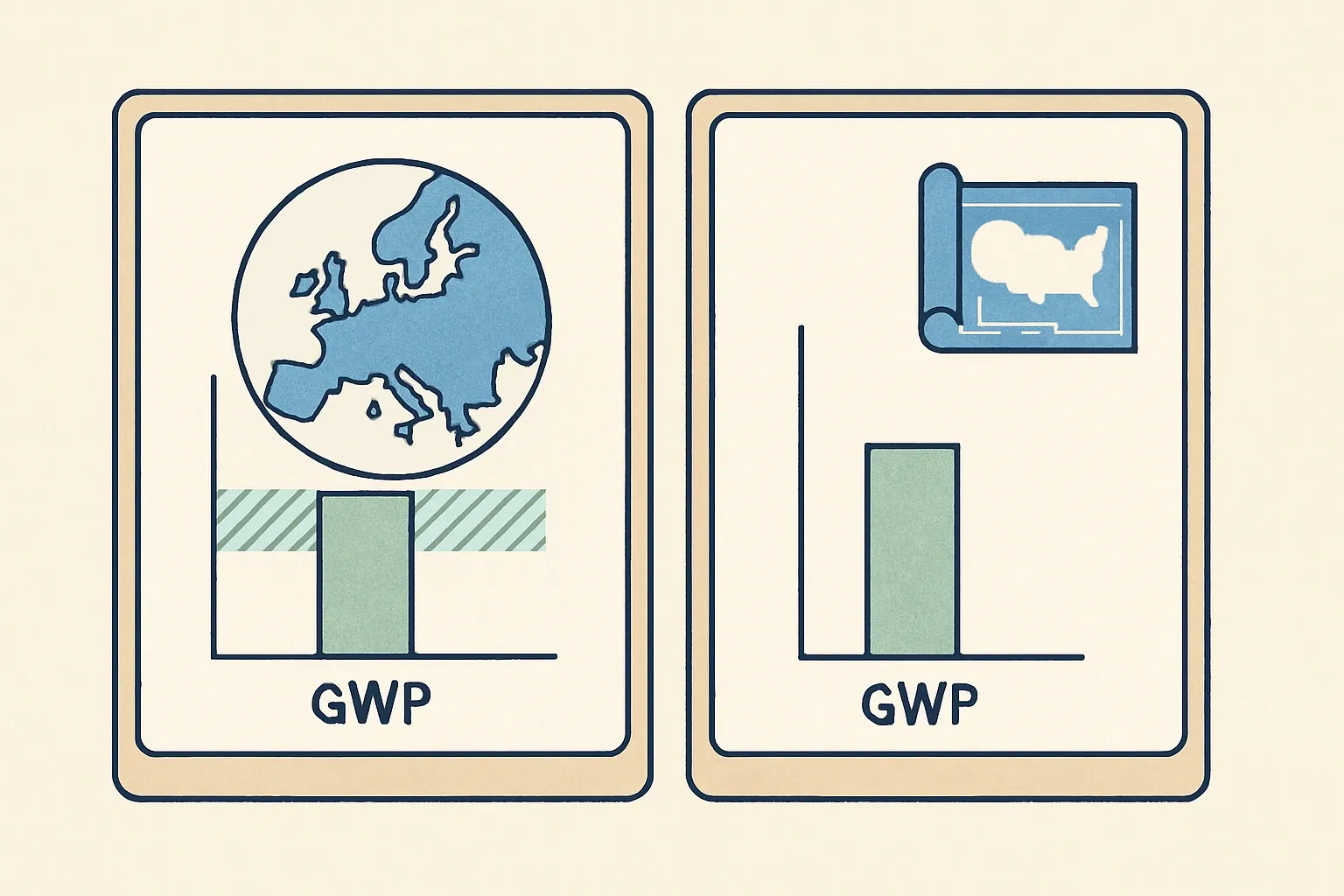
Think of a sector‑average EPD like the league average in baseball. It sets the baseline, not your highlight reel. Recent baselines illustrate this. For LVT, Carbon Leadership Forum’s 2025 dataset shows an industry‑average A1–A3 global warming potential (GWP) around 10.7 kg CO2e per m², while product‑specific EPDs span a wide range beneath and above that mean. Rigid‑core averages sit near 9.7–11.9 kg CO2e per m² depending on construction, again with outliers that perform better than the average (CLF, 2025). If your process beats the average, relying on the sector number hides your advantage.
Want to win more specs with vinyl flooring EPDs?
Follow us on LinkedIn for insights on how product-specific EPDs can differentiate your offerings and boost your ROI.
Commercial angle: why a product‑specific EPD wins more specs
Many whole‑building LCA workflows plug in sector averages when product EPDs are missing, sometimes with additional conservatism. That can make your material look heavier on carbon than it actually is, nudging projects toward competitors who do publish. A verified, product‑specific EPD removes that penalty and often lifts your product into preferred status. Teams that move fast here don’t just comply, they differentiate.
Competitor signal check: who already publishes product‑specific LVT EPDs
Not a complete list, but enough to show momentum across regions and formats:
- Karndean Designflooring publishes multiple LVT EPDs through SCS Global Services across gluedown, looselay, and rigid‑core ranges.
- Metroflor lists several product‑specific EPDs for commercial LVT formats with SCS verification.
- HMTX/Aspecta has rigid‑click and other resilient EPDs verified through SCS and IBU.
- Mannington Mills holds LVT EPDs verified by NSF for common thicknesses. If these are your peers, the market is already moving. Don’t get left squinting at spreadsheets becuase the spec went elsewhere.
How to use this if you manufacture LVT or SPC/WPC
Start now with the relevant industry‑wide EPD to satisfy immediate bid requests, then commission product‑specific EPDs for your top sellers and plants. Prioritize the SKU families with the largest volumes or clear process advantages. Keep a five‑year renewal calendar and align reference‑year data with your fiscal cycles so updates feel routine, not heroic (IBU, 2025) (IBU, 2025).
The bottom line
Yes, sector‑average EPDs exist for vinyl flooring. They are a credible bridge that gets you in the door, yet they are averages by design. When your real‑world footprint beats the average, a product‑specific EPD tells that story and tends to pay back quickly in won specifications. Use the league average to play, but publish your own stats to win.
Source notes
- RFCI’s 2024 industry‑wide EPD suite lists LVT gluedown, LVT looselay, SPC and WPC for North America (RFCI, 2024) (RFCI, 2024).
- MMFA association EPDs for Vinyl‑HDF and Vinyl‑SPC are valid 2024–2029 and 2025–2030 respectively under IBU (MMFA, 2024; MMFA, 2025) (MMFA, 2025).
- Carbon Leadership Forum’s 2025 Baselines summarize industry‑average vs product‑specific GWP for resilient flooring categories (CLF, 2025).
- EPD validity is generally five years under EN 15804 program rules (IBU, 2025) (IBU, 2025).