What exists right now in the United States
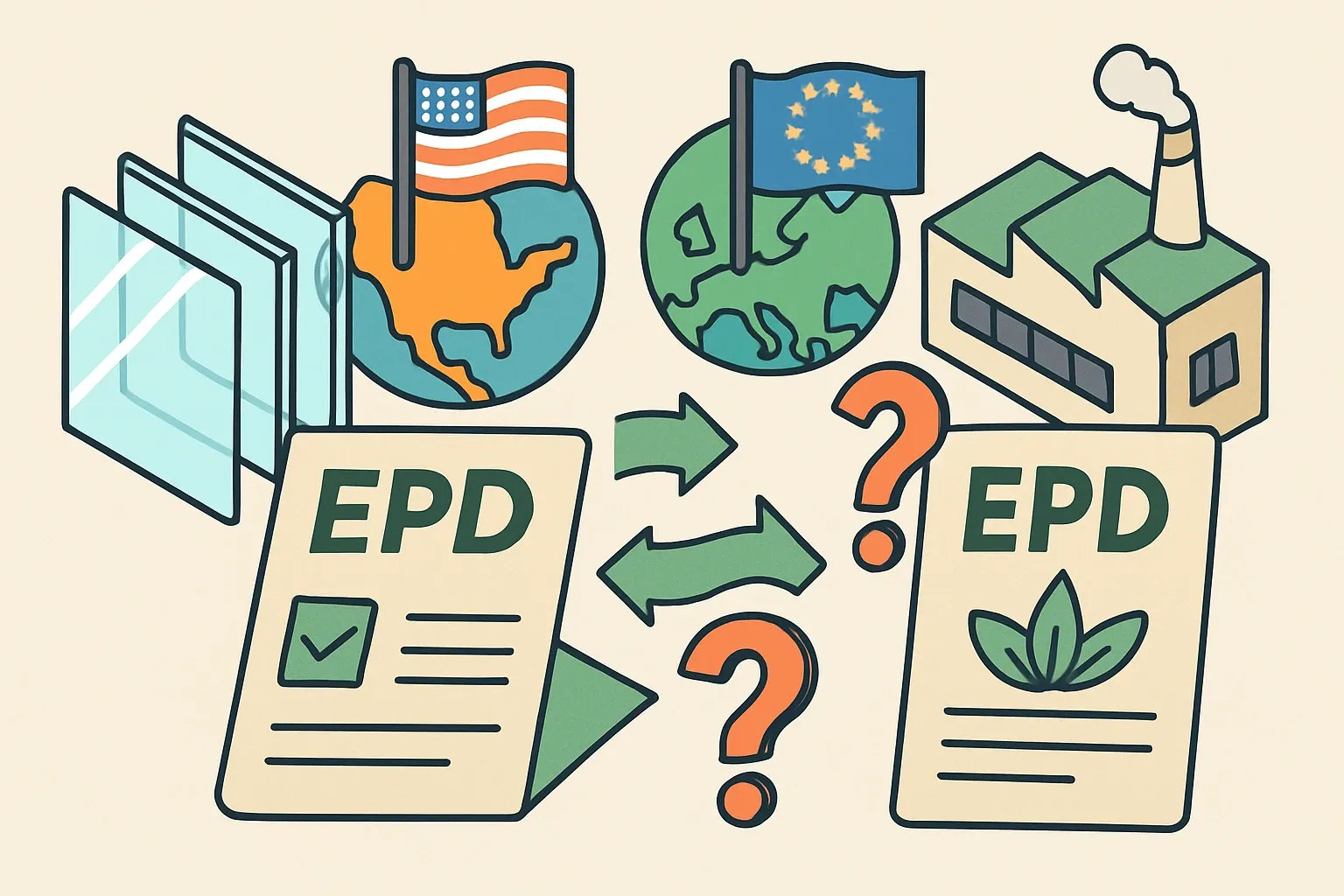
There is no U.S. industry wide EPD dedicated to laminated safety glass. The National Glass Association published an industry average flat glass EPD that explicitly covered unprocessed annealed glass only and it reached the end of its five year validity on December 20, 2024 (NGA, 2024) (NGA, 2024). That leaves fabricators of laminated glass without a U.S. sector average to cite.
NGA has funding to raise the tide. In July 2024, EPA selected NGA for a 2.1 million dollar assistance grant to improve processed glass EPDs and tools, including support for fabricators. This is aimed at expanding EPD coverage for processed categories that include laminated glass (NGA, 2024) (NGA, 2024).
Where a sector average EPD does exist
In Germany and some EU markets, the Bundesverband Flachglas and ift Rosenheim offer verified “Muster EPD” templates that represent sector averages for several glass product groups. One of these templates covers laminated safety glass, known locally as Verbundsicherheitsglas, and can be transferred to individual manufacturers once qualifying conditions are confirmed. These are created under EN 15804 and verified by ift Rosenheim.
If you operate across the EU, check your program operator’s rules and local buyer preferences before using a template EPD. Some clients will still ask for product specific declarations.
Competitors already publish product specific EPDs for laminated glass
Plenty of mid sized and multinational peers publish product specific EPDs that include laminated constructions and laminated IGUs. Recent examples include Guardian Glass in Europe for laminated flat glass ranges, Viracon in the U.S. for multiple processed units that include laminated configurations, and AIS in India for laminated safety glass under the International EPD System. Viracon states it offers fourteen product specific EPDs, which signals how common this has become in commercial glazing (Viracon, 2025) (Viracon, 2025).
This matters commercially. When a whole building LCA is run, a product with a verified EPD gets modeled with its declared impacts. A product without one gets modeled with generic or conservative defaults. Specs tend to favor the option with dependable data.
Manufacturing laminated safety glass and facing competition?
Follow us for a product-by-product analysis that reveals how your offerings stack up against competitors like Guardian Glass and Viracon.
Why sector averages help and where they fall short
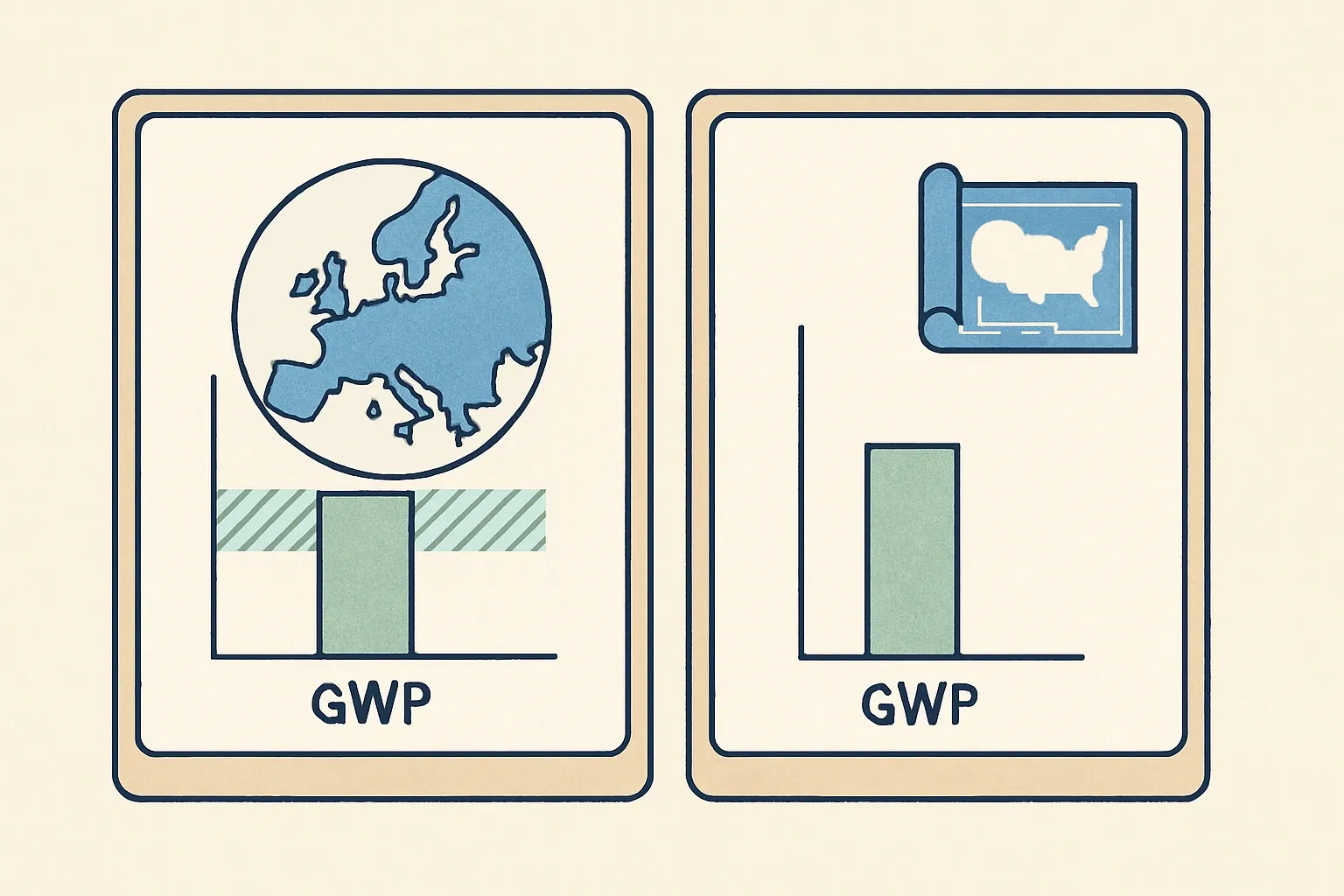
Sector average or industry wide EPDs are useful entry tickets. They give buyers something credible to reference and they clear minimum documentation bars in many tenders. Template based EPDs in Europe are designed around average data and a clearly conservative approach, often described as reflecting a worst case plus a safety margin so they are transferable.
That conservative center of gravity is the downside. If your process uses higher recycled content cullet, optimizes yield, or runs efficient furnaces, your actual impacts can be materially lower than a sector average. Only a product specific EPD lets you claim that advantage with third party verification.
The upside of going product specific for laminated safety glass
Think of an industry average as the league table’s middle. A product specific EPD lets your product move up the table by reflecting real process and supply choices. It can cut the modeling penalty designers face when they must use generic or sector average values. On large facade packages, that difference can be decisive.
We also see a branding lift. Teams that publish product specific EPDs for their laminated lines usually standardize data collection across plants, clean up bills of materials, and get faster at answering carbon RFIs. That agility wins time on fast moving jobs.
Regional notes worth knowing
Europe has clearer pathways today for a laminated sector average via ift Rosenheim and BF. The U.S. is catching up with tools and data development focused on processed glass categories, which include laminated safety glass. If your sales footprint crosses borders, plan for both use cases and keep an eye on program operator guidance.
If you decide to commission an EPD, choose a partner for speed and sanity
Pick a team that will actually collect data from your lines, not hand you spreadsheets. Ask for clear project management, experience with the flat and processed glass PCRs, and publishing options with operators accepted in your target markets. Insist on practical guidance on which PCR competitors use so your EPD aligns with buyer expectations. You should not have to chase utility invoices or reconcile production volumes yourself, your partner should handle that heavy lifting end to end.
Bottom line
For laminated safety glass, there is no U.S. industry wide EPD today, while a sector average route exists in parts of Europe through ift Rosenheim and BF. That makes a product specific EPD the stronger play in most markets. It turns your real process advantages into verifiable numbers and helps teams model projects without conservative penalties. If you can move quickly to publish, you will likely recieve an outsized return in specifications won.