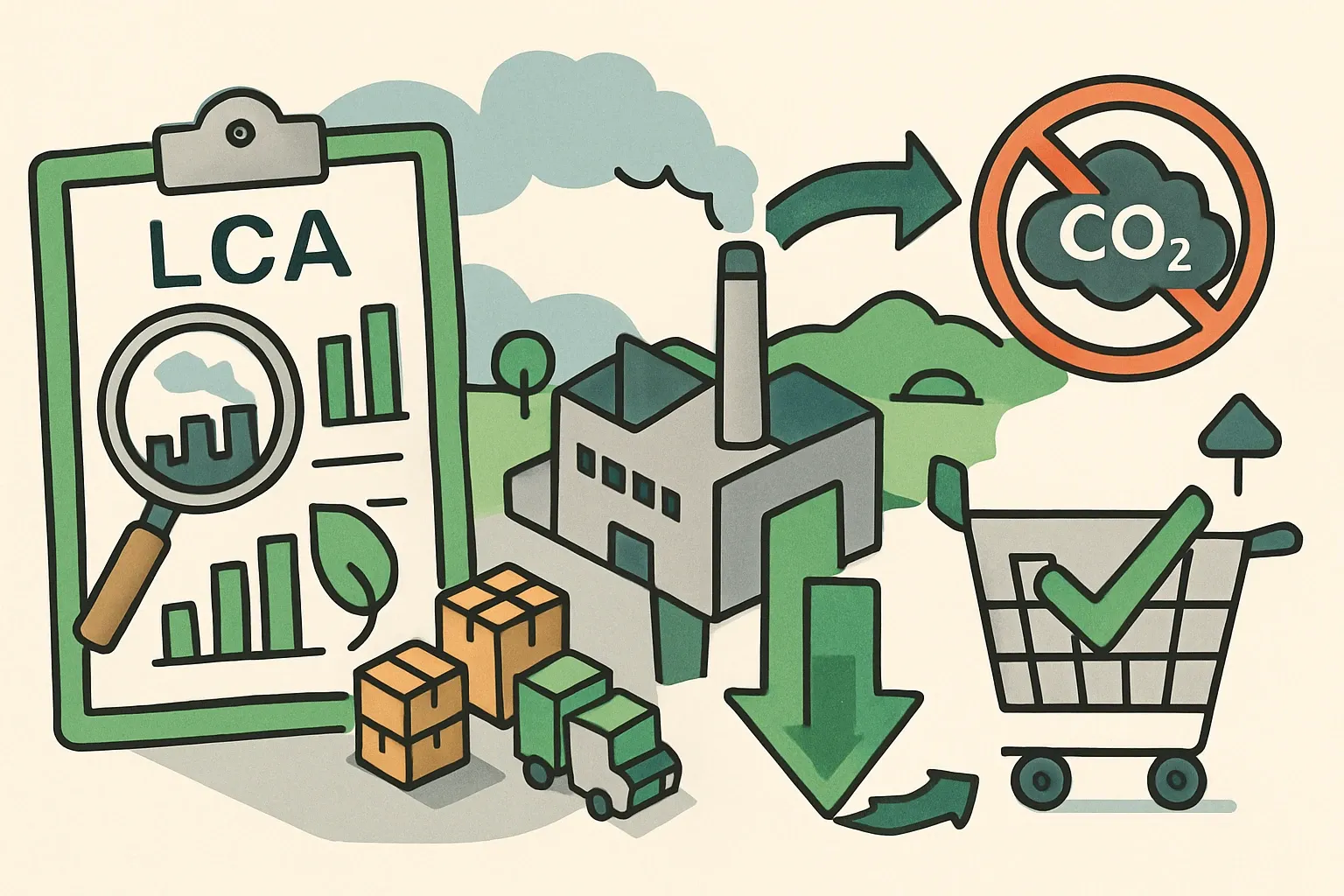
Net zero is a materials story
Materials are a big slice of climate math. In 2022, buildings accounted for 34% of global energy demand and 37% of energy and process‑related CO2, so material choices and manufacturing efficiency matter to every product in that ecosystem (GlobalABC, 2024) (UNEP Buildings‑GSR, 2024). LCA shows where your product lands in that footprint and where to cut first.
LCA is the map, EPD is the passport
Think of a good LCA as an MRI for your product. It scans cradle‑to‑gate and beyond, across modules like A1–A3 for raw materials and manufacturing, A4 transport, A5 installation, and the use and end‑of‑life stages. The EPD is the public, third‑party‑verified summary that buyers trust for apples‑to‑apples comparisons.
Use the reduction ladder, not the credit card
Your LCA will surface hotspots. Tackle them in an order that compounds gains.
- Switch to lower‑carbon inputs where feasible, like higher recycled content metals or SCMs in cement blends.
- Clean the energy feeding your lines with contractual renewables that match time and location, then optimize loads.
- Redesign processes and formulations for yield, cure times, and scrap reduction, and right‑size packaging.
- Reroute logistics with fewer miles, fuller trucks, cleaner modes, and confirmed distances in primary data.
- Tighten supplier specifications so their EPDs and data improvements lift your product every refresh.
Want to turn EPDs into revenue-generating assets?
Follow us on LinkedIn for insights that help you win tenders and unlock new business opportunities.
Offsets have a small, specific job
Offsets are for residuals after deep cuts. The Science Based Targets initiative states companies must cut all possible emissions, usually more than 90%, before neutralizing the tiny remainder with permanent removals at net zero (SBTi, 2024) (SBTi Corporate Net‑Zero Standard, 2024). That keeps the focus on operational change, not accounting tricks.
Model scenarios before you spend a dollar
Use your LCA to run what‑ifs. Model a supplier switch, a 24‑month equipment change, or a move from truck to rail. Quantify the GWP shift per unit and the likely payback in procurement wins. Reliable averages for costs differ widely by product and geography, so publish the assumptions next to each scenario if numbers are uncertain.
Data quality upgrades pay for themselves in bids
Primary data beats generic proxies when buyers compare like for like. Each refresh that replaces a default dataset with plant‑specific numbers improves certainty and, often, your reported impact. Sales teams feel this when projects stop penalizing your product for missing or generic data.
Where this shows up in specs
LEED v5 puts more weight on product‑specific, verified disclosures and lower embodied carbon options. Teams that carry current EPDs and demonstrate modeled reductions avoid the conservative penalties applied when no EPD exists. That advantage compounds across multi‑product portfolios.
Policy winds shift, reductions still bankable
U.S. federal incentives are in flux in 2025. Procurement preferences can move with politics. Process improvements, cleaner inputs, and verified EPDs remain bankable because they reduce exposure to future rules and keep you in more conversations with carbon‑sensitive buyers. Offsets alone do not do that.
What a credible reduction plan looks like
Pick a recent reference year, lock your data boundaries, then timebox the work. Near term, fix measurement and no‑regret efficiency. Mid term, swap inputs and electricity contracts with suppliers aligned on data and EPD cadence. Long term, retool processes and invest in durable removals only for what you cannot eliminate.
Choose partners who remove friction, not just emissions
The slowest part is usually data wrangling across plants, ERP exports, and suppliers. Favor LCA partners who collect and validate the inputs for you, manage program‑operator details, and keep your EPDs current with minimal lift from R&D and operations. Speed with discipline beats a pretty roadmap that never ships. It’s definately the difference between a credential and a door‑opener.
The takeaway
Use LCA to cut first where it counts, publish the proof as an EPD, and reserve offsets for the last inches. That is how manufacturers reach net zero without leaving growth on the table.