What we analyzed and why it matters
We mapped the wood flooring category in Europe using the global public registry most specifiers rely on. The scope covers product-specific EPDs tied to MasterFormat 09 64 00 and adjacent parquet terms. The lens is commercial: where competitors publish, which program operators they choose, and how renewals in 2027 to 2028 could reshape the field.
The size of the landscape in numbers
Across the last five years there are 35 current wood flooring EPDs from 18 manufacturers, issued by 8 program operators and anchored in 10 distinct PCRs. The latest newly issued EPD landed on Jan 1, 2024.
Most European building EPDs now follow EN 15804 A2 rules adopted in 2019, which standardizes climate impacts and data quality across declarations (CEN EN 15804 A2, 2019). EPDs are typically valid for five years, so timing renewals against PCR updates is essential (EPD International GPI, 2024).
Who’s publishing: manufacturer snapshot
The category shows a classic long tail. Leaders by volume include Monier Roofing Components with 6 EPDs and Kährs with 5. Kerakoll lists 4, Holse&Wibroe 3, while Forestry Timber Holdings, SIA Amber Wood, and Välinge Innovation show 2 each. Fifteen other manufacturers appear with a single EPD, including AB Golvabia, EGGER, and mafi.
Two observations stand out. First, several names are materials or systems firms adjacent to pure hardwood brands, which signals cross-over specs where parquet competes with laminates, hybrids, and surface systems. Second, the field is still open: no single brand dominates the category with double‑digit share.
Program operators: where wood flooring brands publish
Operator selection affects reviewer familiarity, language expectations, and market access.
- EPD International AB hosts the largest share with 16 wood flooring EPDs from 8 manufacturers, indicating broad, multi‑country adoption rather than one client driving the count.
- INIES shows 6 EPDs, but all from a single manufacturer, a sign of strong national anchoring for France.
- EPD Hub has 4 EPDs across 3 manufacturers, and IBU lists 3 across 3 manufacturers. RTS carries 3 across 1, while ITB, Kiwa, and NIBE Research each publish 1.
Takeaway: Environdec is the most common cross‑border path. National schemes like INIES fit France‑focused sales. IBU continues to be a credible German route for floor coverings.
PCRs in circulation and what they signal
Think of a PCR as the rulebook of Monopoly: ignore it and the game falls apart. In wood flooring, ten PCRs are in play, with several converging on EN 15804 A2. The French national addition appears frequently for products marketed into France, and operator‑specific Part A or "Teil B" documents tune reporting depth.
Want to optimize your EPD strategy for wood flooring?
Follow us on LinkedIn for insights that help you secure specifications and unlock new market opportunities.
PCR usage and latest expiries
| PCR | EPDs | Latest expiry |
|---|---|---|
| PCR 2019:14 Construction products (EN 15804+A2) (1.3.3) | 10 | Jun 7, 2028 |
| Sustainability of construction works… National addition to NF EN 15804+A2 | 6 | May 29, 2028 |
| EN 15804:2012+A2:2019 core rules | 4 | Jan 5, 2027 |
| EPD Hub Core PCR v1.0 (Feb 1, 2022) | 4 | Dec 22, 2028 |
| Teil B: Anforderungen an die EPD für Bodenbeläge | 3 | Aug 8, 2027 |
| c‑PCR‑006 Wood and wood‑based products for use in construction (EN 16485) | 4 | Jun 27, 2028 |
| Part A: Construction Products and Services | 1 | Jun 6, 2028 |
| Core Product Category Rules | 1 | Jan 18, 2029 |
| CEN standard EN 15804 | 1 | Mar 14, 2027 |
| Unknown PCR | 1 | Jan 16, 2028 |
What this means for planning: the heavy use of PCR 2019:14 and NF EN 15804+A2 signals that A2 alignment is now table stakes for comparability in Europe (CEN EN 15804 A2, 2019). If you plan a new EPD today, pick a PCR that competitors already use and that will be current through your next renewal window.
Issuance trend: three years of push, then a pause
| Year | EPDs issued |
|---|---|
| 2021 | 3 |
| 2022 | 13 |
| 2023 | 18 |
| 2024 | 1 |
| 2025 | 0 |
Activity ramped in 2022 and peaked in 2023. The near‑pause in 2024 and 2025 likely reflects internal portfolio consolidation and teams waiting for strategic PCR choices. The latest new issue in the dataset is Jan 1, 2024: S‑P‑08162 for Golvabia’s Maxwood, published with EPD International AB under Core Product Category Rules, expiring Jan 18, 2029.
Renewal risk: 2027 and 2028 are crowded
Expiries cluster in two waves: 13 EPDs come due in 2027 and 18 in 2028. Three more end in 2026, while only one runs into 2029. Most 2027 expiries sit under Part B for floor coverings, EN 15804 A2 core rules, and operator documents like EPD Hub Core PCR. Most 2028 expiries follow PCR 2019:14 and the French national addition.
Commercially, this creates two crunch windows. If your EPD is due in those years, plan verification capacity early and consider light technical updates that sharpen declared unit assumptions or end‑of‑life modeling. Renewals also reset comparative positioning: a fresh A2‑aligned EPD can become the default spec in a tight bid.
How many declarations used an EPD consultant
Twenty‑nine of the 35 wood flooring EPDs list an external EPD service provider or consultant. That is a clear majority and matches what we see in other categories where plant data, adhesives, surface treatments, and logistics make modeling complex. If internal bandwidth is thin, partnering with a white‑glove EPD service provider like Parq keeps senior R&D and operations focused on production while data wrangling moves in parallel.
Notably absent or light‑presence brands in 09 64 00
As of Jan 19, 2026, several large European parquet and laminate brands show limited or no current wood flooring EPDs in public registries for MasterFormat 09 64 00. UNILIN does appear with recent INIES declarations valid to late 2028. Tarkett has a current EPD running to Aug 1, 2027. In contrast, Bauwerk Parkett, Parador, and BerryAlloc list only expired or no current EPDs under 09 64 00. Junckers, HARO, and Pergo did not surface with current 09 64 00 listings in this check. Brand owners may hold EPDs in adjacent floor‑covering categories or national portals that map differently, yet the public wood flooring view remains sparse for those names today.
If you compete with any of these brands, a well‑timed EPD can become a decisive pre‑qualifier on projects that require verified product‑specific data. That reduces the penalty specifiers face when they must fall back to conservative database factors.
Picking the right PCR in 2026
Start with the competitive set. If your direct rivals declare under PCR 2019:14 or the NF EN 15804+A2 national addition, that is the fastest path to apples‑to‑apples comparisons. If you sell primarily in Germany, IBU’s Part A plus floor coverings Part B is a credible frame. For France, INIES alignment simplifies documentation. When in doubt, pick the rulebook your buyer already recognizes, then optimize declared unit scope, installation assumptions, and end‑of‑life routes. It is definately easier to win a spec when reviewers do not need to translate methodologies.
Operator choice: practical factors
Consider reviewer capacity, expected language of the dossier, and whether your marketing team plans cross‑border reuse of the same EPD. EPD International AB works well for multi‑country use. INIES fits France. IBU remains strong for German projects. Smaller operators can be faster for first‑time declarations if the PCR fit is right. The best operator is the one that publishes a robust, A2‑aligned EPD your sales team can cite with confidence.
The fast path to a publishable EPD
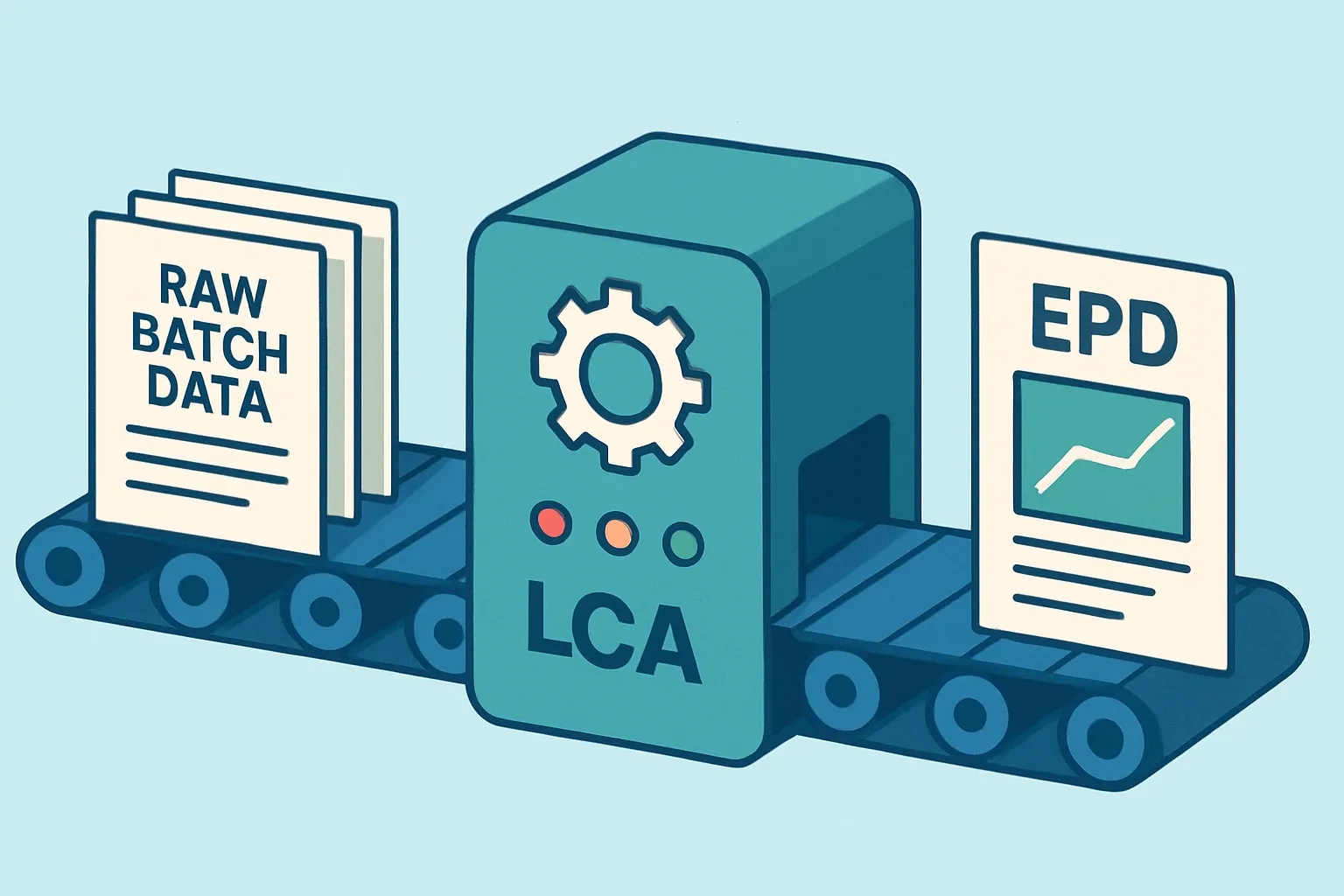
Two things unlock speed. First, a clean data room covering one full reference year of utilities, raw materials, scrap, and transport. Second, a partner that removes collection overhead. We built our process to be ruthlessly efficient on both fronts, so manufacturers ship data once, review once, and publish on time without heroics.
One last thing
This analysis uses the global public EPD registry that most architects and specifiers consult. Due to loading delays, some late‑2025 publications may not appear yet. If you want the full up‑to‑date background dataset, connect with me on LinkedIn and send a message. I am also happy to hop on a quick call to help pick the best‑fit PCR for your next EPD based on your competitive landscape.
Parenthetical citations for numeric claims: EN 15804 A2 adoption in 2019 (CEN EN 15804 A2, 2019). Five‑year validity expectation for declarations (EPD International GPI, 2024).