Lighting’s carbon math is changing
Global buildings electricity demand jumped by more than 600 TWh in 2024, growing 5% year over year (IEA, 2025). Lighting remains a large slice of that pie, accounting for about 16.5% of buildings’ end‑use electricity, with solid‑state lighting and controls capable of cutting that by 50% or more (IEA 4E, 2023).
Minimum energy performance standards now cover almost 80% of the world’s lighting energy consumption, and above 90% in Europe, the United States, and China (IEA, 2024). Specs are tightening. Without a product‑specific, third‑party verified EPD, your fixture is harder to compare fairly on carbon and more likely to be swapped for one that is.
What luminaire EPDs actually declare
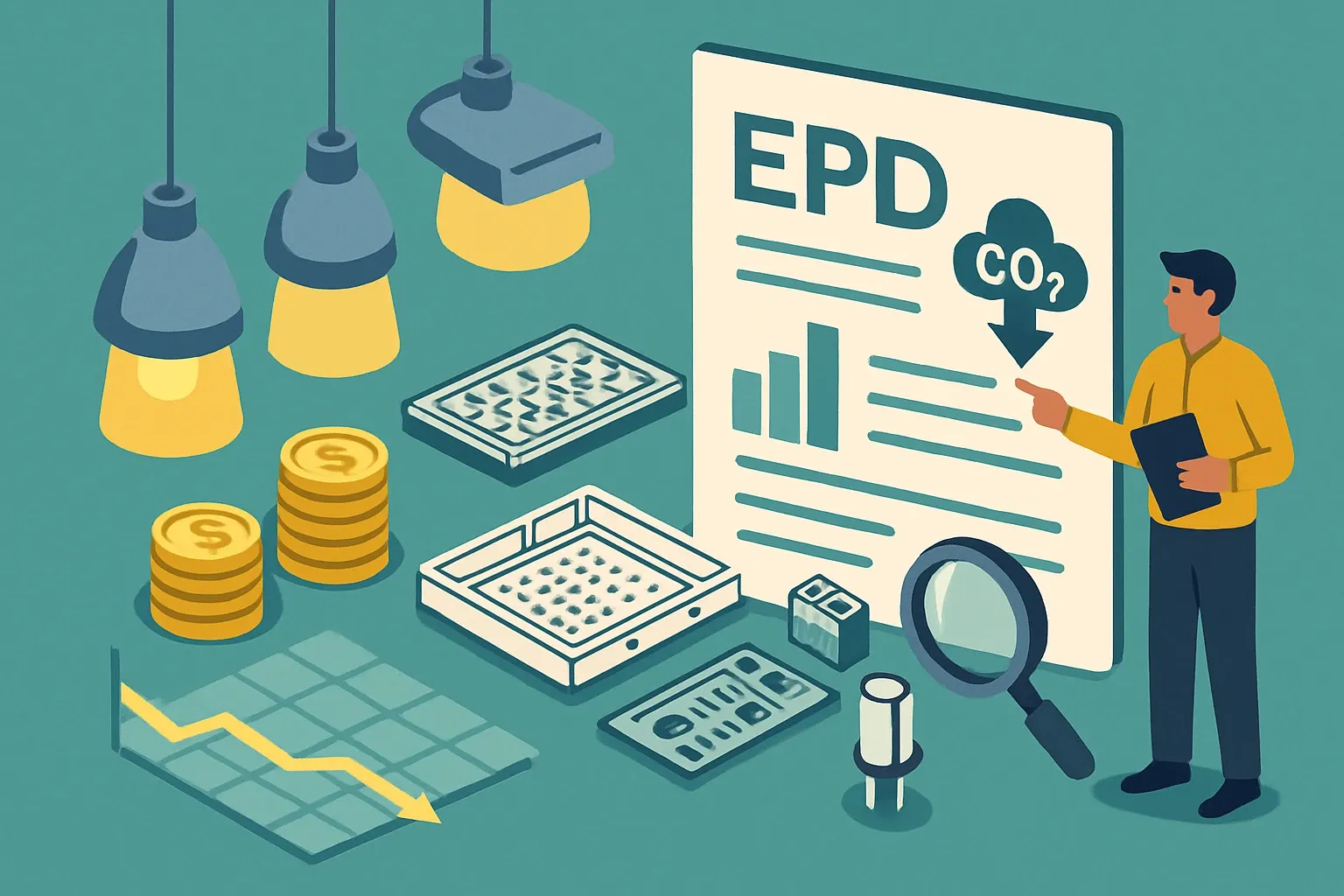
A luminaire EPD reports cradle‑to‑gate impacts (A1 to A3) and, when required by the chosen PCR, transport and install (A4 to A5), replacements (B4), operational energy in use (B6), and end‑of‑life (C1 to C4), with potential benefits beyond the system boundary shown in D. Think of it as a verified scorecard, not marketing copy. It tells a specifier how materials, manufacturing energy, packaging, logistics, lifetime, and disposal interact.
EN 15804‑based PCRs are widely used for luminaires published in European programs and internationally, with recent luminaire EPDs registered under “2019:14 Construction products (EN 15804+A2)” through 2024 and 2025 (EPD International, 2025). That means your product can be compared on consistent rules when projects ask for EN 15804 alignment.
Pick the right rulebook for luminaires
If your sales focus is buildings and infrastructure, EN 15804 PCRs are the common path. For some electrical equipment portfolios, electrical‑sector frameworks such as PEP ecopassport are recognized in certain markets. The smartest move is to match the rulebook common to competitor EPDs in your target geographies, and check any national add‑ons the program operator flags for France, Italy, the Netherlands, or the United States.
Want to unlock new opportunities in lighting specs?
Follow us on LinkedIn for insights that help you meet carbon targets and get your luminaires spec'd more often.
The data pack to assemble first
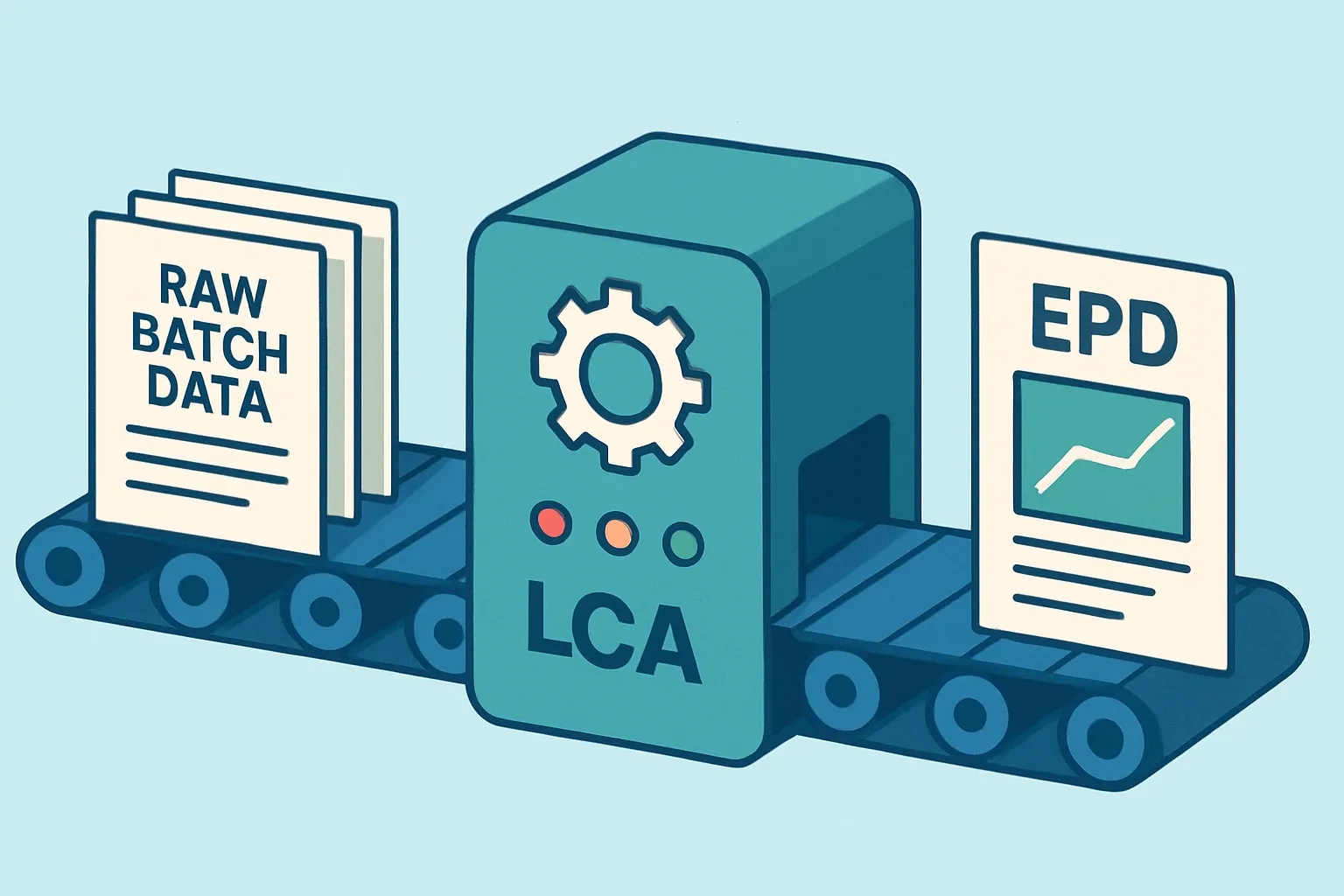
Getting to a high‑quality EPD quickly comes down to wrangling the right inputs early. Pull these without waiting for someone to ask:
- Bill of materials by mass for housing, heat sink, optics, LED boards, drivers, wiring, fasteners, coatings, and packaging
- Material grades and recycled content (especially aluminum)
- Factory utilities and process data for the reference year, plus scrap and yield
- Assembly locations, shipping legs, and modal splits
- Rated power, standby power, expected service life, and replacement intervals for drivers and light engines
- Controls assumptions for standard use cases (occupancy, daylight, tuning)
- End‑of‑life routes you can justify (disassembly steps, material recovery)
Get B6 right (use‑phase energy is the swing factor)
For most luminaires, B6 drives the total footprint. Define annual operating hours and control strategies clearly, then pair them with local grid emission factors. U.S. eGRID 2023 subregion CO2e rates span roughly 0.12 to 0.68 tCO2 per MWh, which can move a luminaire’s annual emissions by more than a factor of five depending on where it runs (EPA eGRID, 2025). Provide a simple calculation method in your EPD so specifiers can scale energy use by hours and power.
Controls matter. Presence detection, daylight dimming, and high‑end trim routinely push real‑world savings far beyond nameplate efficacy, and are part of the 50%‑plus potential cited for LEDs with good controls (IEA 4E, 2023). Document default control settings and standby power so the math matches reality, not a lab fantasy.
Design for lower embodied carbon without hurting performance
Most luminaire mass sits in the housing and heat sink. Right‑sizing thermal design, switching to high‑recycled aluminum, and specifying lower‑impact coatings typically deliver quick wins. Electronics carry outsized impacts per kilogram, so modular drivers and replaceable LED boards help avoid full‑fixture replacement. Where supplier data is incomplete, CIBSE TM65.2 provides a transparent method to estimate embodied carbon for luminaires and identify the biggest contributors (CIBSE, 2023).
Policy tailwinds are real too. The global move away from flourescent lamps and toward high‑efficacy LEDs keeps ratcheting minimum performance upward, rewarding fixtures that pair efficient optics with robust controls (IEA, 2024).
Publish smart for speed and reach
Pick a program operator aligned with your buyers and leverage mutual recognitions to avoid duplicate verification effort across regions when possible (IBU, 2025). Confirm the PCR version and any national annexes early, lock a reference year for data, and set a maintenance plan for updates. Federal incentives in the U.S. shifted in early 2025, so rely on clear ROI from specs and owner requirements rather than dated subsidy math.
The fast play for lighting decarbonization
Luminaire EPDs translate design choices into credible carbon numbers. Pair a thoughtful bill of materials with realistic B6 assumptions and documented controls, then publish under the rulebook your market expects. That turns a commodity fixture into a verified, low‑carbon choice buyers can defend in a room full of skeptics. The result is simple. Less energy, less embodied impact, and more wins when carbon is on the line.