What counts as a “water heater” in this guide
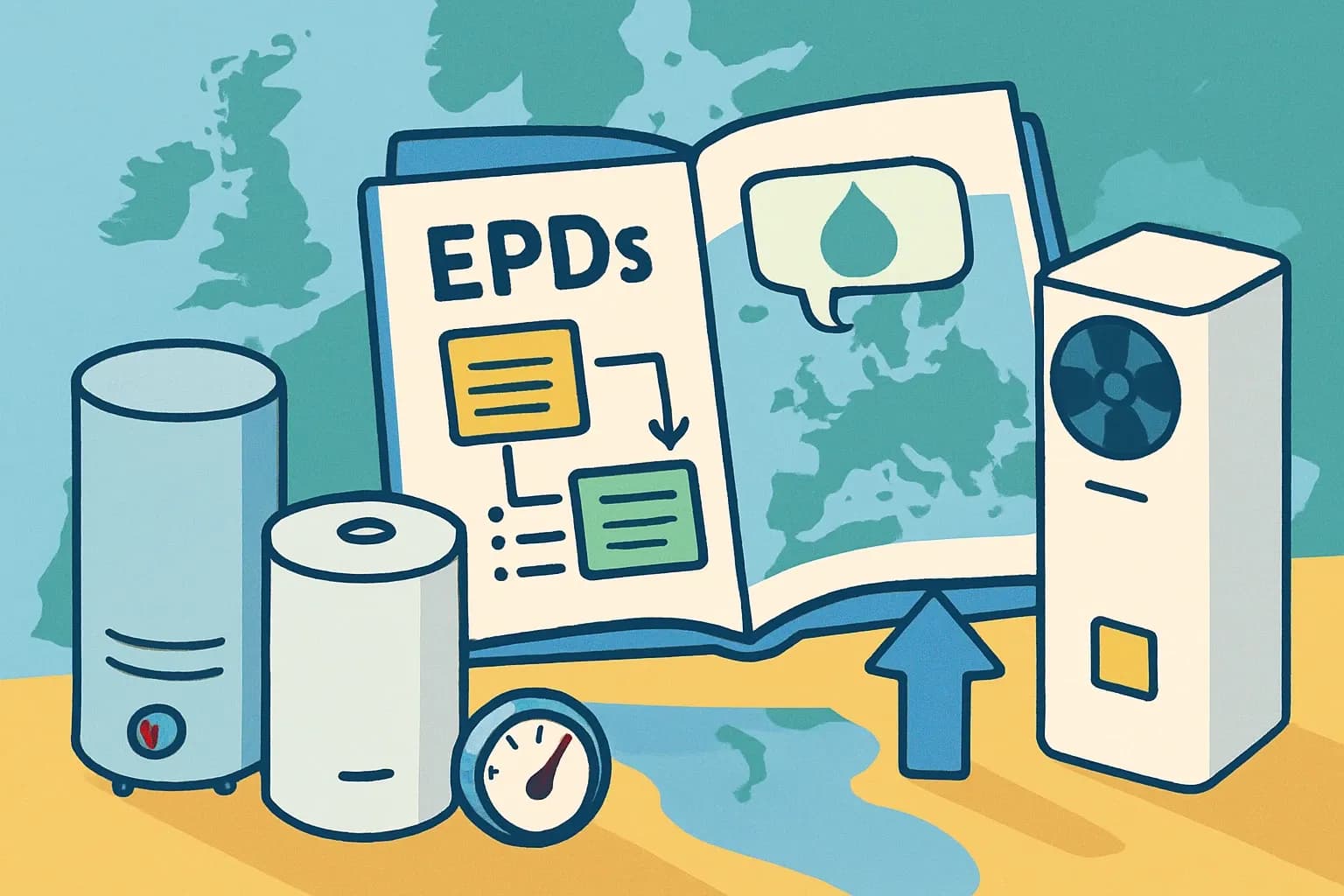
In Europe, specifiers often search for heat‑pump water heaters, cylinders, condensing combi boilers, and thermodynamic generators that produce domestic hot water. We grouped those under “Water Heaters” and focused on product‑specific EPDs in Europe.
The 2021–2025 surge at a glance
Across the last five years, 13 current EPDs were published by 4 manufacturers via 2 program operators using 3 PCRs. Momentum peaked in 2024 with ten releases, a classic “catch‑up” year as teams raced to align portfolios.
| Year | EPDs issued |
|---|---|
| 2021 | 0 |
| 2022 | 2 |
| 2023 | 0 |
| 2024 | 10 |
| 2025 | 1 |
The latest issue we see is from Jan 1, 2025, which fits the push to lock in declarations ahead of mid‑decade refresh cycles.
Who is publishing these EPDs
Four manufacturers show up most: AUER with 6 EPDs, BDR THERMEA GROUP with 4, ARISTON GROUP with 2, and Hitachi Energy HVDC with 1. AUER’s lead hints at a focused release plan that covered multiple models in short order. BDR Thermea and Ariston appear to be aligning water‑heating assets alongside broader HVAC plays rather than one‑off drops.
At BDR Thermea or competing with them?
Follow us for product-by-product EPD insights to see which water heater models get spec'd or VE'd out against AUER and Ariston.
Program operators used in Europe for water heaters
Two names cover the field in this snapshot. Association P.E.P hosts 10 EPDs across 3 manufacturers, showing solid cross‑brand adoption. INIES accounts for 3 EPDs across 2 manufacturers and serves as a familiar home for French‑market documentation. The spread suggests buyers do not demand a single operator here, so teams can choose based on workflow preferences, reviewer familiarity, and language fit.
PCRs that govern the category
Two rulebooks dominate, with one acting as a generalist and one as a specialist. The generic “Product Category Rules for Electrical, Electronic and HVAC‑R Products” covers 11 EPDs. The specialist “Specific rules for thermodynamic generators with electric compression for space heating and or cooling and or the production of domestic hot water” covers 2 EPDs.
| PCR | EPDs | Share of total | Latest expiry | Notes |
|---|---|---|---|---|
| Product Category Rules for Electrical, Electronic and HVAC‑R Products | 11 | ~85% | Jul 1, 2029 | Broad umbrella that many water‑heating products can legitimately use when scope fits |
| Specific rules for thermodynamic generators with electric compression for space heating and or cooling and or the production of domestic hot water | 2 | ~15% | Jan 1, 2030 | Tighter product fit for integrated heat‑pump systems producing DHW |
If you are choosing a PCR today, start with the competitive set your sales team faces weekly. A PCR is the rulebook of Monopoly. Ignore it and the game falls apart.
Renewal risk map you can plan against
The next five years are forgiving until they aren’t. Zero expiries arrive in 2026, then a small bump in 2027 with 2 expiries. The cliff comes in 2029 with 10 expiries, followed by 1 in 2030. Most of the 2029 pile is tied to the general EEE HVAC‑R PCR window, with an extra thermodynamic‑generator expiry in June 2029.
Practical takeaway. If your first water‑heater EPD lands in 2026, aim to stagger model families so you do not have every SKU expiring around early to mid 2029. Staggered vintages reduce review bottlenecks and sales disruptions.
The most recent EPD on record
BDR THERMEA GROUP’s BLW Mono‑P 6.1 MH issued on Jan 1, 2025 through Association P.E.P under the thermodynamic‑generator PCR. It runs to Jan 1, 2030. This is a clean example of a heat‑pump based product that declares DHW functionality without stretching definitions.
How often teams used an EPD consultant
Only 1 of the 13 EPDs lists an external EPD service provider. That is roughly 8 percent. Many HVAC teams have internal LCA skill, yet the hidden tax is data wrangling across plants, SKUs, and regions. An EPD consultant or service provider like Parq can cut cycle time by taking the data‑collection burden off production and engineering without lowering quality. You keep control of the narrative while someone else chases meters, bills, and BOM revisions you’d rather not touch.
Notably absent or under‑represented names
Several large European brands do not appear in this water‑heater EPD snapshot. We looked for Vaillant, Bosch Thermotechnology, NIBE, and Stiebel Eltron. Some of these manufacturers publish EPDs in adjacent HVAC categories or for components like storage tanks, yet they are not visible here as water‑heater EPDs in Europe. If you compete with them, a well‑timed release can recieve outsized attention from specifiers who filter by product‑specific EPDs.
Practical playbook for 2026
Pick the PCR your competitors use unless there is a compelling reason to differ. Get your first models declared, then phase the rest so expiries spread between 2027 and 2030. Choose a program operator your internal reviewers and target markets know. Focus on clean system boundaries and transparent assumptions. A product‑specific EPD unlocks projects where generic estimates carry penalties, so you avoid competing on price only.
A quick note on sources and getting the data
This article uses the global public registry of EPDs that architects and specifiers rely on. Due to loading delays, EPDs from the last half of 2025 might not be fully reflected yet. If you want the full underlying dataset or a sanity check on which PCR fits your upcoming water‑heater EPD best, connect with me on LinkedIn and send a message. I am happy to hop on a quick call and talk through the competitive landscape at no cost.