The 2026 snapshot at a glance
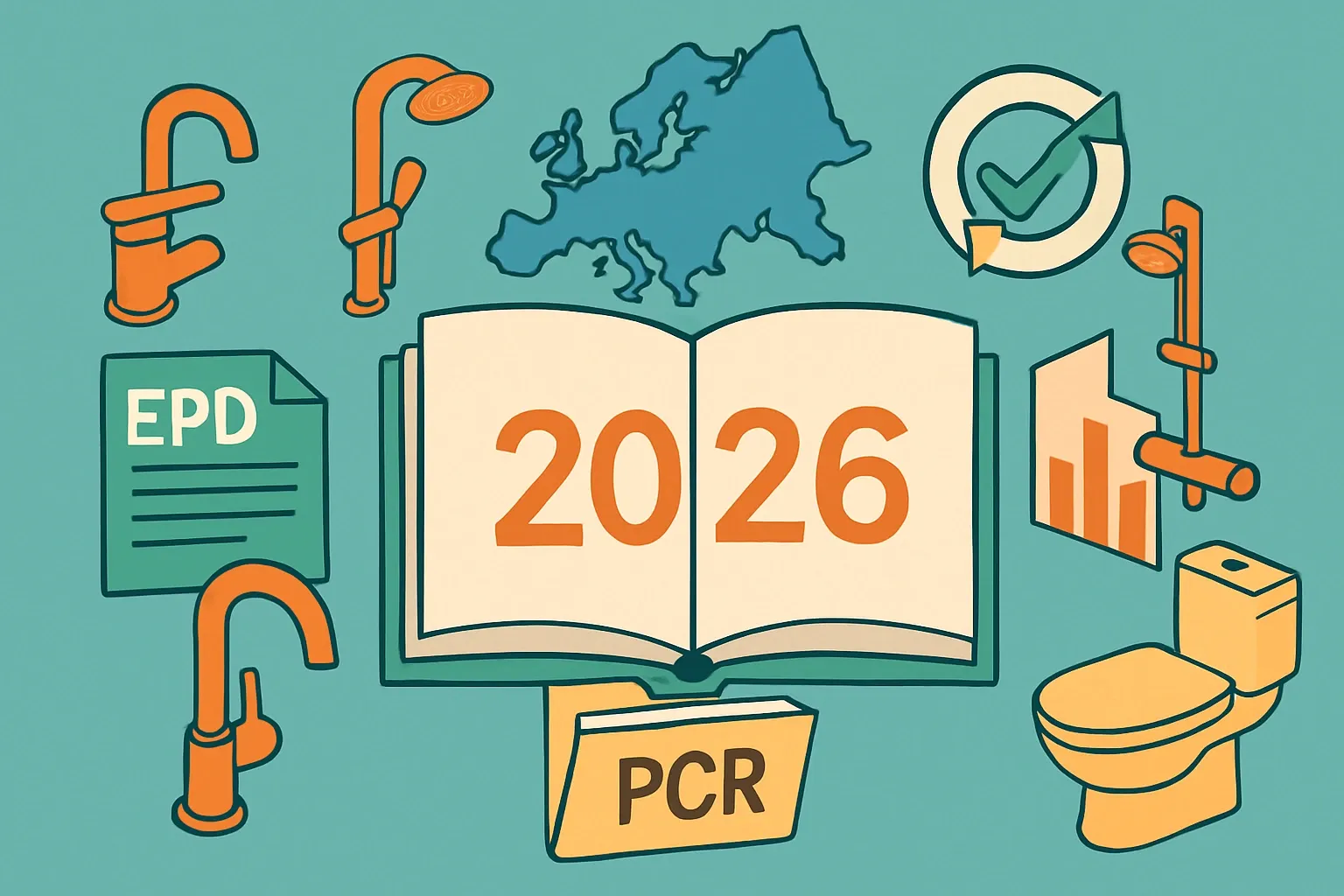
Plumbing fixtures in Europe show a focused but active EPD field. Over the last five years there are 12 currently valid EPDs across 7 manufacturers and 4 program operators, grounded in 6 distinct PCRs. The latest issue we see is Geberit’s Duofix element for wall‑hung WC from Aug 8, 2025 under EPD Hub Core PCR v1.1 with an expiry on Aug 7, 2030.
Who is publishing EPDs
Seven manufacturers appear with current declarations. Geberit International AG leads with 4 EPDs, followed by DURAVIT AG and Saint‑Gobain with 2 each. Aluminium‑Laufen, Eiffage Construction, Oras Group, and Villeroy & Boch AG each have 1. The mix skews toward sanitary ceramics and installation systems, with a few tapware entries.
Where they publish: program operators
Four operators carry the category. EPD Hub hosts 5 EPDs from 2 manufacturers. EPD International AB lists 4 from 3 manufacturers. IBU has 2 from 1 manufacturer, and INIES has 1 from 1 manufacturer. That split tells us two things. EPD Hub is the most used home for this niche by count, and several competitors also favor Environdec, which helps cross‑border recognition in European specs.
The rulebook behind results: PCR patterns that matter
A PCR is the rulebook of Monopoly. Ignore it and the game falls apart. Six PCRs show up, with A2‑aligned versions clearly dominant. A small tail of older A1 remains and it times out in 2026.
PCR overview
| PCR | EPDs | Latest expiry |
|---|---|---|
| EN 15804:2012 + A1:2013 Core rules | 1 | Jul 31, 2026 |
| EPD Hub Core PCR v1.1 (Dec 5, 2023) | 2 | Aug 7, 2030 |
| EPD International 2019:14 (EN 15804:A2/AC:2021) v1.3.4 | 3 | Aug 7, 2028 |
| PCR 2019:14 Construction products (EN 15804+A2) v1.3.3 | 2 | Dec 23, 2027 |
| PCR 2019:14 Construction products (EN 15804:A2) | 2 | Dec 21, 2027 |
| Part B: Requirements on the EPD for Sanitary ceramics | 2 | Jan 23, 2027 |
What to do with this. If you are planning an EPD in 2026, align to the A2 family used by your closest competitors unless a product‑specific Part B offers stronger comparability. Check the next revision window so your launch does not land on a PCR that is about to be revised.
At Geberit or competing in plumbing fixtures?
Follow us for a product-by-product EPD analysis to see which fixtures get spec'd and how you can unlock new opportunities.
Release momentum, five years
Here is the count of currently valid EPDs by year of issue. The dip in 2024 tracks the shift to A2 and renewed PCRs in this niche.
| Year | EPDs issued |
|---|---|
| 2021 | 2 |
| 2022 | 5 |
| 2023 | 3 |
| 2024 | 0 |
| 2025 | 2 |
Expiry watch: renewals to plan for
Renewals cluster in 2026 to 2028, then ease.
- 2026 has 2 expiries. One A1 core rules item and one 2019:14 A2 v1.3.3 item.
- 2027 has 5 expiries. Two sanitary ceramics Part B, two 2019:14 A2, and one 2019:14 A2 v1.3.3.
- 2028 has 3 expiries. All tied to 2019:14 A2 v1.3.4 on Aug 7.
- 2029 shows 0 expiries.
- 2030 has 2 expiries. Both on EPD Hub Core PCR v1.1, including the Aug 7 Geberit Duofix.
If your products compete with those lines, lock in data collection windows now so testing, verification, and design refreshes are not crammed into Q4. There are less renewals in 2029, which can be an opening for launches.
Consultant or DIY: how these EPDs were produced
Seven of the twelve EPDs were issued with the help of an EPD consultant or service provider, which is 58 percent of the set. That tracks with what we see across construction products that juggle multiple plants and complex bills of materials. If you want a white‑glove option that compresses your internal workload, an EPD service provider like Parq can manage data collection, LCA, authoring, and publication with the operator you choose.
Program operator choices, explained
- EPD Hub appears attractive for manufacturers that want fast turnaround and are comfortable with an operator used broadly in Nordic and DACH projects.
- EPD International AB (Environdec) remains a common home for faucets and mixers. It also supports group EPDs, which some tapware brands use for families of SKUs.
- IBU is a strong choice when German‑language market recognition matters and when Part B for sanitary categories fits the product scope.
- INIES coverage is useful for France. If distribution is France‑heavy, consider how French credits and data portals will pick up your declaration.
The punchline. Pick the operator your top three competitors already use unless there is a clear reason not to, like a better Part B fit or a strategic market push into a different country bloc.
Notably absent or hard to find
Several big names are present with active EPDs that many specifiers know, including GROHE and Hansgrohe. Others like Roca Group and KLUDI do not appear in the public registry slice we analyzed. They may simply file under national portals or adjacent product categories that were not synchronized yet. If you compete with them, this is an opportunity to be the first result that pops up in a tender search. If you are at one of those organisatons and do have fresh EPDs, ping me and I will update this page.
Picking your lane: quick PCR decision tree
Start with competitor alignment. If your closest analogs use EPD International 2019:14 A2, match that unless a sanitary ceramics Part B improves comparability. Check revision timing so you avoid publishing right before a version change. Confirm operator fit with your sales footprint. If France and Germany drive revenue, cost the benefit of INIES or IBU visibility into the plan.
What this means for sales and specs in 2026
Product‑specific EPDs remain a clear tie‑breaker in public and private projects that must hit carbon accounting targets. Without one, buyers often assign a conservative default factor, which can push you out of the short list. An early 2026 EPD can carry you through several bid cycles while competitors face renewals in 2027 to 2028.
Data notes and how to go deeper
This overview is based on the global public registry of EPDs that most architects and specifiers use. New listings from late 2025 can take time to appear, so a few recent declarations might not be reflected yet. If you want the full up‑to‑date background dataset, connect with me on LinkedIn and send a message. I am also happy to hop on a quick call to help pick the best fit PCR for an upcoming EPD, free of charge.