What we measured and what counts as “mechanical insulation”
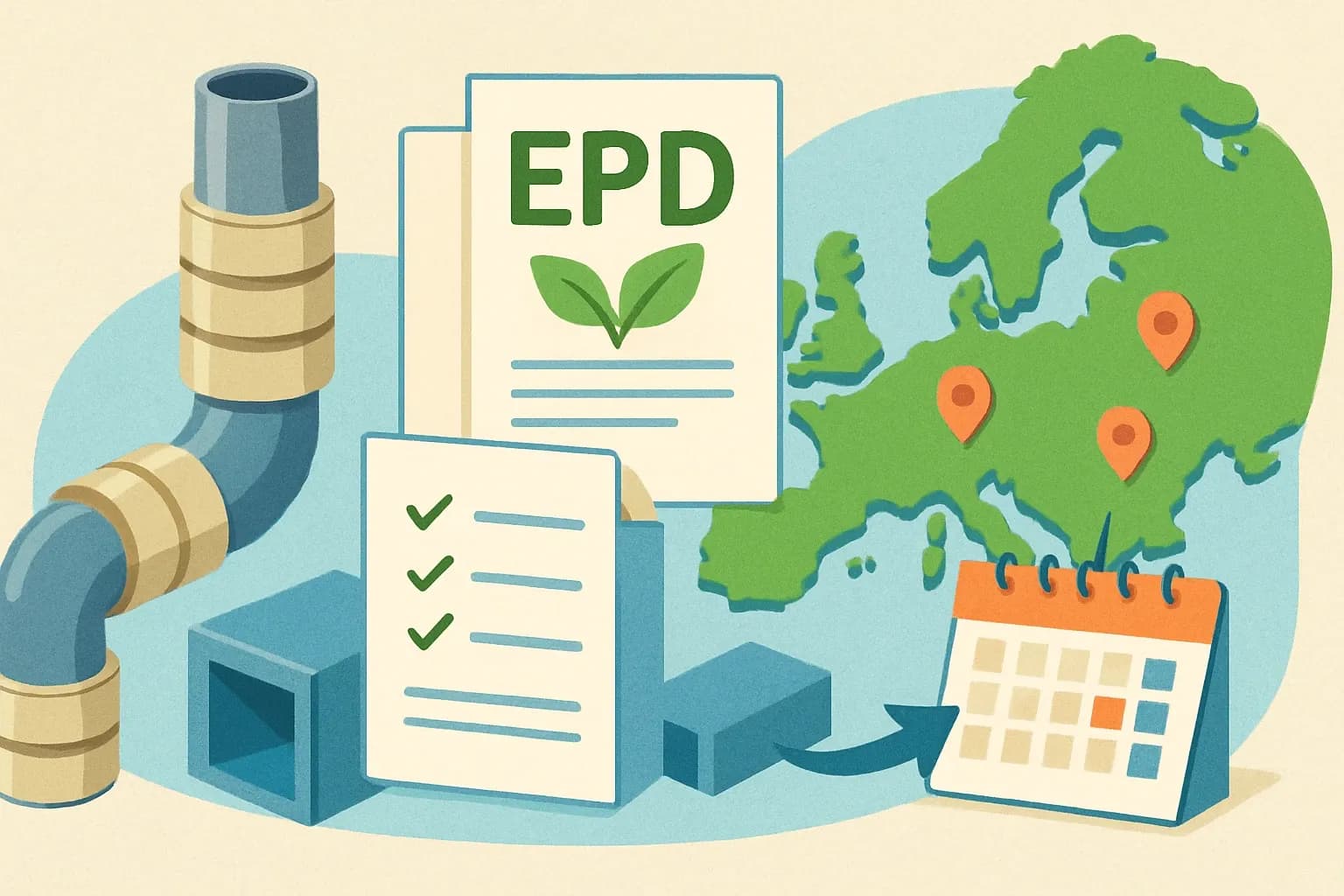
Mechanical insulation here covers HVAC and industrial applications, including pipe insulation, duct wrap, and technical insulation used on building equipment. The dataset reflects Europe only and tracks unique EPDs, manufacturers, program operators, and the PCRs they used across the last five years.
Highlights at a glance: 27 active EPDs, 5 manufacturers, 2 program operators, and 6 distinct PCRs. The most recent EPD we see is Isover Saint‑Gobain’s Duct Wrap issued on Nov 30, 2022 under EPD International AB with PCR 2019:14, expiring Jan 1, 2030.
Five‑year activity snapshot
2021 carried the bulk of new declarations and things have been quiet since. That lull is not unusual when a sector is mid‑transition between PCR families or when teams are waiting for portfolio refreshes.
| Year | EPDs issued |
|---|---|
| 2021 | 22 |
| 2022 | 5 |
| 2023 | 0 |
| 2024 | 0 |
| 2025 | 0 |
Why that pattern matters in 2026. Large cohorts tend to expire together, which concentrates renewal effort into a short window.
Manufacturer leaderboard
Two brands account for nearly nine in ten declarations in scope. Isover Saint‑Gobain and Knauf Insulation each hold 12 EPDs. Armacell, ISOPIPE S.A., and Climate Recovery Ind AB round out the long tail with one EPD apiece. For sales teams this concentration is a signal that competitive benchmarks are clear and achievable if you know which PCR to pick.
Program operators used in Europe
EPD International AB dominates with 26 EPDs across four manufacturers. ITB appears once and is used by a single manufacturer. That spread indicates broad acceptance of Environdec for mechanical insulation in Europe, plus enough variety that specifiers are not locked into one operator.
At Isover Saint-Gobain or competing in mechanical insulation?
Follow us for product-by-product EPD insights and competitive analysis to see which insulation solutions get spec'd and where gaps may impact your positioning.
The PCR playbook for mechanical insulation
A PCR is the rulebook of Monopoly. Ignore it and the game falls apart. Mechanical insulation in Europe leaned heavily on EN 16783‑based PCRs, with EN 15804 A2 showing up on newer issues.
| PCR used (exact label) | EPDs in set | Latest expiry |
|---|---|---|
| Sub‑PCR‑I Thermal insulation products (EN 16783) | 11 | Jul 13, 2026 |
| c‑PCR‑005 Thermal Insulation products (EN 16783) | 10 | Apr 6, 2027 |
| PCR 2019:14 Construction products (EN 15804:A2) | 2 | Jan 1, 2030 |
| PCR 2012:01 Construction products and construction services (EN 15804:A1) | 1 | Sep 23, 2026 |
| PCR 2012:01 Construction products and construction services (EN 15804:A1) (expired) (2.34) | 2 | Feb 27, 2027 |
| EN 14313:2015 Thermal insulation for building equipment and industrial installations, PEF products | 1 | Sep 2, 2026 |
What this means for 2026 planning. Most of the installed base must move from EN 16783‑based PCRs to A2‑aligned options at renewal. Teams that decide their A2 path early will avoid rework, especially for multi‑facility footprints.
The 2026 renewal wave
Renewals cluster hard in 2026, then thin out.
| Expiry year | Count | Notes |
|---|---|---|
| 2026 | 22 | A concentrated window from Jan 17 to Dec 17 across EN 16783 families plus one EN 14313 PEF product |
| 2027 | 4 | Includes two EN 16783 items and one late A1 issue |
| 2028 | 0 | |
| 2029 | 0 | |
| 2030 | 1 | The A2 Duct Wrap from Isover reaches its end on Jan 1, 2030 |
The practical takeaway. If your product competes with glass or stone wool duct wraps, pipe sections, or flexible elastomeric foam, a renewal in the first half of 2026 is both a risk and an opportunity. It is easier to leapfrog peers when everyone is updating at once.
How EPDs were produced
26 of 27 EPDs were created with help from an EPD consultant or service provider. That aligns with what we see in technical insulation, where plant data, multi‑SKU coverage, and variant bill‑of‑materials make DIY efforts slow and error‑prone. If you plan a portfolio refresh, an experienced partner can compress the path from data call to published EPD.
If you want a fast, low‑friction path, an EPD service provider like Parq brings a white‑glove data‑collection team plus a platform that keeps multi‑site inputs on track. We typically manage the operator workflow end‑to‑end while your team focuses on design choices that actually move the needle.
Picking or switching PCRs without drama
A2 is now the default in Europe for new construction product EPDs. Many mechanical insulation EPDs still sit on EN 16783‑based Part B documents from earlier cycles, which is fine until renewal. The cleanest play is to preview two PCR paths in parallel, test comparability with your nearest rivals, and choose the operator that matches your go‑to markets. This is especially relevent for teams with Q1 budgets.
Quick rule of thumb. Stay consistent with the PCR your key competitors use unless you have a clear reason to move. Consistency supports apples‑to‑apples comparison in bids and reduces reviewer back‑and‑forth.
Commercial impact for specification and bids
Product‑specific EPDs prevent the penalty many projects apply when a product lacks one. That penalty often takes the form of conservative default factors that make your solution look heavier than reality, which raises the chance it gets swapped late in design. A current, A2‑aligned declaration keeps you in play on carbon‑targeted jobs and shortens the conversation about eligibility.
A note on brands and what sits outside this count
This analysis focuses on mechanical insulation EPDs published in Europe under the operators seen here. Several large technical insulation brands are active with EPDs under other European operators or in adjacent categories. If you are comparing across regions or operators, pull those disclosures too so you do not miss valid references that fall outside this specific cut.
Want the full dataset or PCR advice for your product?
I’m happy to share the complete, up‑to‑date background data and talk through which Part B best fits your upcoming EPD based on competitors and expiry timing. Connect with me on LinkedIn and send a note if you want a quick call. No sales pitch, just clear next steps.
Method note
Data is based on the global public registry most specifiers use. Due to loading delays, EPDs issued in the last half of 2025 may not be fully reflected yet. If you need a real‑time pull for your market slice, ping me and I will run it immediately.