The 5‑year snapshot at a glance
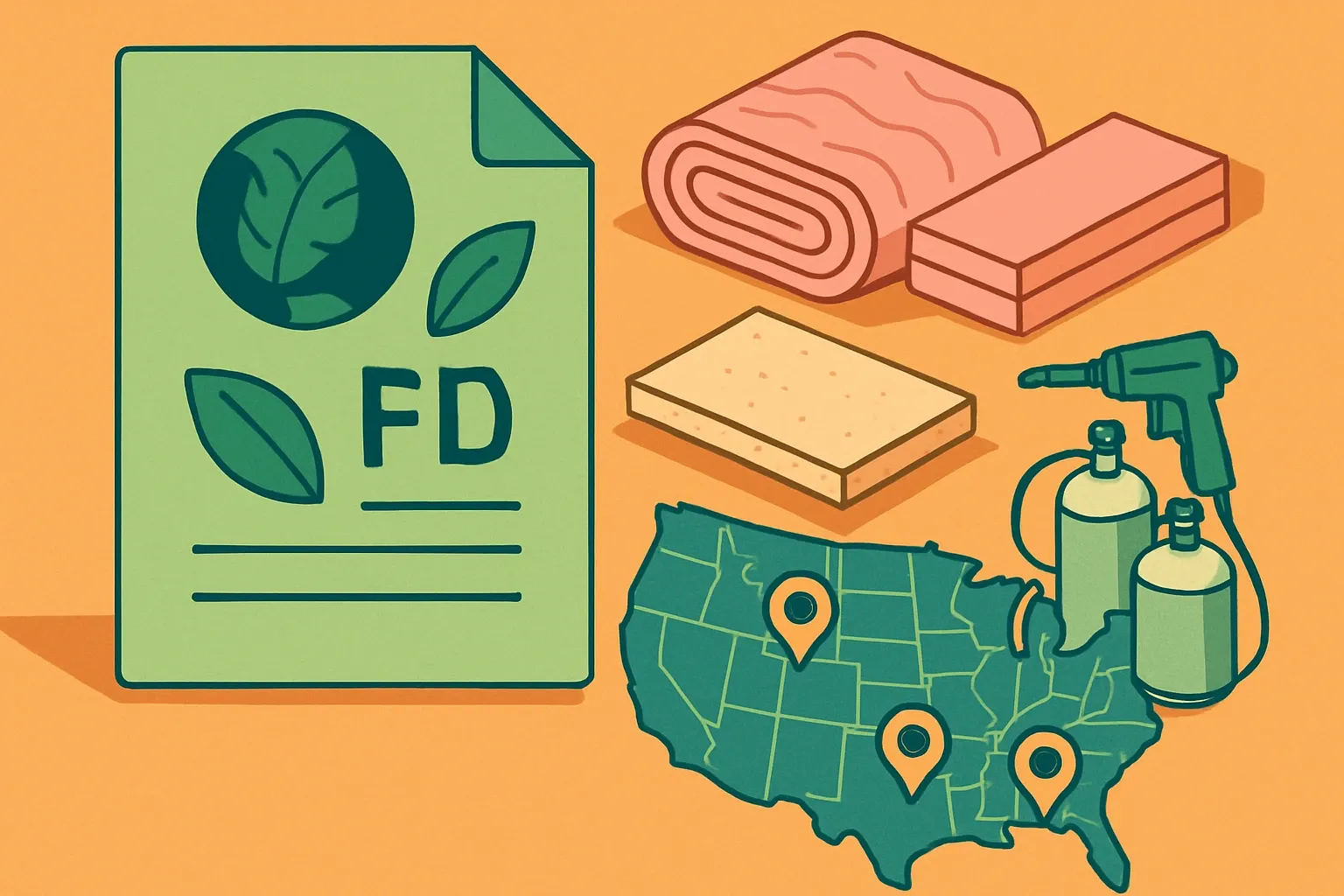
Insulation EPDs published for the United States over the last five years total 34 across 14 manufacturers and 8 program operators. Six distinct Product Category Rules (PCRs) show up, which matters because PCR choice determines comparability and renewal timing. The most recent EPD in this set is for PINK Next Gen Fiberglas Insulation (Canada) from Owens Corning, issued Oct 21 2024 under SCS Global Services with validity to Aug 31 2028.
Why this matters commercially is simple. Teams chasing LEED v5 oriented projects or public owners that score embodied carbon prefer product‑specific EPDs, which reduces the risk that your product gets swapped late in design because a competitor can be counted accurately.
Who published the most, and who is in the mix
The category is active yet concentrated. Owens Corning and Aeroflex lead the pack with 7 current EPDs each, followed by Saint‑Gobain GLASS with 5. GAF sits at 3. DuPont and Johns Manville contribute 2 each. A long tail, including CertainTeed Saint‑Gobain, Malarkey Roofing, Thermafiber and USG, contributes single declarations. This is a classic “power‑law” footprint that favors manufacturers who keep a steady renewal cadence rather than one‑off drops.
A practical takeaway for product management. If your line spans multiple insulation formats, plan a rolling release so specifiers always see fresh coverage across your biggest revenue SKUs.
Program operators US manufacturers actually use
The operator map shows clear preferences and a few outliers.
- SCS Global Services accounts for 13 EPDs across 4 manufacturers, which signals broad acceptance among competitors.
- UL hosts 8 EPDs across 4 manufacturers, also well diversified.
- EPD International AB and NSF International each show 3 EPDs but from only 1 manufacturer in this snapshot, which hints at single‑company portfolios rather than market‑wide adoption.
- ASTM International lists 1, as do Labelling Sustainability, Topcret tecnología en revestimientos SL and W‑L Construction & Paving Inc, each tied to a single manufacturer.
- Three EPDs show “No Program Operator Listed,” a red flag in specs since verifiability and searchability suffer.
When speed is paramount, pick an operator that already houses competitor records in your PCR family. Review authoring templates and verification queues before you commit so your team avoids preventable back‑and‑forth.
PCRs that set the rules, and what their clocks say
Six PCRs appear in this US insulation set. Two dominate the runway.
- Part B: Building Envelope Thermal Insulation Products features 14 EPDs with latest expiries reaching Mar 1 2029. That gives a long planning horizon.
- Part B: Mechanical, Specialty, Thermal, and Acoustic Insulation Products covers 8 EPDs with expiries through Nov 1 2027.
Secondary rulebooks show up less often. ISO 21930:2017 appears on 3 EPDs. PCR 2019:14 Construction products (EN 15804 A2) covers 3, with a favorable expiry on Apr 17 2029 that offers headroom for late‑decade renewals. A few entries are mapped to “Unknown PCR,” which complicates benchmarking.
Think of a PCR as the rulebook of Monopoly. Ignore it and the game falls apart. Choose the one your direct competitors use unless there is a clear reason to deviate, such as a significantly longer expiry horizon or a materially better fit for your product system boundary.
Selling insulation products or competing in the space?
Follow us on LinkedIn for insights that help you win specs and understand the EPD landscape in your market.
Issue momentum by year
Publishing volume spiked in 2021 then settled into a steady cadence. Use this to time your next release so you are not renewing in a crowded quarter.
| Year | EPDs issued |
|---|---|
| 2021 | 17 |
| 2022 | 5 |
| 2023 | 5 |
| 2024 | 7 |
| 2025 | 0 |
If you are entering the category in 2026, you are not late. You are early to the next renewal cycle, which can be a margin advantage when bids require current documentation.
The 2026 renewal wave you should plan around
Sixteen insulation EPDs in this set expire in 2026. The earliest expiries land Mar 10 2026 for a CEN EN 15804 entry, followed by several ISO 21930 records on Jun 14 2026. Building Envelope Thermal Insulation expiries cluster from Jul 1 2026 to Oct 1 2026. Mechanical, Specialty, Thermal, and Acoustic Insulation expiries span Jun 14 2026 to Dec 23 2026.
Translation for commercial teams. If your EPD expires in the second half of 2026, start data collection by late Q1. That gives room to adjust foreground data, validate utilities, and avoid a gap that forces specifiers to use conservative default factors.
Consultant involvement is now the norm
Twenty‑seven of the 34 EPDs list an external EPD service provider or consultant. That is almost 80 percent, which tracks with what we see across other construction categories. The takeaway is not that in‑house is impossible. It is that the hidden cost of internal data wrangling is high. A white‑glove partner like Parq typically shortens the path by centralizing data capture, sanity checking bills of materials, and steering PCR selection so your declarations are comparable out of the gate.
Product coverage by insulation type
The dataset spans fiberglas batt and roll products, stone wool, polyiso board insulation, and mechanical or specialty insulation used in HVAC and industrial settings. This is helpful for firms that sell across building envelope and MEP since one PCR family often covers both, provided the scope and modules match your actual use cases.
If you sell spray polyurethane foam, look closely at comparator PCRs used by polyiso and mineral wool products in your target specs. Mixed‑type comparisons are allowed when PCRs align on modules and assumptions. Specifiers want apples to feel like apples, even when one is red and the other green.
Not reflected in this 5‑year US snapshot, yet still relevant
A few large brands do not appear in the 34‑EPD US insulation count but do have current insulation EPDs in public registries. Hunter Panels has several polyiso EPDs with expiries in 2026. ROCKWOOL North America lists stone wool insulation verified by UL with validity to Feb 24 2030. Kingspan publishes broad portfolios, much of it under European programs, with many records valid into 2030. Knauf Insulation maintains a large global set as well. The absence from the US‑tagged count usually means cataloging under a different geography or PCR family rather than a lack of transparency.
If you compete with these brands in North America, map their operator and PCR choices to avoid needless rework during your own verification.
Operator and PCR picklist for teams that want less friction
- If your competitors sit with SCS or UL on Part B: Building Envelope Thermal Insulation Products, start there. Templates, reviewer familiarity and background datasets will line up.
- If you need a longer runway, PCR 2019:14 under EN 15804 A2 shows expiries into 2029 in this category. That can be a tiebreaker when timing is tight.
- Avoid “no operator listed” situations. They make search and submittals harder and can slow approvals.
We are operator‑agnostic in practice. The real speed unlock comes from rock‑solid foreground data and a clear PCR match before modeling begins.
What good looks like in 2026
- Publish where your rivals publish so your numbers compare cleanly. Then differentiate with decisive claims like thermal resistance per unit mass, installation waste factors, and service life assumptions. Those influence A1 to A3 and B‑modules in ways buyers notice.
- Plan renewals to land ahead of busy windows. The 2026 wave is your cue to start now, not in Q3.
- Bring an EPD consultant into the room early. You will save your engineering team dozens of hours on data requests, version control, and validator Q&A. Time you can invest in product work that actually moves the needle.
A quick note on data scope and how to go deeper
This analysis uses the global public registry of EPDs most specifiers search, shaped to United States insulation products published in the last five years. Due to registry loading delays, some late 2025 records may not appear yet. If you want the full and most current background dataset, connect with me on LinkedIn and send a message. I am happy to share the file, answer questions, or hop on a quick call to help pick the best‑fit PCR for your next EPD based on your competitive set. We can definately help you avoid dead ends before modeling even starts.