The 2026 snapshot, at a glance
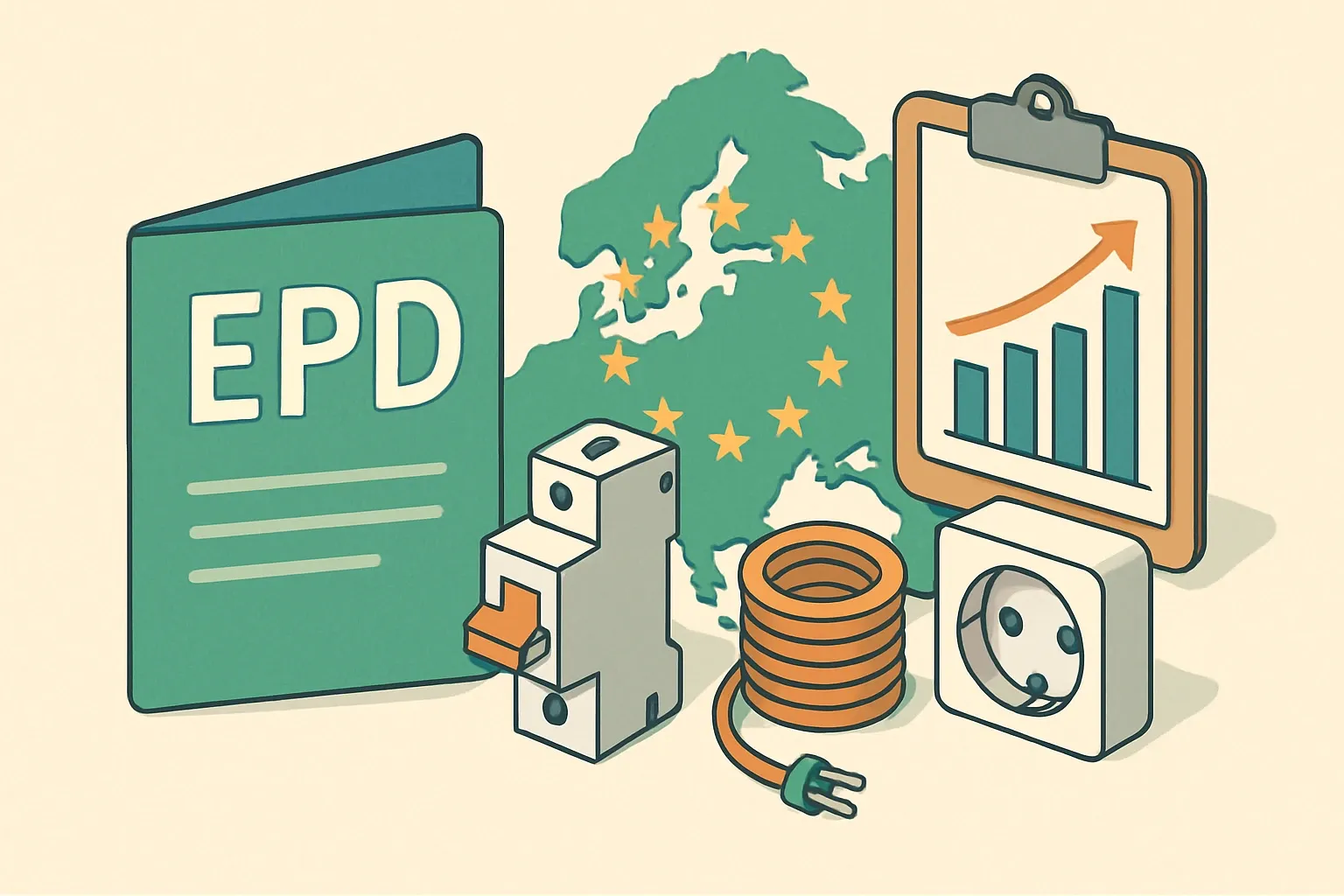
The registry’s “Other Electrical Equipment” bucket—our shorthand here will simply be electrical equipment—covers wiring devices, cable systems, lighting controls, small switchgear, and related accessories. In the last five years, 1,785 valid EPDs have been published in Europe across this catch-all category by 38 manufacturers and 6 program operators, using 5 distinct PCRs. The most recent entry landed on Jul 25 2025 for a 2-pole, 63 A modular switch by Hager Group under Association P.E.P, expiring on Jul 25 2030.
Who is publishing the most
A handful of manufacturers drove the majority of EPD volume. In this category view, the leaders by count include NEXANS with 395 EPDs, ABB S.p.A with 326, SAS International Ltd. with 294, Hager Group with 202, Severfield plc with 171, and Bette GmbH & Co. KG with 76. Activity is broad rather than a single-brand outlier, which helps specifiers compare like with like when projects set carbon targets.
Program operators used in Europe
Association P.E.P is the workhorse for electrical, electronic and HVAC-R products in Europe in this category view, with 1,682 EPDs spanning 34 manufacturers. INIES accounts for 91 EPDs across 8 manufacturers. EPD International AB shows 4 EPDs across 1 manufacturer, UL lists 6 for 1 manufacturer, while EPD Hub and EPD Italy each appear with 1 EPD across 1 manufacturer.
Why does this matter? Program operator familiarity can speed review cycles and lower friction in specification. Think of it like using the same referee crew every week. Everyone knows the rulebook, so the game flows.
PCRs that actually get used
A PCR is the rulebook of Monopoly. Ignore it and the game falls apart. Here is what manufacturers used for electrical equipment in Europe.
| PCR name | EPDs in use | Latest expiry |
|---|---|---|
| Product Category Rules for Electrical, Electronic and HVAC-R Products | 1,779 | Jul 25 2030 |
| PCR 2012:01 Construction products and construction services (EN 15804:A1) (expired) (2.34) | 4 | Jan 25 2026 |
| EPD Hub Core PCR version 1.0, 1 Feb 2022 | 1 | Nov 6 2029 |
| PCR for electronic and electrical products and systems | 1 | Mar 30 2028 |
Two takeaways. First, there is clear convergence on the Electrical, Electronic and HVAC-R PCR, which simplifies comparability across brands. Second, a small tail of legacy or generalist PCRs appears in the data, typically from earlier cycles.
At NEXANS or competing in electrical equipment?
Follow us for a product-by-product competitive analysis to understand which EPDs get spec'd and where you can gain a commercial edge.
Issuance tempo since 2021
Momentum matters for sales planning and replacement cycles. 2024 was the busiest year in the set.
| Year | EPDs issued |
|---|---|
| 2021 | 340 |
| 2022 | 373 |
| 2023 | 291 |
| 2024 | 585 |
| 2025 | 196 |
If you are entering the space in 2026, that 2024 wave means many competitors will face renewals between 2029 and 2030. That is an opening to leapfrog with cleaner data and updated footprints while others are heads-down on renewals.
Expiry cliff, 2026 through 2030
Renewal timing drives resourcing and commercial risk. Here is what is scheduled to expire next.
| Expiry year | Total EPDs due |
|---|---|
| 2026 | 340 |
| 2027 | 372 |
| 2028 | 299 |
| 2029 | 579 |
| 2030 | 194 |
Details worth noting. In 2026, 336 of the expiries come from the Electrical, Electronic and HVAC-R PCR, with a small tail from the legacy EN 15804:A1 PCR hitting Jan 25. In 2029, 578 expiries reference the Electrical, Electronic and HVAC-R PCR, plus a single EPD under EPD Hub’s 2022 core PCR that ends on Nov 6. If your portfolio leans on multi-SKU families, align sampling and primary data collection now so 2029 does not turn into a scramble.
How often teams use an EPD consultant
Manufacturers engaged an EPD service provider in 205 of the 1,785 EPDs in this set, roughly 11 percent of declarations. The label varies by region, you will hear consultant, verifier, or EPD service provider. The practical meaning is consistent. A partner handles the heavy lift on data wrangling, LCA modeling, and publication with your preferred operator. If you want a white-glove option designed for speed and completeness, consider an EPD service provider like Parq. We usually see the cost repaid by even one mid-sized project where an EPD is table-stakes.
Operator choice for electrical products
For low-voltage components, wiring devices, cable systems, small switchgear, and lighting controls, Association P.E.P is widely recognized by specifiers across Europe. INIES remains influential in France, EPD International AB is common for multi-national portfolios, and UL appears here where brands run a single global template. Operator agnosticism is useful when you sell into multiple countries, since local databases often mirror national preferences.
Notably absent in this category view
Some big names do not show up heavily under the registry’s “Other Electrical Equipment” tag in this dataset, although they do maintain active EPD portfolios in public European registers. Schneider Electric publishes PEP Ecopassport entries for switchgear and transformers. Prysmian Group issues EPDs for cables in Nordic and EU markets. If you compete with them, check how their products are categorized. It is common to see cable systems filed under cable-specific Part B rules, and controls filed under narrower electrical PCRs rather than this catch-all category.
Practical playbook for 2026 starts
Pick your PCR by looking at competitors, expiry runway, and the operator you want to publish with. The market is already converging on the Electrical, Electronic and HVAC-R PCR, which reduces debate over scope. Build a single reference year for primary data across plants, then lock a cadence for updates. That way you avoid sudden crunches when the 2029 swell hits.
Two quick tips. First, treat packaging, spares, and installation accessories as adders that can swing results if left out. Second, design for modular updates. When a supplier changes resin or copper sourcing, you want a fast road to a data refresh, not a re-build from scratch. This saves time alot.
What this means for sales
In projects with embodied-carbon accounting, a product without a third-party EPD often gets a penalty that pushes it out of contention. With a published EPD, your team enters those bids with fewer hurdles, and you are less likely to be swapped late for a competitor that has one. The upside is not abstract. It shows up as earlier spec inclusion, faster submittals, and less back-and-forth on compliance.
One last thing and how to get the raw data
This analysis uses the global public registry that most architects and specifiers rely on. Due to real-world loading delays, some EPDs from the second half of 2025 may not yet appear. If you want the up-to-date background dataset, or you want help choosing the best-fit PCR for an upcoming declaration, connect with me on LinkedIn and send a note. I am happy to share the full extract and hop on a quick call for free to walk through your competitive landscape.