The 2026 snapshot in one glance
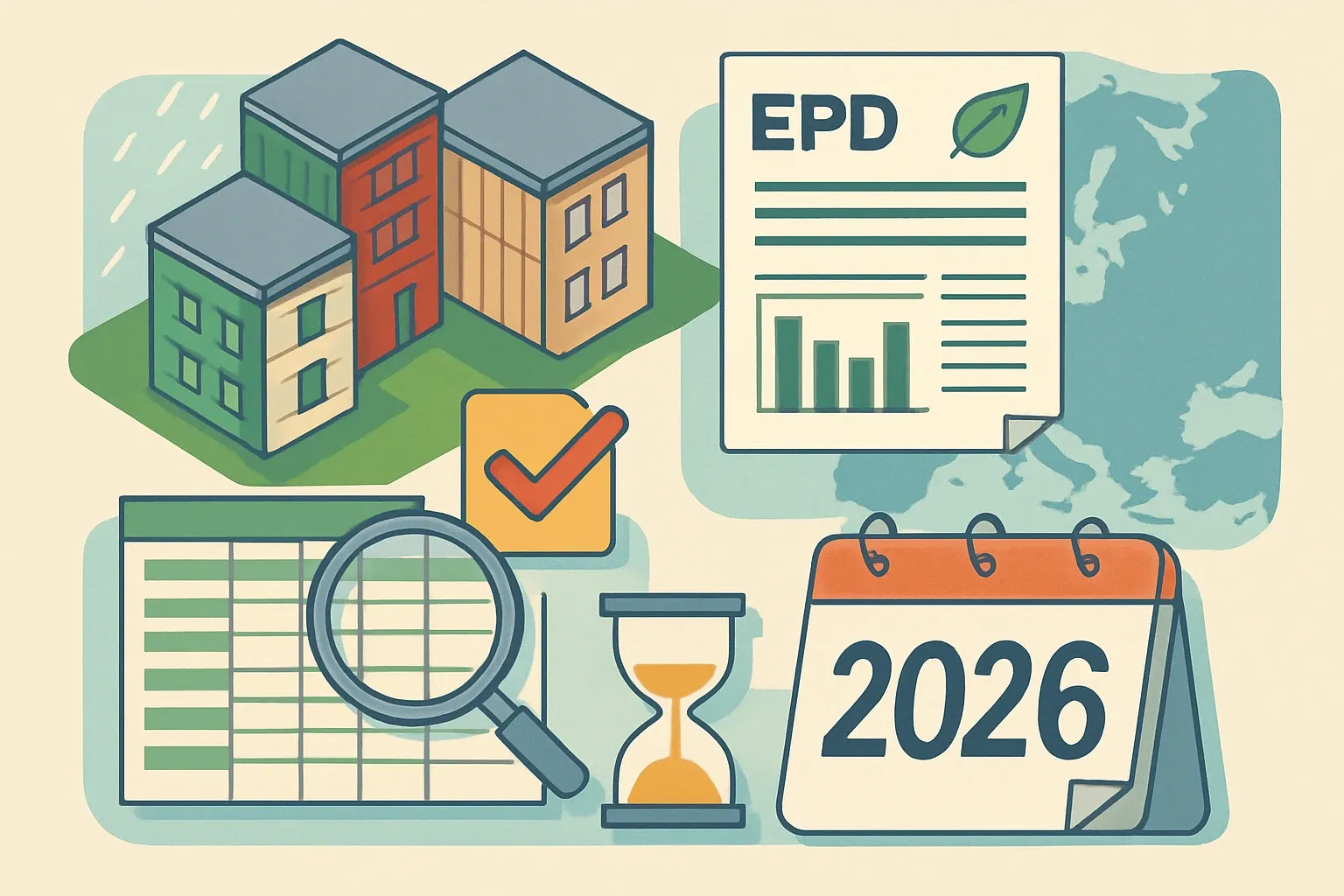
Across Europe, cladding has 33 currently valid EPDs from 23 manufacturers and 9 program operators, based on the last five years. That is a lean market with roughly 1.4 EPDs per manufacturer. Fourteen distinct PCRs were used, which means choices matter for comparability and renewal timing.
Issuance tempo since 2021
Here is the year by year cadence visible in the registry window.
| Year | EPDs issued |
|---|---|
| 2021 | 8 |
| 2022 | 11 |
| 2023 | 12 |
| 2024 | 2 |
| 2025 | 0 |
The visible slowdown in 2024 may reflect reporting lag plus teams shifting to updated EN 15804 A2 aligned rule sets. Expect late‑2025 entries to surface as operators complete uploads.
The newest EPD on the board
The most recent cladding entry is S‑P‑10672 for a Compact Panel from Bastug Metalurji Sanayi A.S, issued Apr 30, 2024 by EPD Australasia under c‑PCR‑006 Wood and wood‑based products for use in construction. It runs through Apr 29, 2029. A non‑European operator publishing for a European manufacturer is uncommon but valid, and specifiers generally accept it when the PCR is clear and third‑party verified.
Who publishes cladding EPDs
EPD International AB is the workhorse in Europe for cladding with 20 of 33 current EPDs, used by 13 different manufacturers. That is about 61 percent of the set, a strong signal that many peers will compare against this rulebook and format.
Several operators appear but with narrower footprints. ITB shows 3 EPDs concentrated with one manufacturer. EPD Hub carries 2 EPDs used by 2 manufacturers, suggesting early but growing adoption. INIES contributes 2 EPDs from 2 firms, and IBU has 1. Bau EPD GmbH, EPD Norway, and Maxime Pousse each appear once.
Operator choice influences review timelines and the markets where sales teams need quick confirmations. If projects expect French RE2020 documentation, INIES helps. If your channel meets Nordic clients, EPD Norway familiarity can be useful. For pan‑EU comparability, EPD International AB’s share speaks for itself.
At a cladding manufacturer or competing in Europe?
Follow us for a product-by-product analysis of EPDs to see which offerings get spec'd and where you can unlock market opportunities.
Manufacturers shaping the benchmark
Multiple brands have more than one current EPD in cladding. Kingspan has 3. Russwood has 3. ASAŞ Alüminyum has 3. URSA, CEWOOD, Fairview Europe t⁄a Valcan, and ISOSPAN each show 2. The rest are single declarations, including Stora Enso, ArcelorMittal, Gustafs, and NorDan.
Material mix spans timber, fiber cement, metals, and composite laminates. That mix matters when you pick a PCR. Wood‑based façade boards should generally sit under EN 16485 aligned c‑PCRs, while fiber cement and HPL laminates cluster under the construction products family rules.
Which PCRs dominate
Two families do most of the lifting. The EN 16485 wood and wood‑based c‑PCRs and the EN 15804 A2 construction products PCR in recent versions. Both attract meaningful volume and have clear renewal paths.
| PCR | EPDs | Latest expiry |
|---|---|---|
| PCR 2019:14 Construction products (EN 15804+A2) v1.3.3 | 6 | May 15, 2028 |
| PCR 2019:14‑c‑PCR‑006 Being updated. Wood and wood‑based products for use in construction (EN 16485) | 6 | Nov 27, 2027 |
| Part A: Construction Products and Services | 4 | Dec 12, 2028 |
| PCR 2019:14 Construction products (EN 15804:A2) v1.2.5 | 3 | Jul 11, 2027 |
| EPD Hub Core PCR version 1.0, Feb 1, 2022 | 2 | Nov 23, 2028 |
| PCR 2019:14‑c‑PCR‑005 Being updated. Thermal Insulation products (EN 16783) | 2 | Dec 20, 2027 |
| Sustainability of construction works. National addition to NF EN 15804+A1 | 2 | Oct 28, 2027 |
| Unknown PCR | 2 | Jun 13, 2028 |
| CEN standard EN 15804 | 1 | Dec 31, 2029 |
| PCR 2012:01 Construction products and construction services (EN 15804:A1) | 1 | Aug 4, 2026 |
| PCR 2019:14 Construction products (EN 15804:A2) | 1 | Feb 24, 2026 |
| PCR 2019:14‑c‑PCR‑005 c‑PCR‑005 Thermal Insulation products (EN 16783) | 1 | Jun 10, 2026 |
| Part B: Requirements on the EPD for Ceramic panelling | 1 | Mar 12, 2026 |
| c‑PCR‑006 Wood and wood‑based products for use in construction (EN 16485) | 1 | Apr 29, 2029 |
If you want apples to apples comparisons in spec battles, pick the PCR your closest competitors use unless there is a strong rationale to do differently. A PCR is the rulebook of Monopoly. Ignore it and the game falls apart.
Watch the expiry cliff
Renewal planning is real work for 2026 and 2027. Eight cladding EPDs expire in 2026 with dates clustered from Feb 9 to Aug 4. Twelve more roll off in 2027, including wood and insulation c‑PCRs that many timber and mineral‑board products rely on. Eleven expire in 2028. Only two run to 2029.
Teams that sell into long tender cycles should start refresh work roughly two quarters before expiry. That keeps pricing live in bids and avoids last minute scrambles when a program operator’s queue tightens.
How teams are getting EPDs done
Twenty nine of the 33 cladding EPDs were published with the help of an external EPD consultant or EPD service provider. That is about 88 percent, which tracks with what we see across heavy building materials where data gathering spans multiple plants and suppliers. If you choose to work with a service provider, prioritize reliability, completeness, and speed in data wrangling. If you want an example of a white‑glove model, see Parq.
Picking a program operator and PCR with confidence
Start with the competitive set. If your peers publish under EPD International AB and use PCR 2019:14 v1.3.3, match that unless a national scheme like INIES is commercially decisive. Second, check the expiry window. Launching a new product with a PCR that sunsets within a year can force an early redo. Third, consider the verification path and languages your channel needs. A French operator can make RE2020 exchanges smoother. A Nordic operator can speed sign‑offs with local reviewers.
If the category is split between wood and fiber cement, pick the specific c‑PCR that fits your material rather than a generic fallback when possible. That keeps comparisons fair and your story credible.
Who is quiet right now
One notable brand is currently light on visible cladding EPDs. FunderMax France shows no current entries in the public registry window we used, only an older record that has since expired. Peers such as Trespa and James Hardie Europe do have current cladding EPDs on file. If you are evaluating HPL exterior panels, this gap may influence shortlist decisions until new declarations land.
What this means for your 2026 plan
If you sell timber façades, the EN 16485 c‑PCRs remain the safe lane. If you sell fiber cement or HPL laminates, the EN 15804 A2 construction products family rules are the center of gravity. Plan renewals now if your expiry sits in 2026 or 2027. Coordinate operator choice with where your bids actually happen, not just where your headquarters sits.
This analysis is based on the global public registry most specifiers consult. That registry sometimes loads entries with a delay, so late‑2025 EPDs may not yet be visible. If you want the full up‑to‑date background data, connect with me on LinkedIn and send a note. I am happy to share the dataset, answer questions, and hop on a quick call to recommend the best fit PCR for your upcoming EPD based on the current competitive landscape. That will make your next move definately faster.