The 5‑year snapshot for US underlayments
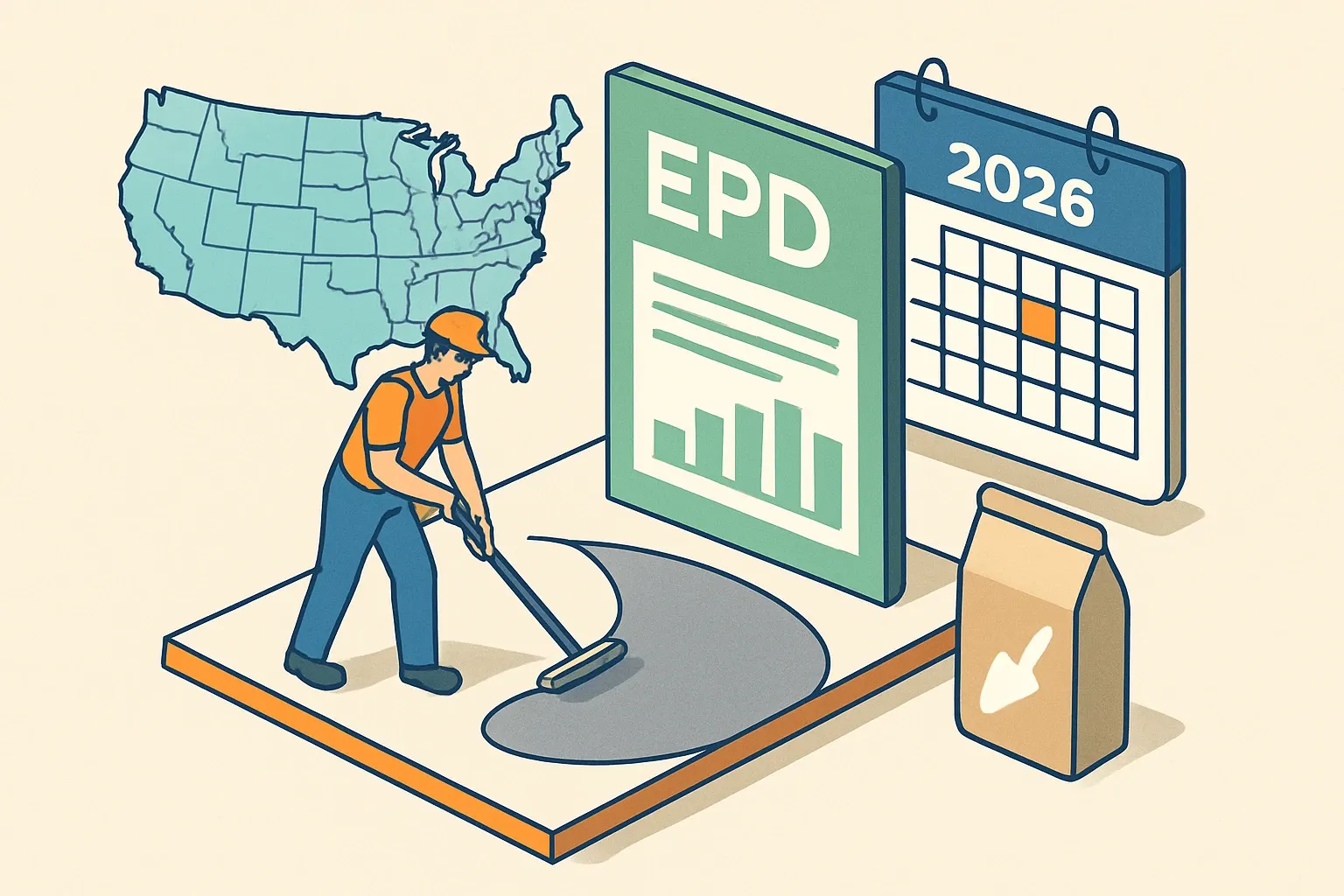
In the last five years, the United States market logged 51 current EPDs for cast decks and underlayment across 5 manufacturers and 4 program operators. Seven distinct PCRs show up in those declarations, so choice of rulebook truly shapes comparability.
The latest release on record is Durock Quik‑Top Self‑Leveling Underlayment from USG on Jan 8, 2025 with ASTM International as program operator and c‑PCR‑001 Cement and building lime as the referenced rule (valid through Jan 8, 2030). That single line tells you a lot about where the center of gravity sits right now.
Year‑by‑year pace
Issuance volume has not been linear. 2023 surged, then activity cooled in 2024 and 2025.
| Year | New EPDs |
|---|---|
| 2021 | 12 |
| 2022 | 8 |
| 2023 | 22 |
| 2024 | 5 |
| 2025 | 4 |
A spike in 2023 often reflects pent‑up product lines being formalized in one go. The softer 2024 and 2025 rhythm likely means teams are moving into maintenance mode while watching PCR updates before committing to the next wave.
Program operators used (and how concentrated they are)
Four operators handled the category in the period, but manufacturer diversity differs.
- ASTM International published 7 EPDs across 2 manufacturers. That split suggests ASTM is a common US pathway when multiple brands are present.
- EPD International AB handled 12 EPDs across a single manufacturer. High concentration like this usually means a portfolio push by one firm.
- EPD Norway appears with 19 EPDs from one manufacturer. Again a single‑maker cluster.
- Labeling Sustainability Inc. accounts for 13 EPDs from one manufacturer.
If competitive separation matters, note the pattern. Three of the operators above anchor one‑brand portfolios. When several competitors share the same operator the verification cadence and formatting feel more directly comparable in specs.
Are you with USG or competing in the underlayment space?
Follow us for a free product-by-product competitive analysis to see which self-leveling underlayments get spec'd and where EPD gaps might impact your projects.
Who is publishing
Manufacturer volumes are lopsided, which is typical for mature chemistries.
- Weber Saint‑Gobain Sweden AB leads with 19 EPDs in the US category scope.
- CTS Cement has 13.
- MAPEI lists 12.
- USG shows 6.
- Sika USA appears with 1.
For teams planning their first declaration, this concentration is a gift. You can quickly see which chemistries, packaging options, and performance families competitors choose to cover first.
PCRs that actually show up
Seven PCR references power the declarations. Here is the scorecard plus the latest expiry seen for each.
| PCR name | EPDs | Latest expiry |
|---|---|---|
| NPCR 009 Part B Technical Chemical products for building and construction industry | 19 | Jan 12, 2029 |
| PCR 2019:14 Construction products EN 15804 A2 v1.3.3 | 11 | Jan 11, 2029 |
| PCR for Portland, Blended, Masonry, Mortar, and Plastic Stucco Cements | 15 | Jan 8, 2030 |
| Part B Cement‑based Grout, Adhesive Mortar and Self‑Leveling Underlayment EPD Requirements | 1 | Aug 1, 2029 |
| Part A Implementation and use of EN 15804 2012 and CEN TR 16970 in Ireland | 1 | Mar 9, 2028 |
| Unknown PCR | 1 | Jun 4, 2029 |
| c‑PCR‑001 Cement and building lime EN 16908 | 2 | Jan 8, 2030 |
| c‑PCR‑003 Concrete and concrete elements EN 16757 | 1 | Jan 8, 2029 |
What this means in practice. Cement‑centric PCRs dominate, so mixing, density, admixtures, and curing assumptions matter more than branding. If your product is closer to grout or adhesive mortar, the dedicated Part B route appears but is rare, which can affect comparability in submittals.
The renewal clock you should actually plan around
A large share of current EPDs reaches a renewal decision between 2026 and 2028. That window is where competitive positioning is won or lost.
- 2026 has 12 expiries, all tied to NPCR 009 Part B. Renewals here influence continuity for chemical‑type formulations.
- 2027 has 8 expiries across NPCR 009 and PCR 2019:14.
- 2028 is the big year with 22 expiries, dominated by 13 cement PCR renewals plus 8 PCR 2019:14 cases.
- 2029 drops to 5 expiries across several one‑offs including c‑PCR‑003.
- 2030 currently shows 4 expiries, split between the cement PCR and c‑PCR‑001.
Most US operators use five year validity windows, so plan your internal data pull to start at least two quarters before expiry to avoid rushed updates. Missing a renewal by even a few weeks can stall a bid cycle when a spec asks for current declarations.
Spotlight on the most recent EPD
Durock Quik‑Top Self‑Leveling Underlayment (USG) posted on Jan 8, 2025 through ASTM under c‑PCR‑001. The expiry on Jan 8, 2030 gives a clean runway for specs while many competitor declarations face renewal earlier. If you sell into projects with heavy subfloor prep, that timing matters alot.
How often teams use EPD consultants
38 of the 51 declarations were published with an external EPD service provider involved. That is a strong signal that time and data wrangling are the real constraints, not modeling theory. If your product line is busy or distributed across plants, bringing in an EPD consultant can keep senior R&D and operations focused while the heavy lifts get done. Parq is one example of a white‑glove EPD service provider with fast data collection and operator‑agnostic publishing (Parq).
Notably absent in the US underlayment EPD landscape
Several sizable brands in self‑leveling underlayment are not visible in the US cast decks and underlayment EPD set as of Jan 22, 2026. ARDEX Americas, Maxxon, Custom Building Products, Schönox HPS North America, and UZIN UTZ North America do not appear with US‑scoped underlayment EPDs in this category. Some of these firms do publish EPDs in Europe or for adjacent adhesives and mortars, which may not translate one‑to‑one for US specs. If this changes we will update future editions.
Choosing the right PCR and operator for your product
Start with the competitive map. If your closest rivals align with the cement PCR or PCR 2019:14, following that path improves apples‑to‑apples comparability in submittals. Consider operator familiarity among your target specifiers. Where multiple competitors use the same operator, reviewers tend to recognize the layouts and module scopes faster. Finally, look at expiry clustering. Launching just before a competitor’s renewal wave can create a simple story for project teams.
What this means for sales and specs
An active, multi‑PCR category rewards clarity. Declare your system boundaries, show plant‑specific data when feasible, and keep renewal timing front and center in the sales playbook. One current, product‑specific EPD often removes penalties that would otherwise be applied to your product in carbon accounting, which keeps the conversation about performance and availability rather than price alone.
One last thing
This article relies on the global public EPD registry that most architects and specifiers check. Because of loading delays, some late‑2025 publications might not be reflected yet. If you want the full underlying dataset, or help picking the best‑fit PCR and program operator for an upcoming EPD, connect with me on LinkedIn and send a note. I am happy to share the latest cut and jump on a quick call to talk through options (Toby Urff).