What we mean by “Board” here
This guide covers rigid board and panel products used in building envelopes and interiors. Think insulation boards in foam or mineral wool, wood‑fibre boards, metal-faced sandwich panels, and selected ceiling or lining panels where they appear in the same buyer conversations.
Market snapshot at a glance
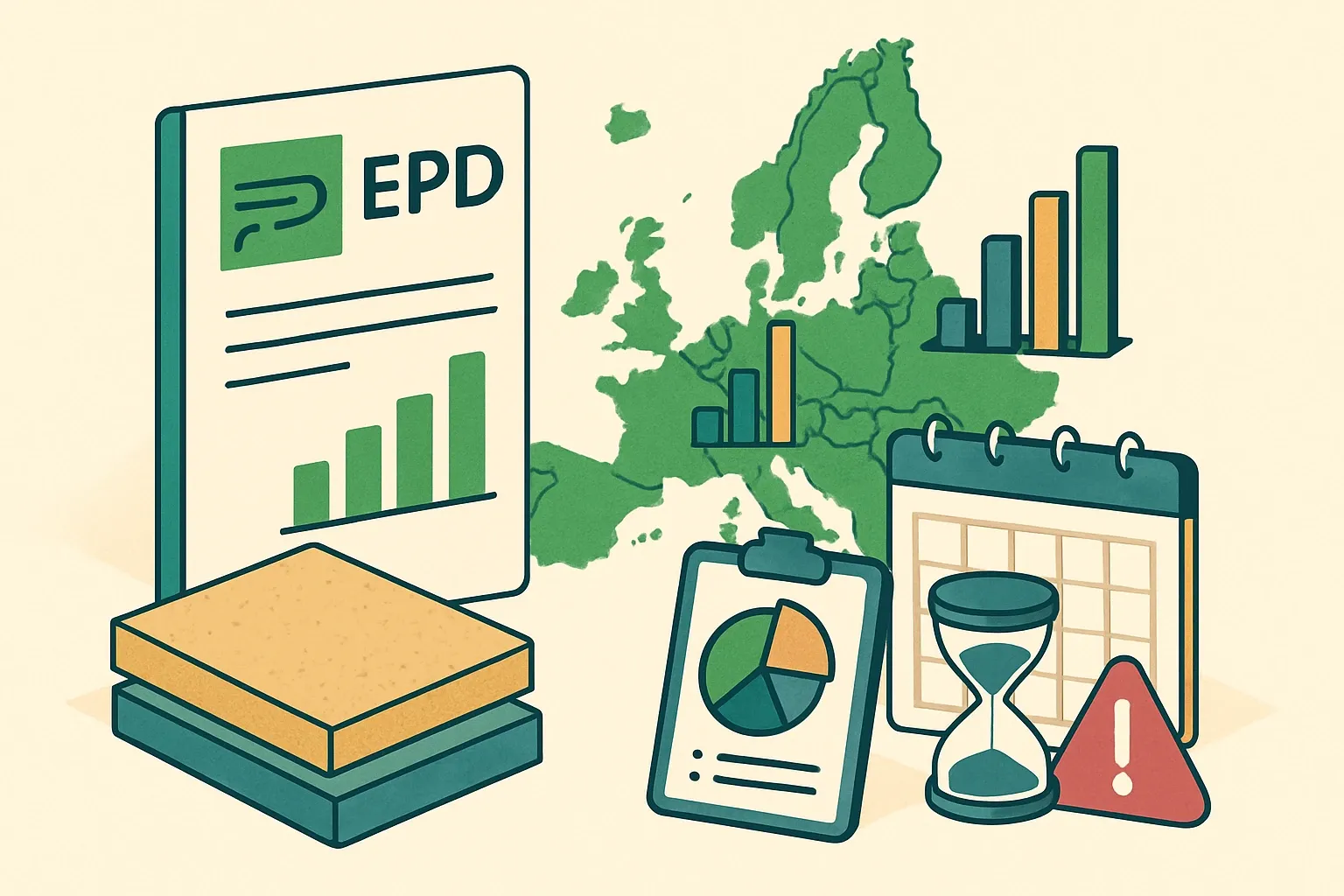
Across Europe, 214 Board EPDs remain valid from the last five years, published by 53 manufacturers through 13 program operators using 40 distinct PCRs. The most recent issue date in this set is June 7, 2025 for an Uponor Corporation product verified by EPD Hub, expiring June 7, 2030.
Momentum peaked earlier in the window. Half of all current EPDs were issued in 2021, with activity easing in 2022 and 2024. That pattern usually reflects large portfolio updates timed to PCR shifts, then slower, targeted additions.
EPDs issued per year
| Year | EPDs issued |
|---|---|
| 2021 | 107 |
| 2022 | 35 |
| 2023 | 59 |
| 2024 | 9 |
| 2025 | 4 |
Who publishes these: program operators by share and diversity
INIES is the clear center of gravity for Board in Europe with 98 current EPDs across 15 manufacturers, a broad and competitive mix rather than one mega portfolio doing all the work. EPD International AB follows with 40 EPDs across 18 manufacturers, then IBU with 36 across 14 manufacturers. EPD Ireland hosts 11 across 2 manufacturers, EPD Norway 5 across 1, EPD Hub 5 across 2, and SCS Global Services 10 across 2. The long tail includes BRE Global, Kiwa, UL, EPD Italy, EPD Australasia, and the Barcelona chapter operator.
What this means in practice is simple. If France is a priority market, INIES and the NF EN 15804 national additions drive format norms inside tenders. If Germany is a priority, IBU’s Part B documents for insulation categories are frequently seen and well understood. Teams can still publish with other operators. It just pays to align the label with the markets where the spec decisions happen.
Manufacturer leaderboard and the long tail
Two names carry roughly one third of the currently valid EPDs in this category. SOPREMA SAS accounts for 35 EPDs. Kingspan contributes 33. The next tier includes Austrotherm at 16 and Knauf Insulation at 10. A healthy long tail rounds out the field with 53 total manufacturers represented, which tells us the space is competitive and buyers have choices.
If your products compete with Kingspan, SOPREMA, or the French brands under INIES, the presence of recent, portfolio-wide EPDs means you are already compared to product-specific numbers at bid time rather than generic, penalizing defaults. That is the commercial unlock.
At Kingspan or competing with them?
Follow us for product-by-product EPD insights that reveal which insulation boards get spec'd and where gaps in your offerings may cost you projects.
The PCR map competitors actually use
No single rulebook dominates every Board application. Here is the pattern that stands out.
- National additions to NF EN 15804 are heavily used in this category, with 60 EPDs on the A1 addition and 35 on the A2 addition. That mirrors the operator mix and the French project pipeline.
- IBU Part B documents are common for foam plastics and mineral insulating materials. We see 16 EPDs under “Insulating materials made of foam plastics” and additional volumes under “Mineral insulating materials” and “Mineral panels.”
- For thermal insulation, EN 16783 based PCRs appear repeatedly, both via EPD International c‑PCR‑005 and operator-specific Part B texts.
- Norway’s NPCR 012 and NPCR 010 show up where wood-fibre boards and national requirements matter.
Choose the PCR that best matches buyer expectations for your product family and region. The fastest path is usually to mirror the PCR used by the products you replace on spec.
The renewal cliff you can plan around
The expiry curve is front‑loaded. 107 EPDs expire in 2026, 34 in 2027, 57 in 2028, 11 in 2029, and 4 in 2030. Many 2026 expiries are tied to NF EN 15804 national additions and early EN 16783 based texts. If your portfolio was last updated in 2021, plan your renewal work now so commercial teams are not surprised in spring and autumn bid seasons.
A quick playbook that works well. Prioritize hero SKUs and high‑volume thicknesses. Align the program operator with the market where the bid will be decided. Check whether your current PCR has a new edition and whether your competitors already moved. Then slot the rest of the range into a rolling update so nothing goes dark.
Where developer support shows up
112 of the 214 Board EPDs used an external EPD consultant or service provider. That means about 52 percent of declarations were delivered with specialist help, not purely in‑house. If speed and completeness matter, it is rational to use a partner that handles data collection inside your plants and publishes with the operator you prefer. Parq is one example of a white‑glove EPD service provider that does exactly that (Parq).
Notably absent or underrepresented manufacturers
A few large European panel players are active with EPDs, yet often appear under sandwich panel or metal profile categories rather than in this Board snapshot. Ruukki Construction publishes dozens of EPDs for mineral wool core sandwich panels. ArcelorMittal Construction has EPDs for deck profiles and PIR core panels. Metecno also posts panel EPDs in EN 15804 contexts. If you compete with these portfolios in roof and facade packages, check the panel category too when benchmarking.
Rockwool’s presence in this particular Board slice is relatively small compared to their overall European footprint, likely because many of their EPDs in public registries cover blanket or technical insulation rather than rigid boards. For gypsum‑fibre and fibre cement boards, brands like fermacell publish in their own board‑specific PCRs, which sit adjacent to the thermal insulation set that dominates here.
Operator by operator: what the numbers suggest
- INIES volume is broad across 15 manufacturers, which signals mainstream acceptance in French‑led projects and multi‑country tenders that include France.
- EPD International AB shows the widest manufacturer diversity at this scale, which helps when your sales footprint crosses borders and you want a label with broad recognition.
- IBU’s Part B texts remain a reliable route for foam and mineral wool boards in DACH markets.
- Smaller operator counts such as EPD Ireland’s 11 across 2 manufacturers likely reflect country‑specific programs serving domestic brands.
A few product notes from the latest filing
The newest EPD in the set is a June 7, 2025 issue by Uponor under EPD Hub using a floor coverings c‑PCR, expiring June 7, 2030. That is an edge case in a Board‑heavy landscape and a reminder to confirm PCR fit before starting. A PCR is the rulebook of Monopoly. Ignore it and the game falls apart.
How to turn this into commercial advantage
Treat the table above like a tide chart. If your category peers face a 2026 renewal wave, you can either time your own refresh to match buyer expectations or leapfrog to a newer PCR that carries through to 2029 or 2030. Sales teams armed with product‑specific EPDs avoid default penalties in many scoring systems and keep options open in low‑carbon tenders. The cost of a well run EPD program is usually dwarfed by one mid‑sized project you win because the data is in place.
If you have a wide catalog, roll out in cohorts. Start with your revenue drivers. Then move to the niche SKUs. That keeps marketing and sales in play while technical teams finish the long tail. It is definately easier to maintain momentum this way.
Method notes and how to go deeper
This article is based on the global public registry of EPDs most architects and specifiers use. Due to normal loading delays, some EPDs from the last half of 2025 may not be visible yet in that registry. If you want the full, up‑to‑date background dataset behind this post, connect with me on LinkedIn and send a message. I am happy to share, answer questions, or hop on a short call to help you pick the best fit PCR and operator for your next Board EPD based on the competitive landscape (Toby Urff).