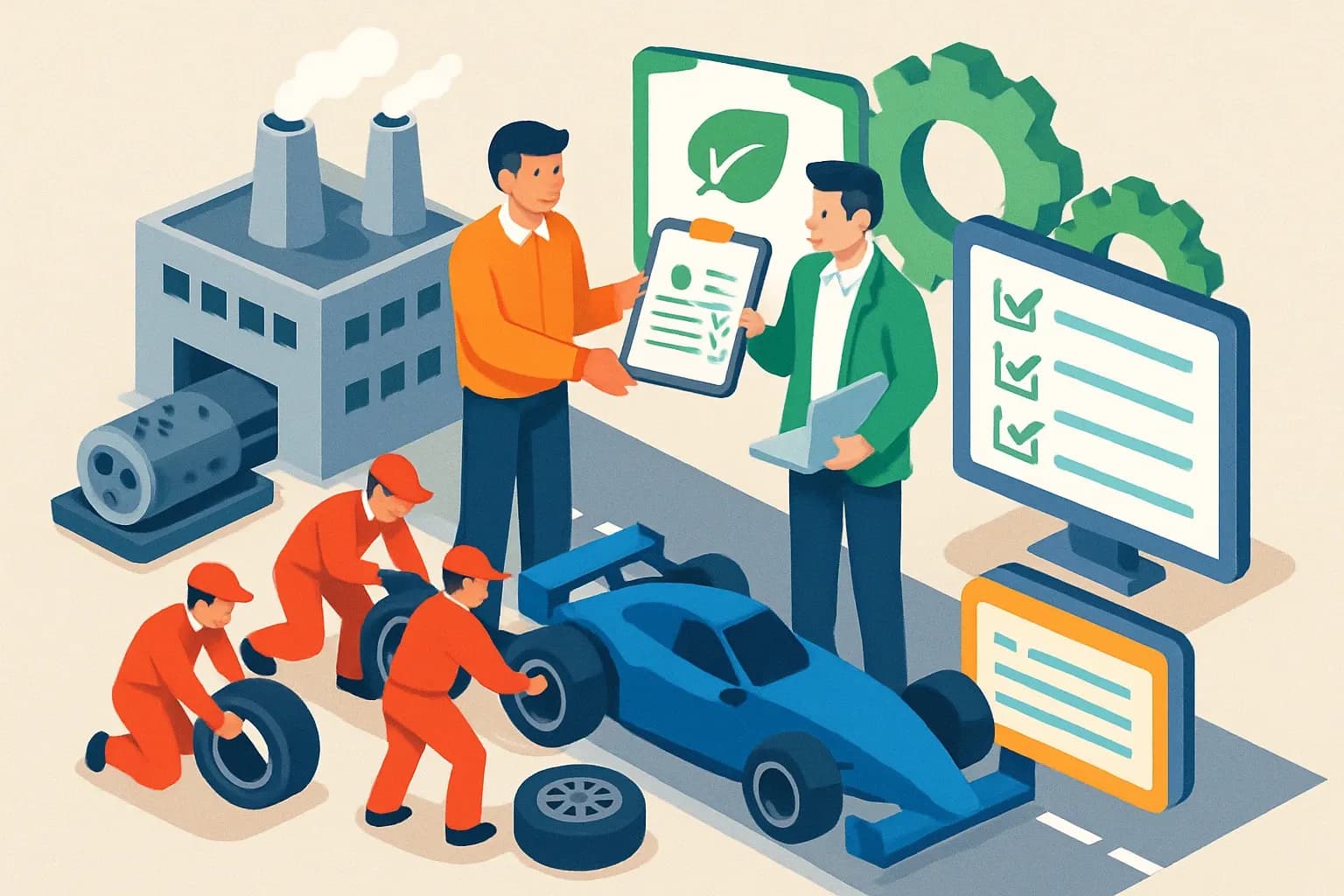
From one-off projects to living product systems
Per-EPD consulting is a sprint that ends at publication. A platform is a runway. It connects to your operations, maintains your portfolio, and prepares renewals before anything expires. That shift matters when declarations are typically valid for five years and then require an update (IBU, 2025) (IBU, 2025).
What “AI-powered” should actually mean
AI should not be a sticker. Expect trained models that map messy bills of materials to PCR scopes, flag data gaps, and propose defensible assumptions your verifier will accept. Think of it like autocorrect for sustainability data that learns your product family, not a generic chatbot.
Data integration that respects reality
Real factories change recipes, suppliers, and loads. The right platform ingests ERP, MES, and energy data on a schedule, tags deltas, and re-runs LCAs when shifts cross materiality thresholds. We like tools that show diffs by indicator so engineering sees what changed and sales sees whether a spec is now safer.
Always current with evolving rules
Rules move. The International EPD System released GPI 5.0.0 on June 19, 2024 with updated procedures and a managed transition approach that protects already-published EPDs (EPD International GPI, 2024) (EPD International, 2024). Platforms should track GPI and PCR versioning, keep your bill of materials mapped to the right methods, and queue updates when a relevant PCR revises.
LEED v5 is upping the bar
LEED v5 was ratified by USGBC members on March 28, 2025 and moves to a five-year development cadence that emphasizes decarbonization and material transparency (USGBC, 2025) (USGBC, 2025) (USGBC, 2025). Platforms should translate these shifts into practical product guidance and ready-to-send submittals so sales does not have to interpret credit language on the fly.
Want to leverage AI for your EPDs effectively?
Follow us on LinkedIn for insights on maximizing your EPD strategy and unlocking new revenue opportunities.
Compliance is the floor, product intelligence is the ceiling
The real differentiator is the intelligence layer on top of the EPD pipeline. Expect natural-language search across your declarations, safety data sheets, and VOC files. Expect instant, project-ready submittal packs. Expect portfolio heatmaps that surface SKUs best suited for carbon-sensitive bids so reps can prioritize where an EPD actually moves the needle.
Sales enablement that targets EPD-sensitive demand
When cities or owners ask for whole-life carbon accounting, assumptions penalize products without product-specific EPDs. A platform should help sales spot those bids quickly, attach the right declaration, and show how your numbers compare within the same PCR scope. It’s not about a faster EPD, its about faster selling.
Subscriptions that map to your portfolio
Per-EPD pricing locks you into hand-picking SKUs. Modern platforms offer subscriptions that cover broad or unlimited SKUs, then refresh results when inputs change. That model fits how manufacturers launch variants, retire materials, and localize supply without pausing for a new consulting SOW every time.
Operational guardrails buyers should insist on
- Verifier-ready outputs aligned to the current PCR and GPI with documented assumptions.
- Source-of-truth links back to ERP and energy meters, not spreadsheets.
- Renewal alerts timed to the five-year validity window and to PCR revision cycles (IBU, 2025) (IBU, 2025) (UL Solutions, 2025) (UL Solutions, 2025).
- Role-based access so sales can self-serve submittals while LCA leads control methods.
- Machine-readable EPD exports so data flows into design and procurement tools.
White-glove where it counts
Automation handles scale. People remove friction. Look for a team that chases the right data inside your org, normalizes it, and keeps verifiers happy. That is what keeps experts in R&D and on the plant floor focused on building better product rather than formatting meter reads.
The payoff manufacturers care about
EPDs open doors where carbon targets are real. LEED v5 tilts more of the conversation toward life-cycle emissions, which favors teams that can produce accurate, current declarations with minimal drag (USGBC, 2025) (USGBC, 2025). When platforms add search, submittals, and targeting on top, compliance work compounds into repeatable revenue impact.
Bottom line
If a platform cannot stay in sync with standards, prove renewals inside the five-year window, and arm sales with instant answers, it is not a platform. It is a point tool. If these basics dont exist, keep looking.