What changed on 1 September 2024
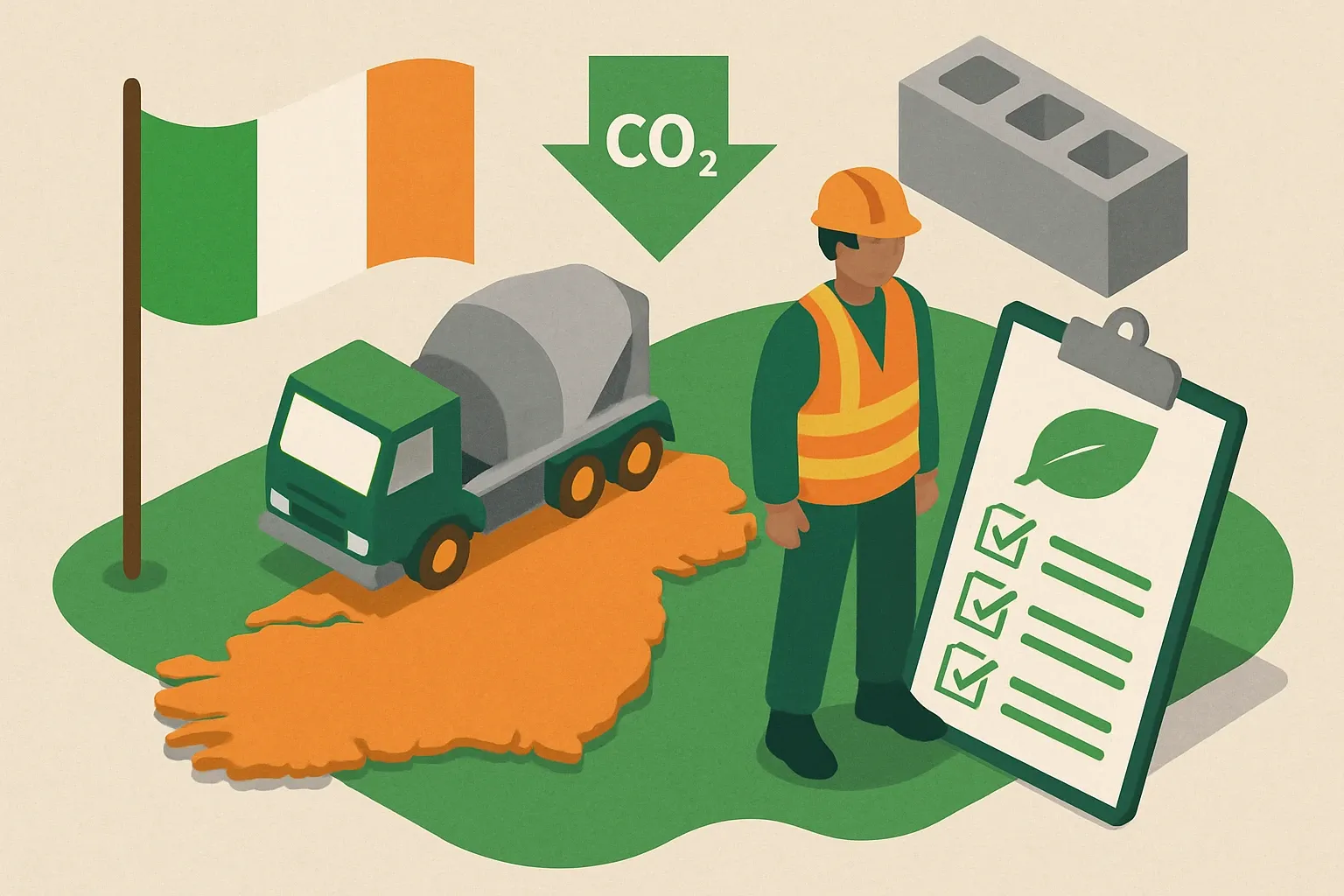
Ireland introduced procurement guidance that applies to public projects beginning design from 1 September 2024. Concrete for these projects should generally specify at least 30% clinker replacement consistent with IS EN 206, and CEM I is off the table unless a qualified professional provides a technical justification (DETE guidance, 2025) (gov.ie). (gov.ie)
Think of it like swapping a pure petrol engine for a hybrid. You still get performance, but with a much cleaner burn.
EPDs are now part of the brief
Public bodies are instructed to seek Environmental Product Declarations to EN 15804, or equivalent, when procuring cement or concrete. If a contractor buys on your behalf, they are expected to evidence similar disclosures. This moves EPDs from “nice to have” to a procurement checkbox that speeds evaluation and reduces back‑and‑forth during tender clarifications (DETE guidance, 2025) (gov.ie). (gov.ie)
Deadlines and thresholds you must track
Whole‑life carbon assessments are being phased in. For new buildings with exchequer funding, assessments start from 1 September 2025 at €10m non‑residential and €60m residential, then tighten from 1 June 2026 to €5m and €30m. Infrastructure projects move to €10m from 1 January 2026 after an initial €60m step. Plan submittals accordingly so your mix data and EPDs slot in cleanly (DETE guidance, 2025) (gov.ie). (gov.ie)
Where the market signal comes from
Cement accounted for 2.88 Mt CO₂e in 2022, equal to 4.8% of Ireland’s total emissions. Government is using its buying power to bend that curve, and it is stating those numbers plainly to industry (DETE press release, 2025) (gov.ie). (gov.ie)
Public procurement represents roughly 10% to 12% of national GDP. When the State signals a preferred spec, private work tends to follow within months, not years (GPP Strategy 2024–2027, 2024) (gov.ie). (gov.ie)
Want to win more Irish public projects?
Follow us on LinkedIn for insights on EPD compliance and strategies to ensure your low-carbon concrete gets specified.
What “lower carbon” concrete means in practice
The guidance does not lock in a single recipe. It points to clinker reduction in line with IS EN 206, which you can achieve with supplementary cementitious materials like GGBS and suitable calcined clays. The key is demonstrating mix performance and documenting impacts across A1–A3 in a third‑party verified EPD.
How to be bid‑ready this quarter
Speed beats promises. Focus on data, comparability, and submittal hygiene.
- Map your portfolio to 30%+ clinker‑replacement candidates and flag where technical justification is truly needed.
- Produce or update product‑specific EPDs to EN 15804. Align declared units, system boundaries, and background datasets so specifiers can compare apples to apples.
- Lock a reference year for utilities, fuels, and SCM sourcing with plant‑level evidence. Capture transport modes and typical pour strengths so mix families can be modeled, not guessed.
- Pre‑assemble tender packs to recieve fewer RFI’s. Include EPDs, DoPs, IS EN 206 conformance, and a short memo that states the clinker‑replacement percentage for each mix.
- Brief sales and technical teams on the thresholds and dates above so they quote the right evidence first time.
Avoid these own‑goals
Over‑specifying strength classes inflates cement content and undermines your carbon story. Ignoring curing or finish requirements can lead to last‑minute switches back to higher‑clinker blends. Waiting for final tender before starting data collection leaves you scrambling and risks missing submission windows.
The commercial upside
With public buyers now expecting low‑carbon mixes and EPDs, manufacturers who arrive with clean declarations shorten reviews and make it easier for design teams to hit carbon targets. That keeps your product in play when value‑engineering starts, instead of being swapped for a competitor that already has the paperwork ready.
Fast path to readiness
Choose an LCA partner that handles cross‑plant data collection, project management, and EN 15804 publishing with the program operator of your choice. The less time your R&D and operations teams spend chasing spreadsheets, the faster you can expand EPD coverage, protect margin, and win more specs.